Get all your news in one place.
100’s of premium titles.
One app.
Start reading
Guitar World
Guitar World
Entertainment
Chris Jisi

“David shook my hand and said, ‘Here’s the song I want to do.’ It was Golden Years. I was auditioning during the making of the album”: Bassist George Murray’s six-year stint with David Bowie

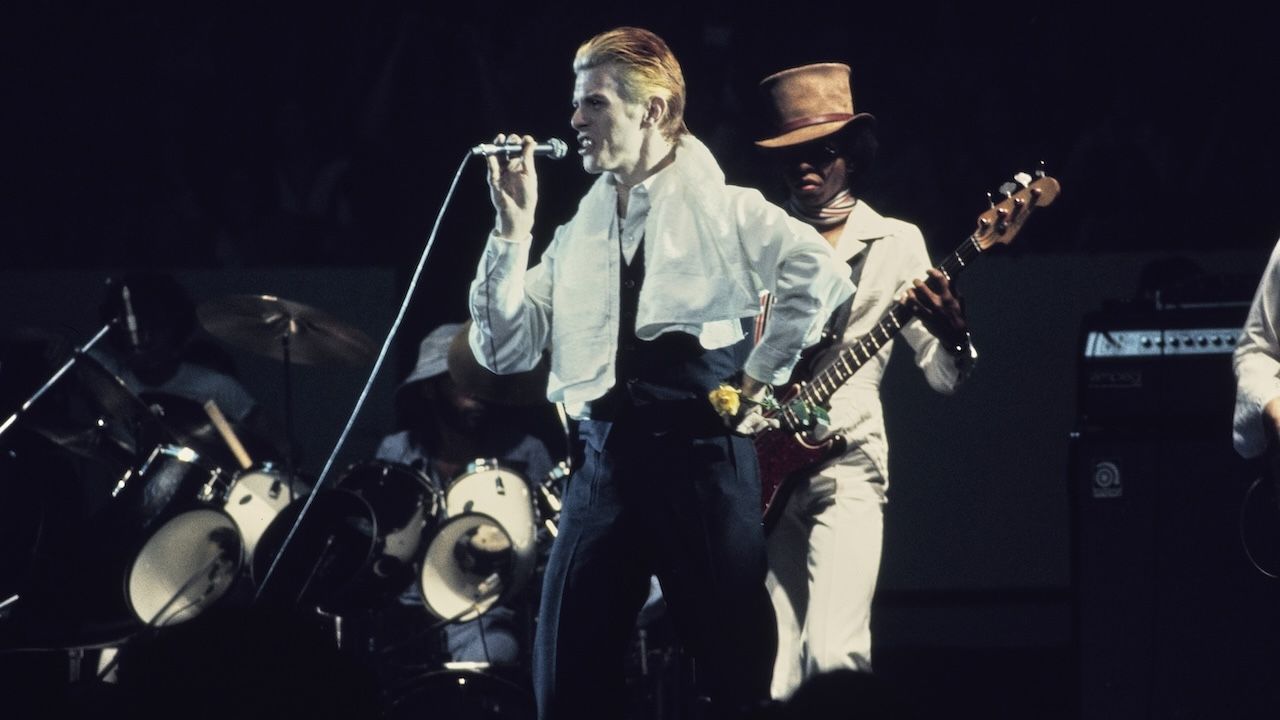
British singer, songwriter and actor David Bowie, wearing a black waistcoat over a white shirt with a white towel draped over his shoulders, with American bass guitarist George Murray, who wears a white suit with a striped scarf and a brown hat behind Bowie as he performs live in concert at Madison Square Garden in Midtown Manhattan, New York City, New York, 26th March 1976. The concert was part of Bowie's 'Isolar Tour' (variously known as the 'White Light Tour', the 'Thin White Duke Tour, and the 'Station to Station Tour'), in support of his album 'Station to Station'.

George Murray spent six years as a member of David Bowie's band – locked tight with drummer Dennis Davis and guitarist Carlos Alomar – to cut the studio albums Station to Station, Low, Heroes, Lodger, and Scary Monsters, and the live discs Stage and Live Nassau Coliseum '76.

Murray's pivotal basslines from this fertile period range from Heroes, which he played on a Rickenbacker using a pick, to his slapped P-Bass on Ashes to Ashes.

His personal favorite is the lesser-known The Secret Life of Arabia, a funky sub-hook that closes Heroes. But first, who is George Murray, and how did he come to occupy one of the most important bass chairs in rock?

Born on October 12, 1951, in the Jamaica, Queens area of New York City, Murray was raised on the sounds of Count Basie, and Frank Sinatra, before the Beatles’ appearance on The Ed Sullivan Show led him to want to play an instrument.

He started on drums in 7th grade, before switching to bass guitar as a high school sophomore, buying a Hagstrom with the money he saved from mowing lawns and shovelling snow.

“I was always pulled to the rhythm,” said Murray in the September 2018 issue of Bass Player. “Whatever was driving the song – and that was drums and bass.”

Having moved from the Hagstrom to a 1973 Fender Precision, Murray started playing with Dennis Davis and Carlos Alomar, ranging from local theater and clubs gigs to road work in Detroit and recording with Luther Vandross.

The pair had already worked with David Bowie on his Young Americans album, and in September 1975, Davis called Murray to ask if he'd come to L.A. to work on Station to Station.

“I met David at the rehearsal studio,” said Murray. “He shook my hand and said, ‘Here's the song I want to do.’ It was Golden Years. Essentially, I was auditioning during the recording of the album.

“I got to create my own basslines for the entire album, except for a specific line he gave me for the first part of the title track.

“We had some philosophical conversations, but David didn't give a lot of feedback musically. He'd play something on a tape recorder in Carlos’ ear, or occasionally he'd say, ‘Turn the beat around’ or ‘Play it backwards.’ He loved ideas and sounds and textures.

“A few weeks later, his business manager called and asked if I was free to go on tour into the next year, and that began our six-year run.”

Asked to pick a favourite bassline from his tenure with Bowie, Murray named The Secret Life of Arabia from Heroes.

(Image credit: Getty Images)

“I don't remember what possessed me to come up with that line. I was just reacting to the chords, and channeling everything l'd learned to that point.

“The rhythm is clearer than it is on other tracks; there's a separation, so you can really feel the bass and the drums moving the song forward.”

The session took place at West Berlin's Hansa Studio by the Wall in July and August 1977. Present for the rhythm-section tracking were Davis, Alomar, Brian Eno on keyboards, Bowie on a guide vocal, and producer Tony Visconti (Robert Fripp's lead guitar was added later).

“Even though we sped up a tiny bit at the end due to excitement, my concept was to play the part right in the middle of the pocket, because that's how David presented the song.”

Three years later, after the Scary Monsters record, Bowie began his move back toward the mainstream, culminating in a new band as his Let’s Dance era dawned. Although it was unexpected, Murray – who had moved to Los Angeles – took it in his stride, but he was never able to establish himself on the L.A. scene.

“My time with David was special – a musical high point for sure. I wish I'd gotten to know him better and had taken more advantage of the places we traveled. Now it's about time for my next musical adventure.”

Sign up to read this article
Read news from 100’s of titles, curated specifically for you.

Already a member? Sign in here
Related Stories
Top stories on inkl right now
One subscription that gives you access to news from hundreds of sites
Already a member? Sign in here
Our Picks
Fourteen days free
Download the app
One app. One membership.
100+ trusted global sources.