Tech companies are building data centers as quickly as possible to run AI. These facilities are controviersial because they use copious amounts of electricity and might tax an electrical grid that in some areas is already straining.
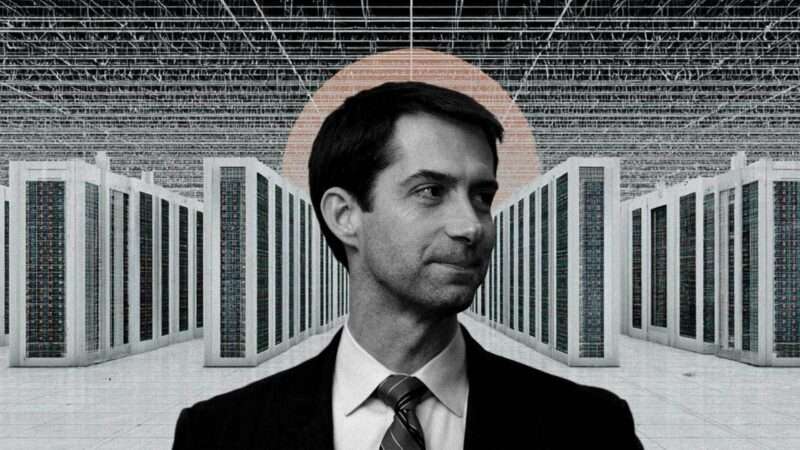
In a bill introduced last week, Sen. Tom Cotton (R–Ark.) proposed an idea: letting these companies get off the grid altogether.
"Power officials have been raising concerns that the grid isn't equipped to handle the sheer number of data centers tech companies are seeking to build," Katherine Blunt wrote last week at The Wall Street Journal. "They say it will take many years to build new transmission lines and power plants needed to support the surge in demand while keeping the lights on for other customers." Some officials, Blunt noted, "have proposed either requiring or encouraging data centers to stop using [the grid] when there is a risk of blackouts, either by powering down or switching to backup electricity supplies."
Jowi Morales of Tom's Hardware reports companies are "looking at alternative power sources to bring their projects online, regardless of the availability of power from the grid." Microsoft, for example, is recommissioning the Three Mile Island nuclear plant in Pennsylvania to generate 835 megawatts of energy for its data centers (though not without a $1 billion loan from U.S. taxpayers).
"These initiatives will take years to take off, though," Morales adds. "The Three Mile Island plant is expected to be operational only by 2028."
Last week, Cotton introduced the Decentralized Access to Technology Alternatives (DATA) Act of 2026. Under the bill, "a consumer-regulated electric utility" would be "exempt from regulation" under federal law so long as it doesn't connect to the overall electrical grid.
When one company contracts to sell electricity to another company, "that retail transaction presently would put you under the jurisdiction of a bunch of people" at the state and federal levels, says Travis Fisher, director of energy and environmental policy studies at the Cato Institute.
And that brings a cumbersome level of red tape. "The rapid pace of innovation means the AI revolution won't wait for multi-year permitting fights, cost-of-service hearings held by regulators, or planning processes built for the analog era," Fisher pointed out last year in an article co-written by Cato's Jennifer Huddleston. "And yet those are the structures that still govern electricity in much of the country. Building a new transmission line in the US now takes about 10 years, while generation projects spend multiple years stuck in interconnection queues, with more than 2,600 gigawatts of capacity now in queues nationwide."
The DATA Act would lower the level of regulatory intrusion for enclosed systems that don't connect to the grid. "It just serves data centers that are probably going to be clustered around it without taking electricity supply off the market for Arkansas families and businesses," Cotton told the Arkansas Democrat-Gazette.
As one example, Fisher tells Reason, Cotton's bill would let companies avoid "the studies that you would need to do to interconnect to the system. Those are on notorious backlogs at this point. They've grown from a year or two to now, in some areas, they're more like four to six years."
The tech industry is already well aware of these challenges. Talking about AI expansion in a 2024 podcast interview, Meta CEO Mark Zuckerberg said he expects companies building data centers will run into "energy constraints" before they ever run out of cash.
"Getting energy permitted is a very heavily regulated government function," Zuckerberg explained, "and if you're talking about building large new power plants or large build-outs, and then building transmission lines that cross other private or public land, that is just a heavily regulated thing, so you're talking about many years of lead time. If we wanted to stand up some massive facility to power that, that's a very long-term project."
Power companies could build substations serving just a single data center, or a series of centers, without touching the overall power grid. The DATA Act would cut through much of the red tape that hamstrings the development of new power stations.
There are other practical reasons to let private companies off the grid. "There is a world where the AI bubble completely bursts and we don't need these data centers, we don't need all that new electricity generation," Fisher says. "In that case, I would say the best thing we can do is put the risk on private actors so that if you fail, it's a company that goes bankrupt. It's not [the] U.S. government that's bailing out large companies, or it's not a state subsidizing something….If a regulated utility were to build all the assets and then the bubble bursts, that risk, that cost overrun falls on other rate payers."
There seems to be some momentum behind the idea. Last week, the American Legislative Exchange Council also released model legislation to let states do the same: exempting companies from regulation if their facilities don't touch the grid.
The post Data Centers Use Lots of Electricity. This Bill Would Let Them Go Off the Grid. appeared first on Reason.com.