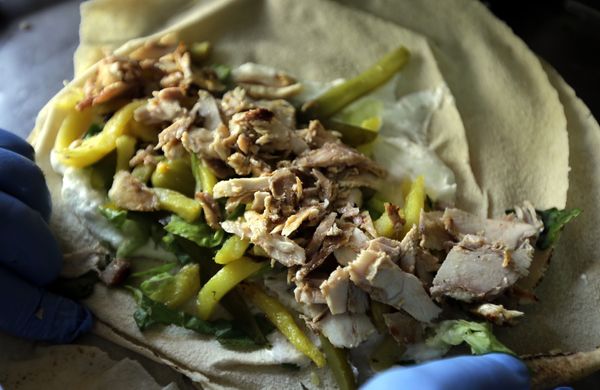
When Abdul’s Lebanese Restaurant closed earlier this month, it was a shock. A beloved fixture of inner Sydney’s landscape since 1968, the restaurant fed celebrities, broke students and anyone in need of a hearty kebab at the end of a night out.
For Hiba Damaa, whose parents Dib and Nizam Ghazal opened the restaurant and named it after her eldest brother Abdul – who eventually ran it with his two brothers – it represented the pioneering spirit of early Lebanese migration.
“Abdul’s originated as a Lebanese sweets and pastry shop run by my brother-in-law,” she says. “When he wanted to move on, my parents started selling falafel sandwiches ... It was tiny. There wasn’t any Lebanese bread of course, so my mother made it all from scratch, and the line for those sandwiches used to go halfway down the street.” The business expanded to dine-in tables, then a second shop.
Abdul’s daughter Dina Ghazal, who worked there after school and on weekends, is not surprised by the outpouring of affection. Her father was so dedicated to pleasing his patrons he rarely took time off work.
Sign up: AU Breaking News email
“Dad never took his customers for granted,” she says. “He was very serious about the business running how it should. In the early years there were tablecloths and wine glasses, and we had to wear a uniform.”
He insisted on making labour-intensive menu items because customers loved them, she says. “And he used to give out a free falafel with tahini sauce if it was really busy and people had to wait in line.”
“He always said you could not succeed in the food business if you were not generous.”
Many assume Sydney’s Lebanese community was always concentrated in the city’s western suburbs, but there are still signs of what was once known as Little Lebanon in the inner-south, if you’re paying enough attention.
John Betros, 91, still vividly remembers his childhood in the area when most of the homes of Great Buckingham Street, on the border of Redfern and Surry Hills, were already occupied by Lebanese families.
“The Lebanese go where the churches are,” he says, and churches with Lebanese priests were well established: St Michael’s Melkite Catholic Church was inaugurated in 1895, St Maroun’s Maronite Catholic Church opened in 1897, then St George’s Antiochian Orthodox Church in 1920. Wilson’s, on Pitt St Redfern, claims to be the area’s first Lebanese restaurant, opening in 1957.
When Betros opened his pharmacy business in Surry Hills in 1960, there were several restaurants catering to Lebanese migrants – particularly single men who wanted a home-cooked meal after work – which then attracted broader patronage.
“There was a Lebanese chicken shop, and then the [Ghazal] family opened Abdul’s ... They were doing well so another opened next door to them called The Prophet, and they were doing well, and then next door to them was a Lebanese grocery store owned by a Greek man and his Lebanese wife. And because [people] were filling the restaurants, another one called Fatima’s opened up. Lebanese food was in great demand.”
Betros says he remembers all the restaurants’ proprietors as very friendly with one another. “Even though they were competitors, there was no animosity between them. They were all nice people and all very respectful of each other.”
Ghazal says her father didn’t feel threatened by the competition and saw “the hub of activity in the area as good”.
Betros says it helped that the food was “somewhat exotic” to westerners.
As the clientele diversified, so did their offerings. Some restaurants recruited belly dancers for functions and for Saturday nights. Eleanor Sharman, who was a belly dancer at nearby restaurant Emad’s, says westerners “didn’t know how to deal” with her. “If it was a couple on a date, the woman would be watching the man, and so he would be trying not to look at me,” she says.
Lebanese people had their own traditions, like tucking bills into her belt and – unless she caught them first – her bra.
“At a room kept for Middle Eastern parties, it was a very different experience, and one that felt far more authentic and satisfying. Cheers went up when I arrived, and men would take turns getting up to dance with me.”
Ghazal said it was a “beautiful, happy atmosphere” at Abdul’s.
“The restaurant used to close at 2am,” she says. “There’d be Arabic music on, and people would have birthdays and parties there. Some asked for the belly dancers and they would dance a little bit. It was fun.”
Abdul Ghazal passed away nine years ago, and at the time of its closure, the restaurant was run by Dina’s cousin Omar Ghazal, who recently revealed the restaurant will be “coming back stronger” after going into liquidation.
Dina Ghazal and Damaa say the changing demographics of the area, rising rents and a shift in footfall post-Covid have all contributed to the decline of a once thriving restaurant scene. Damaa says the labour that goes into preparing Lebanese food, the many fresh ingredients required, and customers’ low-price expectations do not help. She contrasts it with a “bowl of pasta that you pay $30 for” made mostly of flour and egg.
Abraham Zailaa, owner of nearby restaurant Fatima’s, told ABC Radio Sydney that before Covid, Surry Hills was “thriving” thanks to people attending theatres and sporting events. Now local cafes and restaurants “need the support”.
As tributes flowed after Abdul’s closure, some long-time fans and locals lamented the changing area, blaming gentrification and fearing another gym or slick corporate eatery would open in the restaurant’s place.
As for Dina, she remembers her father always wanted to accommodate his customers’ tastes, even if what they asked for was not particularly authentic.
“Dad was adamant that he wanted to cater to the Australian community who still wanted their tomato sauce with hummus and their tahini with BBQ sauce.”
Abdul didn’t care that they would not make it like that in Lebanon, she says. He just wanted to give people what they liked to eat.