Get all your news in one place.
100's of premium titles.
One app.
Start reading
The Guardian - US
The Guardian - US
World
Ruaridh Nicoll in Havana

Cuba hopes for World Cup respite from US sabre-rattling – but prepares for the worst

A man sits on a block as a pedicab driver drives by
A man sells used items on the street in Havana, Cuba, on 6 May 2026. Photograph: Norlys Perez/Reuters

As Cuba crumbles under a nearly five-month-long US oil blockade, many on the island hope that the World Cup might save the island from US attack – or at least offer a respite until the competition ends on 19 July.

“The beginning of the World Cup will make it more difficult for the United States to carry out a military action in Cuba,” said Carlos Alzugaray, Cuba’s former ambassador to the EU. “Cuba is very close to the US, and can hit many targets inside the US, especially in south Florida, with drones or other weapons.”
Seven games, including Scotland versus Brazil, will be held in Miami, a little more than 200 miles from the north coast of Cuba. The Scottish Football Association expects 20,000 fans to travel there.

Eight nations have training camps in Florida, including England and Scotland. The first game scheduled in Miami – Uruguay versus Saudi Arabia – will be held on 15 June, and tens of thousands of fans are due to fly into the city.

Last month, classified US intelligence documents leaked to the news site Axios, as part of a buildup of pressure on Cuba, suggested the island’s communist government has acquired 300 military drones from Russia and Iran. Some types of Iranian drones have a maximum range of 1,500 miles (2,400km).

On Wednesday, the US defence secretary, Pete Hegseth, appeared to refer to the reports during a visit to the US military base in Guantánamo Bay. “It would be unwise for the government of Cuba to try to procure or get access to the types of weapons that could reach this base or the American homeland,” he told troops stationed there.

There is no suggestion that Cuba would want to disrupt the tournament, but the country’s rulers have made clear it would respond to an attack in any way it could. Its president, Miguel Díaz-Canel, warned that any US military assault on Cuba would result in “a bloodbath with incalculable consequences”.

As during the 1962 missile crisis, Cuba’s proximity to the US once again comes into play – if on a less apocalyptic scale. “It’s a factor that complicates things for the American military,” said Alzugaray. “And it was not a factor in Venezuela or Iran. There was no way the Venezuelan or Iranian military could hit America.”

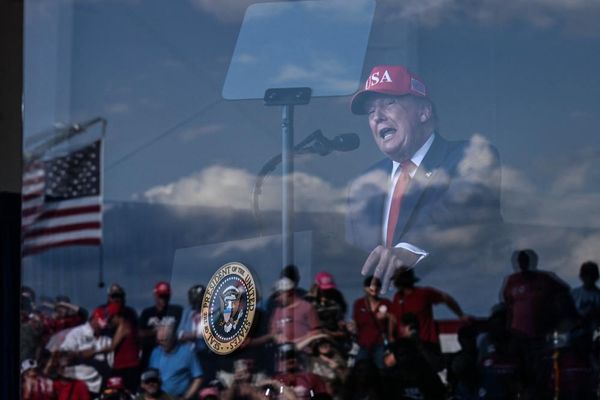
Amid such talk, the World Cup is being seen as a potential salvation, or at least a reprieve from Trump’s attentions. “My theory is he can’t possibly attack during it,” said a European diplomat.

Trump has been making jokes about military action for weeks, and as of Wednesday afternoon, the USS Nimitz’s carrier group, which had been in the Gulf, was just off Cuba’s western tip.

Meanwhile, US surveillance aircraft have been scanning the island, and an indictment for murder has been brought against Cuba’s ex-president Raúl Castro. All are moves that preceded the US military abduction of Nicolás Maduro, the president of Venezuela, on 3 January.

Before launching his assaults on Venezuela and Iran, Trump received the inaugural Fifa peace prize, having been passed over by the more venerable Nobel committee.

Presenting the award, Fifa’s president, Gianni Infantino, said Trump “exemplifies an unwavering commitment to advancing peace and unity throughout the world”.

Some Cubans feel more than cynical about the world’s interest in Cuba. “Timing an invasion of Cuba with the World Cup would be perfect,” said Carlos Bustamante, a film producer who lives in Havana. “Since the world cares a lot more about soccer than Cuba, or anything else.”

But he went on to add: “A US invasion of Cuba will only happen if people in a demonstration are shot and killed by police. The Cuban government has known this forever.”

That pressure is growing on Cuba’s government, as electricity blackouts grow into days-long endurance events. On Tuesday night, protesters used burning bins to block Calzada, a street in Havana that the Cuban president often uses to get to his office off the Plaza de la Revolución. And new police units, with bulletproof vests, guns and batons, have been spotted patrolling on high-power off-road motorbikes.

“Surely a US attack [during the World Cup] would be the biggest shot in the foot it’s possible to make,” said a former Scotland international who asked not to be named to avoid problems when attending the championship. “It doesn’t make any sense, in soft or hard power.”

Sign up to read this article
Read news from 100's of titles, curated specifically for you.
Already a member? Sign in here
Related Stories
Top stories on inkl right now
One subscription that gives you access to news from hundreds of sites
Already a member? Sign in here
Our Picks
Fourteen days free
Download the app
One app. One membership.
100+ trusted global sources.