Get all your news in one place.
100’s of premium titles.
One app.
Start reading
Euronews
Euronews
Quirino Mealha

Crypto's 24/7 platforms dominated Iran war trading when markets closed

When President Trump announced the initial wave of US and Israeli strikes on Iran at 8:30 a.m. CET on Saturday 28 February, marking the start of Operation Epic Fury, all traditional financial markets were closed.

Most markets operate Monday to Friday only, meaning weekend developments, however significant, cannot be priced in until trading resumes on Monday morning, creating a bottleneck of reaction at the open.

US equities, futures, major foreign-exchange platforms, commodity markets, Asian and European bourses were all closed on Saturday.

Middle Eastern exchanges, such as those in Saudi Arabia and Qatar, opened on the second day of the conflict, as they trade Sunday to Thursday, but these attract fewer Western participants and, consequently, lack liquidity.

In the past, investors facing such a major geopolitical shock on a Saturday would have been forced to wait until US futures reopened Sunday evening to start pricing in an expectedly chaotic Monday.

Crypto never sleeps

This time, however, they had a genuine alternative — crypto-based platforms that trade 24 hours a day, 7 days a week and 365 days a year, are globally accessible and settle transactions almost instantly.

The standout choice was Hyperliquid, a decentralised perpetuals exchange that offers contracts not only on cryptocurrencies but also on real-world assets including crude oil.

According to on-chain data, trading volume on the platform spiked sharply, reaching peaks near $200mn (€172mn) in a single 24-hour period on Saturday.

The oil-linked perpetual contracts on Hyperliquid, such as OIL/USDH and USOIL/USDH, rose more than 5% almost immediately after the US-Israeli strikes were announced, providing one of the first real-time price signals before traditional markets reopened.

Hyperliquid contracts were not the only instruments drawing attention.

Tether’s XAUT, a token fully backed by physical gold held in vaults, saw its 24-hour trading volume exceed $300mn (€258mn) — a remarkable figure for a weekend.

Prediction markets such as Kalshi and Polymarket also posted massive volumes, while Bitcoin, Ethereum and other crypto tokens were sold off as proxy assets for broader negative risk sentiment.

For the first time in many observers' memories, crypto markets were effectively "the market" during the weekend.

In a memo published on Tuesday, Matt Hougan, chief investment officer at Bitwise, described it as “the weekend that changed finance”.

Critics will point out that crypto markets remain smaller and more volatile than their traditional counterparts, and that regulatory and operational risks persist.

However, the events of the past weekend showed that on-chain finance is moving from the fringes to the core of global capital markets far faster than most forecasts anticipated even six months ago.

Traditional exchanges accelerate push for 24/7 trading

The success of crypto platforms during the Iran conflict adds to the pressure already felt by legacy financial institutions to follow suit and provide perpetually open markets.

The New York Stock Exchange, owned by Intercontinental Exchange, is actively developing a blockchain-based alternative trading system for tokenised equities and exchange-traded funds that would enable genuine 24/7 trading with instant settlement.

Announced in early 2026 and still subject to regulatory approval, the platform would combine NYSE’s existing matching engine with private blockchain networks for post-trade processing.

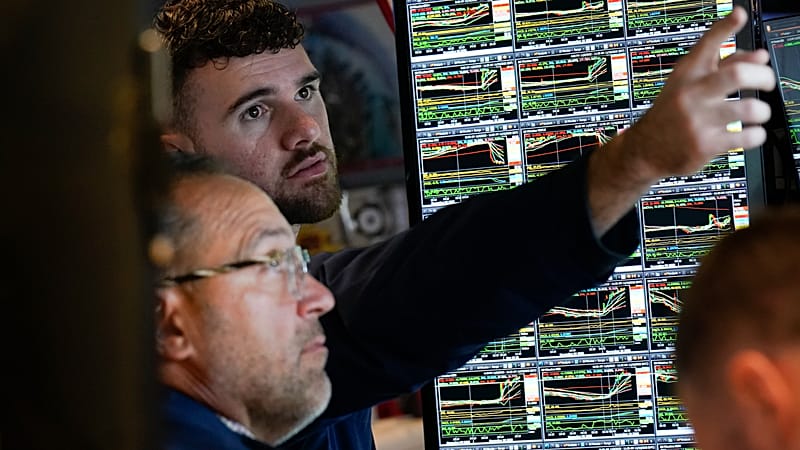
FILE. Traders work on the NYSE floor, Jun. 2008 (FILE. Traders work on the NYSE floor, Jun. 2008)

Trades could be funded and settled in real time using stablecoins, bypassing the T+1 settlement cycle, which dictates the transfer of securities and the corresponding payment must be completed by the next business day and still governs equity markets.

The tokenised venue has a potential launch window as early as the second quarter of 2026, with broader 22 to 23-hour weekday trading on NYSE targeted for later in the year or early 2027, subject to coordination with the SEC, DTCC and market-data providers.

Nasdaq has filed similar proposals to extend US equities trading to 23 hours a day, five days a week, with an anticipated rollout in the second half of 2026.

These moves represent a direct response to the competitive pressure exerted by always-on crypto venues and the growing frequency of market-moving events that occur outside traditional hours.

The Iran weekend served as a vivid case study.

With hedge funds and proprietary traders already active on Hyperliquid and other decentralised platforms, established exchanges recognise that failing to offer comparable access risks losing order flow permanently.

Tokenisation provides the technological bridge, allowing continuous trading while preserving existing regulatory safeguards around custody, dividends and shareholder rights.

Crypto market bill stalls despite Trump backing

While the crypto infrastructure demonstrated its resilience over the weekend, progress on the legislative front remains frustratingly slow.

The Digital Asset Market Clarity Act of 2025, known as the CLARITY Act, passed in the US Congress last year with strong bipartisan support but has since become bogged down in the Senate.

The primary sticking point is friction between the banking and crypto sectors over the treatment of stablecoin yields under the separate GENIUS Act, which established the first federal framework for stablecoin issuers.

Banks argue that yield-bearing stablecoins could drain deposits, and they have lobbied to close perceived loopholes.

Crypto proponents counter that such rewards are essential for customer retention and innovation.

On Tuesday, President Trump weighed in directly via Truth Social.

“The Genius Act is being threatened and undermined by the banks, and that is unacceptable — we are not going to allow it. The U.S. needs to get market structure done, asap."

Moreover, President Trump further sided with the crypto sector by stating that "The banks are hitting record profits, and we are not going to allow them to undermine our powerful crypto agenda that will end up going to China, and other countries, if we don’t get the Clarity Act taken care of."

Despite the presidential intervention and earlier White House meetings between the two industries, no resolution has been reached.

The Senate Banking and Agriculture committees continue to advance differing drafts, and a full vote remains elusive.

With the bill effectively stalled, market participants are left without the regulatory certainty many had hoped would arrive before the end of the first quarter.

The irony is not lost on observers. While crypto markets proved their worth during a real-world crisis, the very legislation designed to integrate them safely into the traditional system remains hostage to lobbying battles.

Until a resolution is achieved, the speed of innovation will continue to outstrip the pace of rulemaking — a dynamic the Iran weekend has only made more apparent.

Sign up to read this article
Read news from 100’s of titles, curated specifically for you.
Already a member? Sign in here
Related Stories
Top stories on inkl right now
One subscription that gives you access to news from hundreds of sites
Already a member? Sign in here
Our Picks
Fourteen days free
Download the app
One app. One membership.
100+ trusted global sources.