On May 26, on the sidelines of the Quad foreign ministers' meeting in New Delhi, India and the United States signed a bilateral framework to secure the supply of critical minerals and rare earths.
The same day, the four Quad nations; India, the US, Australia, and Japan, unveiled the Quad Critical Minerals Initiative Framework, pledging to mobilise up to $20 billion in public and private investment for mining, processing, and recycling.

Also read: India, US seal critical minerals and rare earths pact amid global supply chain race
"This framework aims to deepen our cooperation across the entire critical minerals and rare earth supply chain, including mining, processing, recycling and related investment," External Affairs Minister S Jaishankar said at the May 26 signing.
US Secretary of State Marco Rubio framed the stakes plainly. "We cannot afford to leave the foundational materials of these industries vulnerable to a single-source monopoly that could deny us these things, not just in a time of conflict, but as a leverage point contrary to our sovereign national interests," he said.
The remarks appeared to refer to China.
"The concentration of critical mineral and rare earth processing capacities in a few geographies has transformed these commodities from industrial raw materials into strategic assets," said Asit Saha, Director General of the Geological Survey of India (GSI). "As the world accelerates towards clean energy, electric mobility, advanced electronics and defence technologies, mineral security is increasingly becoming synonymous with economic and strategic security."
The signing was the latest in a series of moves by New Delhi to secure mineral supply chains outside China's dominance. In January 2024, state-owned KABIL (Khanij Bidesh India Limited) signed an exploration and development agreement with Argentina's CAMYEN SE for five lithium brine blocks in Catamarca Province, India's first overseas lithium mining project, according to the Press Information Bureau (PIB).
India has also signed a Memorandum of Cooperation with Japan on critical minerals during Prime Minister Narendra Modi's visit in August 2025, and an MoU with Australia's Critical Minerals Office for lithium and cobalt projects.
Most recently, on June 1, India and Myanmar agreed to maintain close engagement on critical minerals and rare earths, with Foreign Secretary Vikram Misri confirming the subject had been under bilateral discussion for some time, following talks between Modi and Myanmar President U Min Aung Hlaing, according to the Ministry of External Affairs (MEA).
The Chinese dominance
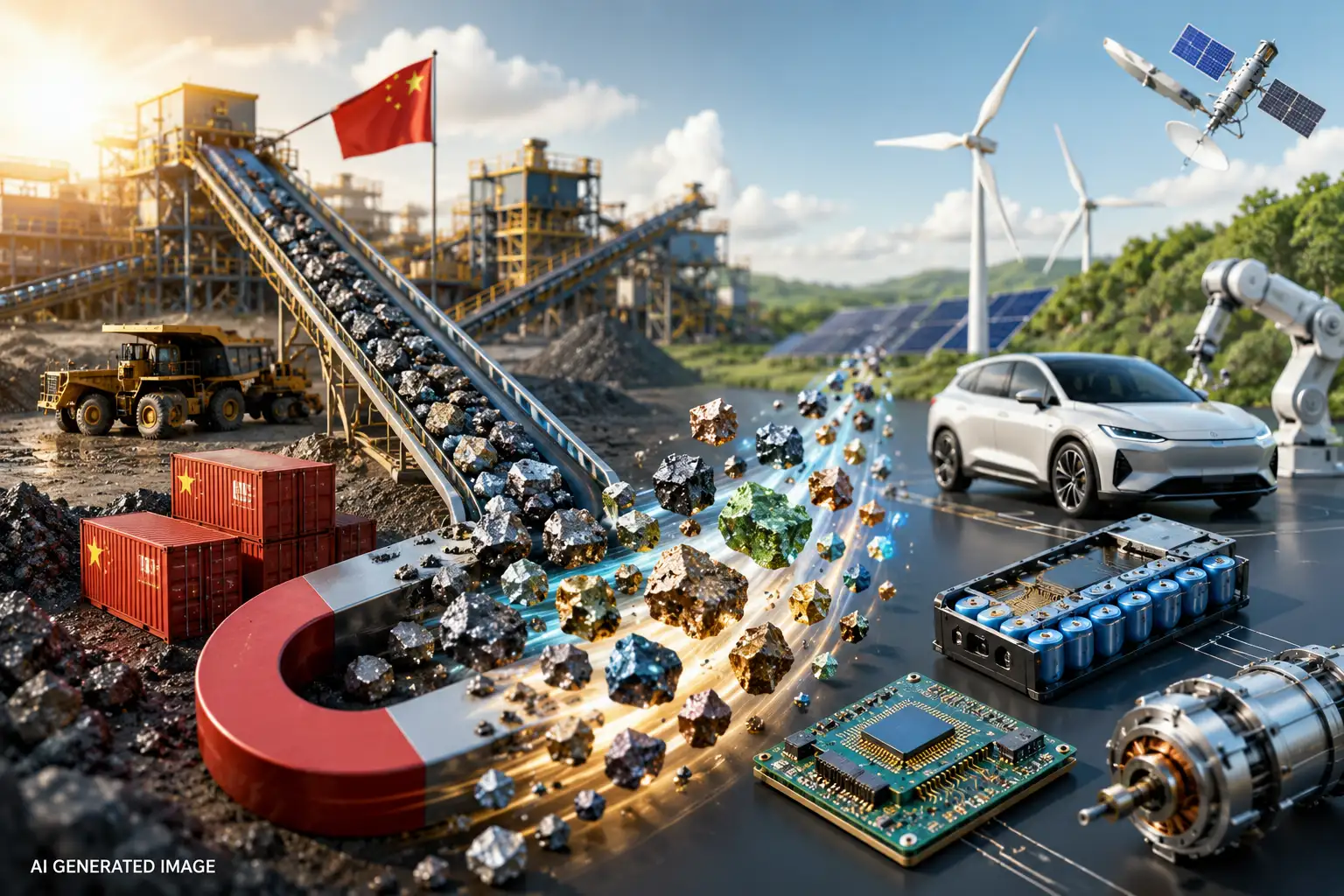
Critical minerals like lithium, cobalt and rare earth elements power electric vehicles, wind turbines, semiconductor chips, missile guidance systems, and radar among others. China controls approximately 80% of global rare earth refining capacity and roughly 91% of refined rare earth output, according to the Institute for Energy Economics and Financial Analysis (IEEFA). Its share of permanent magnet production, which makes rare earths matter for EVs and defence, stands at approximately 94% globally.
"China's dominance is much greater in processing, separation, refining and magnetic manufacturing than in raw ore production," said Harsh Pant, Vice President at ORF. "That is where the strategic choke point lies."