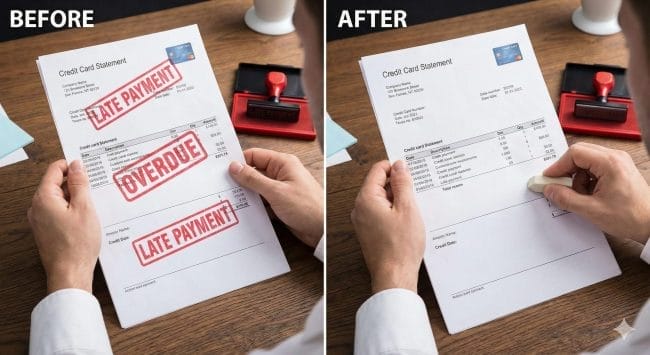
A late payment feels like a permanent tattoo. You missed the deadline—maybe you were traveling, maybe money was tight, maybe you just forgot. Now, that 30-day late mark is dragging your credit score down by 50, maybe even 100 points. It feels unfair that one slip-up can haunt you for seven years. But here is the secret the bureaus don’t advertise: credit reports are not stone tablets. They are data files, and data can be corrected, updated, or—with the right approach—removed.
We aren’t talking about illegal credit repair scams. We are talking about using the system’s own rules and the power of human connection to clean up your history. It’s called a “goodwill deletion,” and it works more often than you think.

Why “Goodwill” Works
Credit card issuers spend millions acquiring customers. They do not want to lose you over a dispute, especially if you have been a generally good customer. Their reporting to the bureaus is voluntary. They can choose to stop reporting a late payment if they want to. Your job is to give them a reason to want to.
Step 1: The “Goodwill Letter” Strategy
Do not dispute the error online yet. That triggers an automated system that simply verifies the data matches their records. Instead, you are going to write a letter. A physical letter. Send it to the CEO’s office or the “Executive Customer Relations” department. You want a human to read this, not a computer.
Step 2: Own It, Don’t Fight It
In your letter, be vulnerable. Admit the mistake. Say, “I know I missed the payment in [Month].” Then, explain why. Was there a medical emergency? A move? A job loss? Context matters. Then, point out your otherwise perfect track record. “I have been a loyal customer for 5 years and have never missed a payment before or since.” You are building a narrative of a responsible person who had a bad month, not a risk.
Step 3: The Ask
Ask clearly for a “goodwill adjustment” to remove the late payment notation from your credit report. Phrase it as a request for help, not a demand. “I am preparing to buy a home/refinance/get a car, and this single mark is hurting my rate. Would you consider removing it as a courtesy?” This appeals to their empathy and their desire to keep you as a happy client.
The “Pay for Delete” Option (For Collections)
If the debt has already gone to a collection agency, the strategy changes. They don’t care about your loyalty; they care about money. Sometimes, you can negotiate a “pay for delete.” You agree to pay the full amount (or a settled amount) only if they agree in writing to delete the collection account from your report. Get this agreement in writing before you pay a dime. Note: this is becoming harder with newer credit scoring models, but it is still worth a try with smaller agencies.
Disputing Inaccuracies
If the late payment is genuinely an error—maybe, you paid on the due date, but it processed late—dispute it aggressively. Gather your bank statements showing the timestamp of the payment. Send certified mail to all three bureaus (Equifax, Experian, TransUnion). If they cannot verify the debt within 30 days with proof, they must remove it by law.
Persistence Pays Off
If your first letter gets a “no,” send another. Try a different department. Sometimes it just depends on who opens the envelope. I have seen people get a “no” three times and a “yes” on the fourth. Be polite, be persistent, and keep your goal in mind.
Reclaim Your Score
Your past mistakes don’t define your future credit. You are not powerless against the credit bureaus. You are a consumer with rights and a voice. Writing a letter takes twenty minutes. The impact on your interest rates and financial freedom could be worth thousands of dollars. Write the letter today.
Have you ever tried the goodwill letter strategy? Drop a comment below if it worked for you or let me know if you are planning to write one this week—I’d love to know how it goes.
What to Read Next…
- Breaking Down Credit Score Gaps by Race: What’s Changing
- The Hidden Divorce Clause That Can Tank Your Credit for Years
- Love is Blind, But Debt is Real: 6 Relationship Traps Draining Your Financial Stability
- Divorce, Grief, and Debt: How to Stop Emotional Spending Before It Ruins You
- 6 Co‑signing Moments That Destroy Friendships—and Credit
The post Credit Card Companies Hate This: How to Legally Remove Late Payments from Your Report appeared first on Budget and the Bees.