Get all your news in one place.
100's of premium titles.
One app.
Start reading
GamesRadar
GamesRadar
Technology
Andrew Brown

Crafting my own devilish dungeons in roguelike Minos has awakened something villainous inside of me, but I can't stop

Minos screenshots.

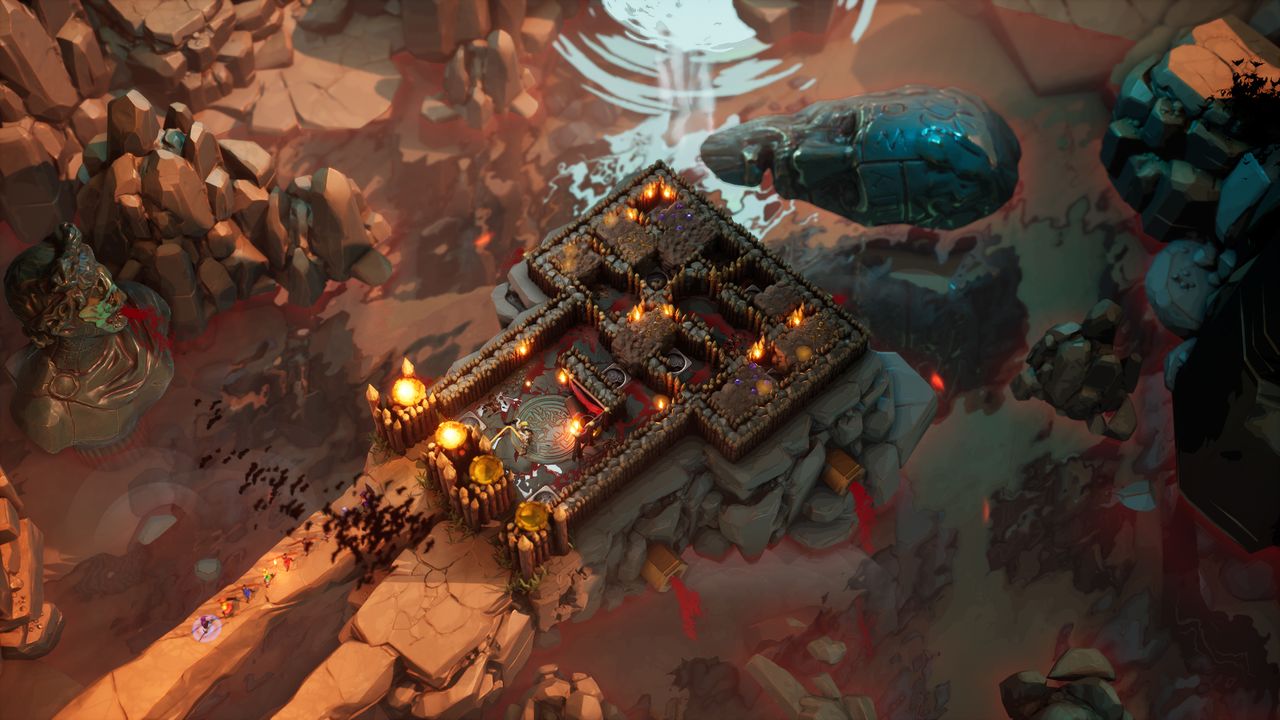
Like the labyrinth it's set within, Minos has a way of drawing you deeper. The tower defense roguelike's premise is simple: playing as the Minotaur, you build traps and winding corridors to pick off your would-be killers in the Labyrinth of Daedelus, earning more traps with every wave survived. Early stages are deceptively simple – whack down a spike trap, job done – but as you complete stages and progress deeper into the labyrinth, Minos asks you to get increasingly devious.

Over the course of 22 hours, my designs have escalated from mild workplace hazards to elaborate Rube Goldberg murder machines. A ballista? How pedestrian. Sword-wielding siren statues that lure trespassers over buzzsaws and into poison gas? Now we're talking.

Cow trap

(Image credit: Devolver Digital)

The majority of roguelikes I play are twitchy little things, with fast reflexes usually counting for as much as smart build choices. Minos still has the latter – you get different traps each run, and can unlock new ones between stages – but real-time combat is a last resort. At the beginning of a stage, you can see where foes will come from, while a handy thread shows the path they'll take to your lair. Before they enter, you're free to add or remove walls, place traps on dedicated trap tiles, and spend energy to remove rubble – in turn unlocking new areas and trap tiles to utilize.

The size of each labyrinth changes depending on the mission type. Some are cramped with a single entrance, others are sprawling mazes with multiple ways in. Enemies also change: the earliest stages of your run will involve mulching puny adventurers and the occasional archer, but at lower depths, you'll be hunted by trap disarmers and hulking champions who gain health from each living ally – forcing you to find creative ways to break up their Lemmings-style order to kill their friends first.

As soon as you hit start, your pursuers begin to follow their predicted path towards your lair. If they reach it, they can track your Minotaur to any portion of the maze. The Minotaur will fight back if he's found, but with your health persisting across stages, it can only take a few battles to cut your run short. Instead, it's worth spending longer in the planning stage to ensure that nobody survives the trip.

(Image credit: Devolver Digital)

As you reach deeper depths, that becomes increasingly hard to do. Most traps are single-use and certain enemies are immune or take less damage from specific traps, which means anticipating the order in which they'll be triggered is crucial.

You may want to place a spike trap first to kill a weak adventurer, then leave a ballista around the corner to deal with an evader who can dodge floor traps; maybe throw in a shifting wall that crushes every third passer-by for good measure. I've spent longer than I would care to admit studying group orders and pathing of later-game waves, tinkering with labyrinth walls to create elaborate routes through every trap tile on the map, and have learned to love Minos' tactical layer. Most of my runs come to an end when I've made a mistake in the planning phase, but spending longer in it never feels like a chore – instead, they're increasingly delightful tests of ingenuity.

That prep time becomes crucial when you're facing down groups of hardened specialists – gold looted from their bodies can be spent on a mixed bag of traps and utility devices in each stage, while blood spilled by traps can be offered to the labyrinth in exchange for more traps. I love Minos' experimental nature, as it's only through trial and failure that you learn to speak its shorthand – working out which traps and orders are best for each wave's foes, and occasionally discovering unique synergies between traps.

Dungeon faller

(Image credit: Devolver Digital)

After 22 hours it still feels like I have a lot to learn about architecture as a murder weapon.

Placing a falling boulder along the route of a lure statue, for example, trades the statue's sword for a giant boulder held above its head – which not only drops on top of its first victim, but then rolls and bounces down corridors. Sometimes, you don't know you've cooked until it's too late – like the time I placed a fire trap too close to a chamber of poison gas, not realizing they would interact until a burning Champion stumbled into the gas. Bon appetit: explosive gas!

In some levels, you're occasionally asked to explore a rigged maze yourself or solve a puzzle. There's also a bit of downtime between stages to unlock new trap designs, spend XP on permanent buffs for the Minotaur, and progress the story. I don't like these detours from dungeon designing as much, but I suspect they're important for another reason: for every gruelling stage I complete with the intent to take a break afterward, after a few minutes of downtime I often find myself queueing back up to do it all over again.

(Image credit: Devolver Digital)

Roguelikes can be judged by the amount of time they steal before you notice. In that regard, Minos is exceptional, paced in a way that its true depth only becomes apparent after you've got the basics under control.

Every time I thought I was getting too comfortable, developer Artificer found new ways to sneak me out of my comfort zone, and after 22 hours it still feels like I have a lot to learn about architecture as a murder weapon. Still, I'm no amateur. Those boulder traps in Indiana Jones? Pathetic, amateur, obvious. My boulder traps only come into play after you're stabbed, set on fire, poisoned, splattered, and stabbed again – Temple of Doom, eat your heart out.

Check out the best roguelike games to play next, from Hades to Mewgenics.

Sign up to read this article
Read news from 100's of titles, curated specifically for you.
Already a member? Sign in here
Related Stories
Top stories on inkl right now
One subscription that gives you access to news from hundreds of sites
Already a member? Sign in here
Our Picks
Fourteen days free
Download the app
One app. One membership.
100+ trusted global sources.