Get all your news in one place.
100's of premium titles.
One app.
Start reading
The Economic Times
The Economic Times
Muskan Singh

Could your laugh be a 15-million-year-old echo that helped shape human speech? Great ape laughter offers surprising clues

The next time you burst into laughter, you might be sharing something with ancestors that lived millions of years ago. A new study suggests the rhythm behind human laughter has endured far longer than anyone imagined. By comparing humans with great apes, researchers believe they have uncovered an ancient link to the origins of speech. The findings offer a rare glimpse into how vocal communication evolved long before language existed, as per a report by Science Daily.

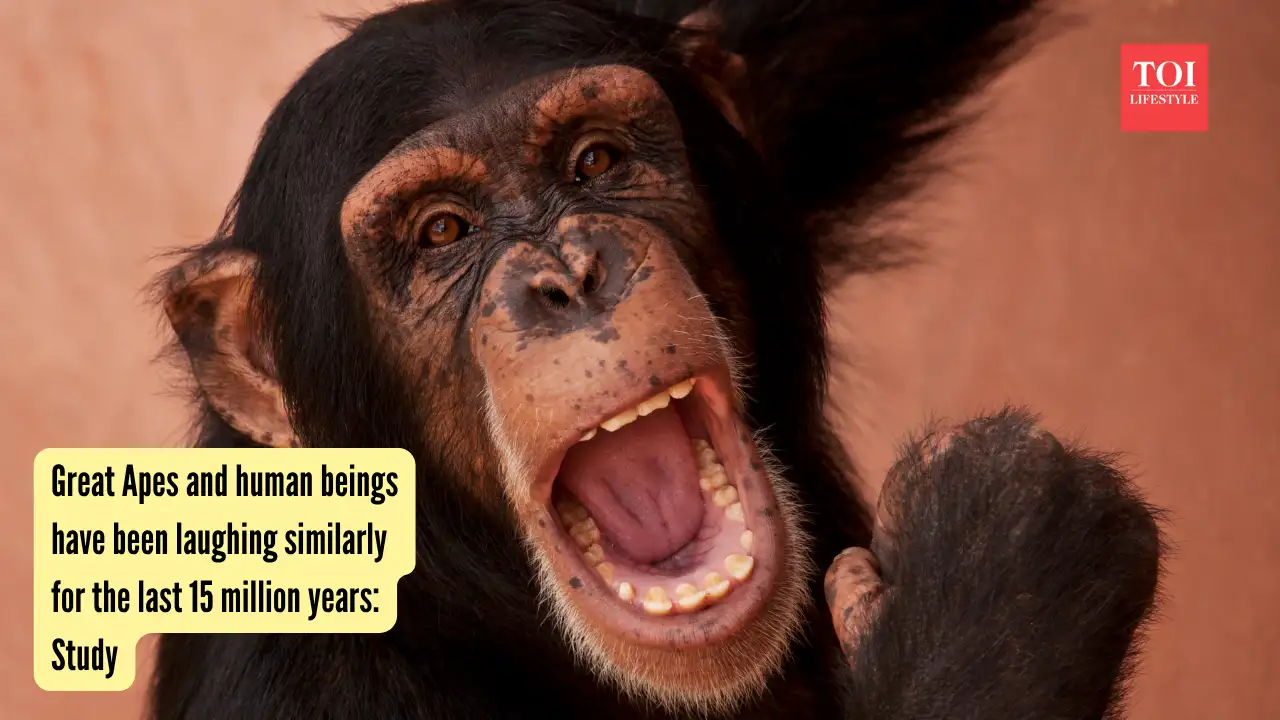
The sound of human laughter may carry a much older story than most people realize. According to new research from the University of Warwick, the rhythm that underpins the way people laugh today appears to have been shared by great apes for roughly 15 million years.

The study offers fresh insight into one of science's biggest mysteries- how human speech evolved. Since spoken language leaves no fossil traces behind, researchers often struggle to identify the steps that led to its development. Laughter, however, presents a unique opportunity because it exists across all living great apes, as per a report by Science Daily.

Published in Communications Biology, the research examined laughter in humans, chimpanzees, bonobos, gorillas and orangutans. The findings point to a vocal pattern that has remained surprisingly stable despite millions of years of evolutionary change.

Why Has Laughter Survived Across Millions of Years?

To better understand the roots of human communication, researchers analyzed 140 laughter sequences collected from four humans, four orangutans, two gorillas, three bonobos and four chimpanzees.

Although each species produces laughter differently, one feature stood out. The intervals between successive sounds followed an evenly spaced rhythm across every group studied.

The team believes this common structure dates back to a shared ancestor that lived around 15 million years ago. Rather than disappearing or transforming completely, that fundamental pattern appears to have endured throughout great ape evolution.

Dr. Chiara De Gregorio, Honorary Research Associate, Department of Psychology, University of Warwick said: "How did humans evolve the remarkable ability to speak? Speech leaves no fossils, and complex language exists only in our own species. But we've found a 15-million-year-old clue in an unexpected place: our laughter. Unlike speech, laughter is shared by all living great apes. By comparing how different species laugh, we can see that a basic rhythmic structure has remained unchanged since our last common ancestor. That's extraordinary."

READ ALSO: Quote of the Day by Robert Downey Jr. : 'You have to let go of the things that are darling to you...'- Life Lessons on humility, selflessness, growth, and putting purpose above ego by the Iron Man

How Did Human Laughter Become More Flexible?

While the underlying rhythm stayed consistent, human laughter evolved in ways that set it apart from other great apes.

People can alter their laughter depending on social settings and emotional situations. A laugh triggered by tickling sounds different from one shared among friends, a nervous chuckle after an awkward moment, or a polite laugh during a formal gathering.

Researchers argue that this increasing control over vocal timing did not appear suddenly. Instead, it likely developed gradually through evolutionary history.

That growing flexibility may have provided one of the key ingredients necessary for speech to emerge. The ability to consciously manage sounds, timing and expression could have formed part of the pathway toward language, as per a report by Science Daily.

READ ALSO: Quote of the Day by Irish literary genius Oscar Wilde: 'Experience is merely the name men gave to their mistakes...'-Life lessons on failure, self-reflection, and learning from life's imperfections from the famous Gothic novel The Picture of Dorian Gray

Could Ancient Laughter Explain The Origins Of Speech?

For scientists studying human evolution, laughter offers something speech cannot: a living connection shared across multiple species.

Because every great ape laughs, researchers can compare modern vocal behaviors to better understand transformations that unfolded long before humans appeared.

Dr. Adriano Lameria, Associate Professor, ApeTank, Department of Psychology, University of Warwick said, "It is impossible to assess the precursor forms of language directly from our extinct ancestors. Laughter, being evolutionarily older and having remained shared between all living great apes, provides a rare evolutionary window into the vocal transformations that unfolded across hominid evolution until the first humans appeared on scene. Contrary to the classic notion that the first humans suddenly acquired vocal control capacities remarkably different from their predecessors, laughter evolution tells us that humans lay on a continuum, a prolongation of vocal control capacities that were already being cumulatively honed in for 15 million years."

The findings suggest that the journey toward human speech was not a dramatic leap but a gradual process built upon abilities already present in ancient ancestors, as per a report by Science Daily.

READ ALSO: Quote of the Day by the American singer Frank Sinatra: 'Regrets, I’ve had a few but then again too few to mention...'- A timeless reminder of the iconic 'My Way' song that the greatest success in life is doing it your own way

In that sense, every burst of laughter today may preserve an echo from millions of years ago, connecting modern humans to a vocal rhythm that has endured across generations of great apes.

FAQs:

Q: What did the study discover about laughter?

A: It found that humans and great apes share a remarkably similar rhythmic pattern in laughter.

Q: Why is laughter important to language research?

A: Because laughter predates speech and is common across great apes, it offers clues about early vocal evolution.

Sign up to read this article
Read news from 100's of titles, curated specifically for you.
Already a member? Sign in here
Related Stories
Top stories on inkl right now
One subscription that gives you access to news from hundreds of sites
Already a member? Sign in here
Our Picks
Fourteen days free
Download the app
One app. One membership.
100+ trusted global sources.