
Get all your news in one place.
100's of premium titles.
One app.
Start reading
RideApart
RideApart
Sport
Janaki Jitchotvisut

Could This New Helmet Tech Make Riders Significantly Safer In A Crash?

If you've been paying even a small amount of attention to motorcycle helmet safety for a little while, then you probably already know that rotational forces are not your friend. Blunt impacts are one thing, but that description alone tells you nothing about multiple other factors that are usually involved in a crash. Things like speed, angle, secondary impacts with other things in the crash zone as the force seeks to dissipate, and so on. In a crash, you have absolutely no say on when your helmeted head stops bumping into, scraping, or flying across objects in its path.

You may have heard some people (whether moto journalists, regular riders, or medical experts) speak about shearing forces on soft body tissue in a crash, and how even good motorcycle gear can still leave riders with skin shearing injuries. The way human bodies are built means that there have always been and will always be multiple factors that gear manufacturers have to consider, design, and test for in order to up the safety ante down the line, rather than simply introducing new styles/cuts/colors for next season.
It's going to sound weird, but an important thing to understand about our frail, strange human bodies is that our brains aren't nearly as solid as they might seem in the movies. If you're a sci-fi or horror nerd, chances are good you've seen plenty of fictional brains depicted onscreen. They look remarkably solid, don't they? Not soft and gooshy, which they unfortunately are. So when your brain is sloshed around in a crash, it's not super dissimilar in concept to skin shearing.

And that's no small reason why traumatic brain injuries (TBI) are a lot easier to undergo when we hit things with our heads. Rotational forces can send your delicate, gooshy brain bouncing and tearing and moving around inside your skull in ways no healthy, functioning brain was ever meant to do. And while you might think that's mostly a danger to worry about if you're traveling at higher rates of speed, according to a European Commission study cited by RLS, the median impact speed for concussions shown by that study was a mere 43 kilometers per hour, or just over 26 miles per hour for those of us playing on my side of the pond.

It's no wonder, then, that RLS started as a technology introduced in bicycle helmets. As I frequently tell people who ask why I insist on wearing motorcycle gear on a scooter, the speed of your crash will give absolutely zero ducks which two-wheeled thing you were riding when you crashed.

There are plenty of cyclists who can top 20-plus miles per hour using nothing but their legs, with no e-bike motors necessary. No matter how anyone chooses to propel themselves through the world on two wheels, I would imagine that most riders in general probably don't want to suffer a concussion (or worse). Most of us would probably like to continue using our brains.

So What Is RLS, Anyway?

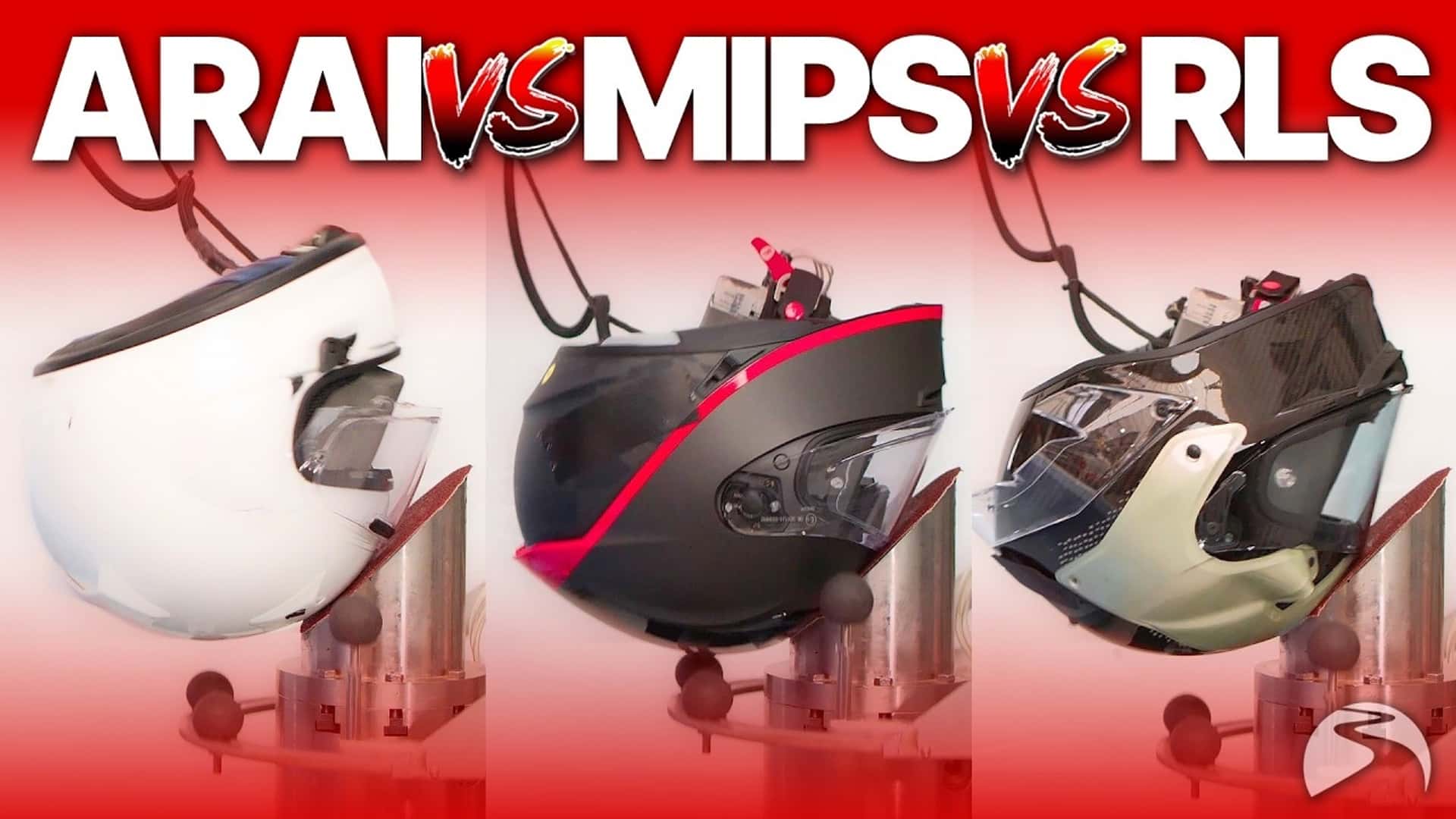
According to the company, it "consists of an array of 2mm polycarbonate spheres bonded to the helmet's outer shell and covered by an additional outer panel. On an oblique impact, the panel's fasteners and adhesive bonds sever, freeing the spheres to roll and the panel to flex away from the main helmet shell."

What's the benefit? Well, according to the company, "this release mechanism disperses and transforms a substantial share of the impact's rotational energy before it reaches the head, complementing the EPS liner's absorption of the remaining linear force."

Sounds great on paper, right? But you'd probably like to see something a little more substantial than that before you go getting your hopes up, and I get that. That's why you should probably watch this video, because in it, you'll get to see independent helmet testing of RLS technology on an AGV Pista GP R3, conducted by the very same independent testing lab that certifies the FIM's latest FRHPhe‑02 standard.

The Impact Laboratory at the University of Zaragoza's Aragón Institute of Engineering Research conducts four separate oblique anvil impact tests on its helmets, which you can read more about if you read the white paper linked above in this piece. You won't see all four of these tests in this video, but you'll see enough to probably take your breath away at the clear difference between a helmet that has the added layer of external RLS protection, and a helmet that does not.

Since RLS is its own independent company, the good news is that this doesn't have to remain a technology exclusively in use on high-end AGV racing helmets. Hopefully, it can be licensed and integrated into a wide range of lids, similar to how a lot of modern helmets now make use of PINLOCK shields as an anti-fog measure to increase visibility for riders across a variety of weather conditions.

Sign up to read this article
Read news from 100's of titles, curated specifically for you.
Already a member? Sign in here
Related Stories
Top stories on inkl right now
One subscription that gives you access to news from hundreds of sites
Already a member? Sign in here
Our Picks
Fourteen days free
Download the app
One app. One membership.
100+ trusted global sources.