
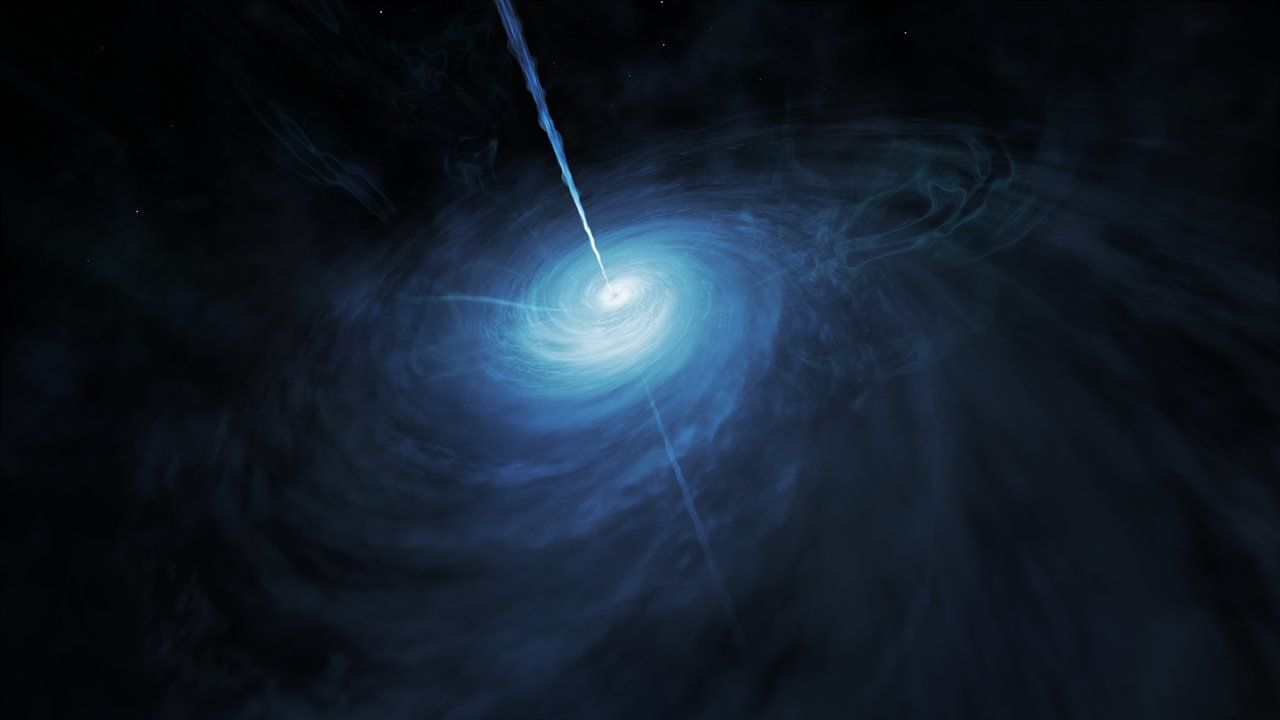
A faraway fluctuating quasar has been seen dimming and brightening by an extraordinary amount, changes in luminosity equivalent to 2 trillion times the brightness of the sun . It is the first time that a flickering quasar has been seen in the early universe, this one dating back 12.9 billion years – just around 900 million years after the Big Bang.
Quasars are the extremely active supermassive black holes at the heart of some galaxies, furiously feeding on gas that is being shoveled towards their maw, and growing as a result of this voracious feeding. As the gas circles the black hole's event horizon – the point beyond which nothing can escape the black hole – it grows hot as a result of friction, leading to the gas shining brightly. Additionally, magnetic fields can whip away some of the charged particles in the gas, blasting them away from the supermassive black hole in the form of powerful and bright jets. As such, quasars are some of the brightest objects in the universe.