
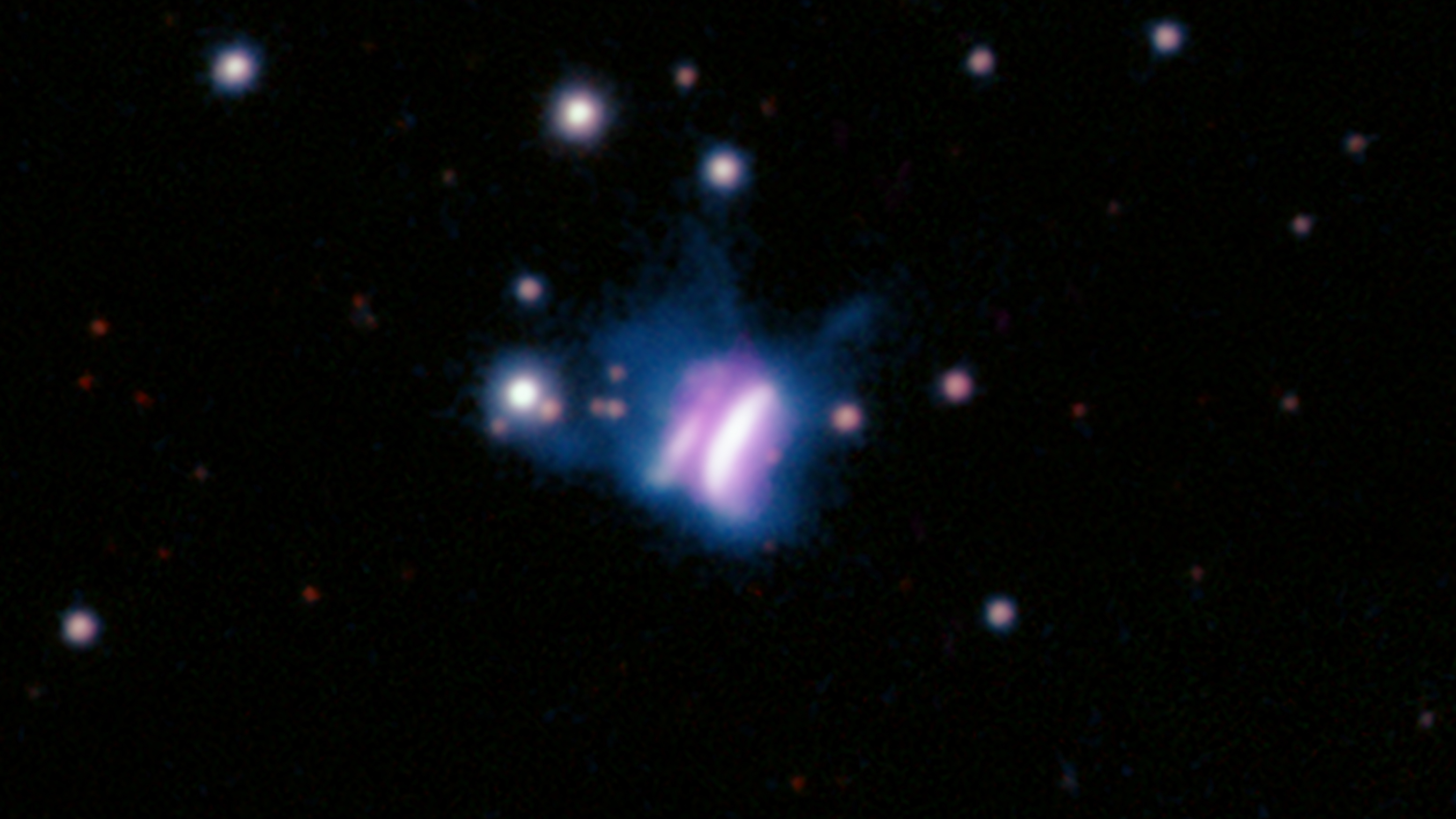
The largest planetary construction site ever seen, spanning hundreds of billions of miles in size, may very well be cast in an enormous shadow that accentuates its bizarre appearance. In short, it looks like a cosmic butterfly — and, for years, it was ignored.
The object, known as IRAS 23077+6707, was originally cataloged as a source of infrared emission by the Infrared Astronomy Satellite (IRAS) in the 1980s. Then in 2016, while conducting a survey of active galaxies in the region of the constellation of Cepheus, astronomer Ciprian Berghea of the U.S. Naval Observatory serendipitously rediscovered it with the Panoramic Survey Telescope and Rapid Response System (Pan-STARRS).




