
External GPUs have become increasingly common in the past few years for both laptops and handhelds in the consumer market. We have different standards like Thunderbolt and OCuLink to choose from, but the corporate world has something better: CopprLink, made by PCI-SIG itself. A new test conducted by PCWorld shows a CopprLink eGPU setup achieving essentially the same performance as an RTX 5090 GPU connected directly to the motherboard.

If you know your eGPUs, you'll know such a feat has been impossible until now. By nature, external GPUs can't quite match the performance of a native PCIe link (even without protocol tunnelling). However, CopprLink can enable a full-fat PCIe 5.0 x16 connection that carries 32 GT/s per lane, allowing for 64 GB/s of bandwidth; the most that even OCuLink (PCIe 4.0 x8) has been able to do previously is just 16 GB/s.
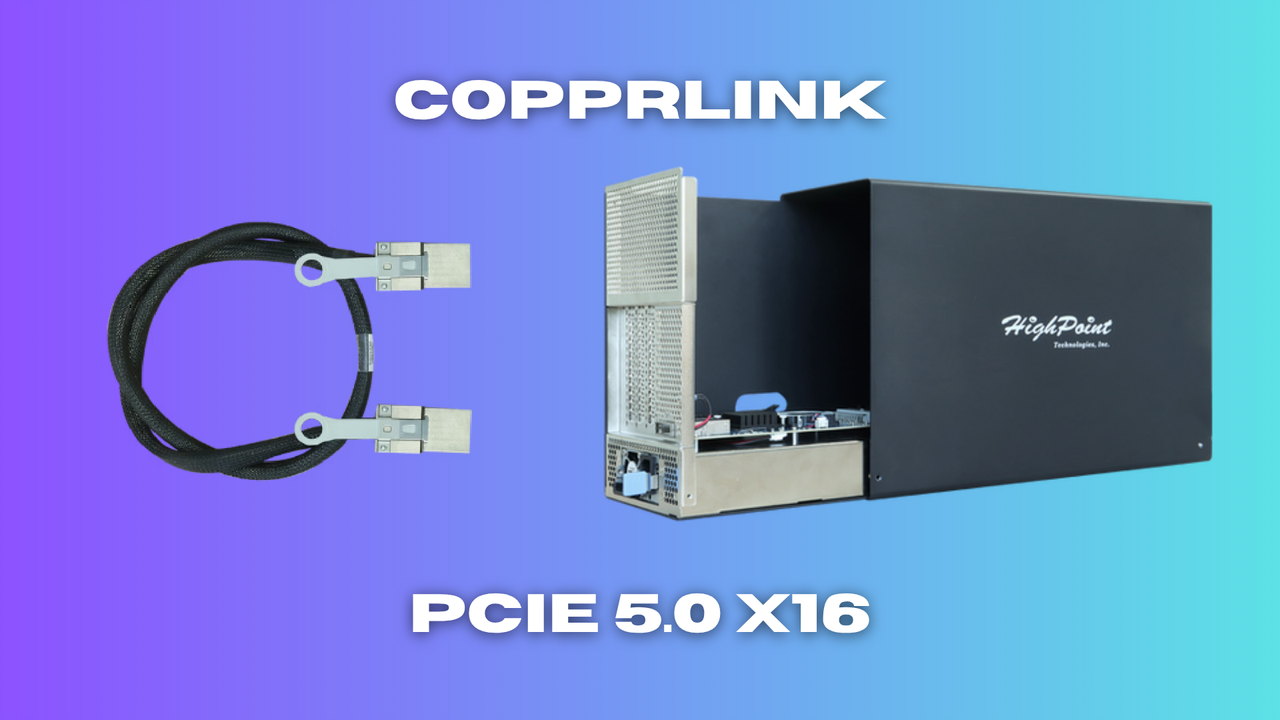
The setup in the video above is powered by HighPoint's RocketStor 8631D eGPU enclosure that costs $1,300 on its own. It's a server-grade chassis meant for rack-scale deployments and other AI workloads, not gaming. It comes with a 1,300W power supply and the appropriate 16-pin cables to power current-gen graphics cards. It can accept pretty much any model, given its large size with ample airflow inside.
The tester slotted a Founder's Edition RTX 5090 in there, then plugged in the CopprLink cable. The other end of this cable goes into whatever device you want the eGPU to power. For this, you need another adapter card that will slot inside a standard x16 slot on the host, giving you a CopprLink port to plug the cable into. PCWorld used HighPoint's Rocket 7634D CDFP card, priced at $999.

CDFP refers to the physical connector that CopprLink uses, and this connector is as robust as it gets. Once plugged in, it's not coming out unless you intentionally pry away the pull tab. Anyhow, the enclosure and the adapter combined are already $2,300 worth of extra hardware on top of the GPU itself. Since it's a 5090 in this case, we're likely looking at a setup that's over $5,000.

That puts it out of most consumers' reach, which is why CopprLink hasn't escaped its corporate target audience yet. The tech is simply too expensive to make sense for mainstream markets, especially when it comes to things like gaming. Still, PCWorld tested a bunch of them and came away surprised at how they all just worked. There was no setup required as the 5090 was recognized automatically in Device Manager.
To the computer, it was as if the GPU was plugged directly into the motherboard. Running some benchmarks, the CopprLink eGPU was able to essentially match an actual native PCIe link with an RTX 5090 test bench. In some cases, there was a slight performance hit on the eGPU, but the overall difference between the two came out to just 2.29%, which is significantly better than any other external GPU setup ever.

In fact, some of those lower numbers could be attributed to the fact that PCWorld was using a PCIe 4.0 riser cable for the CDFP adapter card; had it been PCIe 5.0, there might be no difference logged whatsoever. That adapter itself is made for enterprise systems, so maybe there's some tuning overhead left on the table as well. Regardless, this was an extremely impressive showing for CopprLink, but it's clear that this tech isn't quite accessible enough for consumers just yet.