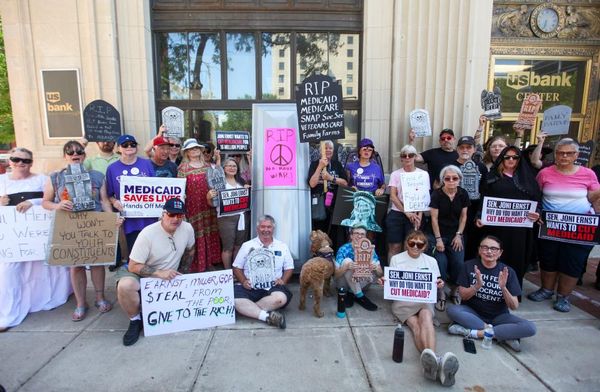
The state of Georgia has appealed a judge’s dismissal of criminal conspiracy charges against 61 people tied to opposition against the Atlanta police training center known as Cop City, prolonging a high-profile case with implications for criminal conspiracy and domestic terrorism prosecutions of movements elsewhere.
With the appeal, the largest case in US history using a racketeering or Rico law against a protest or social movement is now likely to drag on for months, if not years.
Rico is a law created to go after the mafia and closely associated with fighting organized crime. In a sign of what is at stake in the case, in September, Donald Trump called protesters against the Cop City center “antifa” and “domestic terrorists”.
In addition to the state’s appeal, Francis Carroll, one of the dozens of defendants, filed a petition to Georgia’s supreme court, asking the top court to consider a motion asserting that domestic terrorism charges forming part of the case violate the state’s constitution, as they are overly broad and vague. The motion also asserts that Georgia’s domestic terrorism law was passed in an unconstitutional manner.
If the state court of appeals does not grant the attorney general, Chris Carr, a reversal of the trial court’s dismissal, the entire case may fall apart. The same is true if the supreme court takes up Carroll’s claim and rules in favor of the defendant.
“Prosecutors across the country are going to be watching,” said Michael Schwartz, an attorney for Carroll. If the state’s domestic terrorism statute is ruled unconstitutional, for example, prosecutors elsewhere “will be less likely to initiate prosecutions in the same mold”, he said.
Such a result may also affect state lawmakers elsewhere. “Other legislatures considering similar legislation could also be influenced by the outcome,” Schwartz said.
But that, too, will probably take months.
Opposition to the $109m police training center, which opened last spring, came from a wide range of local and national organizations and protesters, centered on concerns around police militarization and clearing forests in an era of climate crisis. Atlanta police have said the center is needed for “world-class” training and to attract new officers.
The recent flurry of activity in the lingering legal case was in response to Fulton county superior court judge Kevin Farmer finally putting an order in writing in late December to dismiss the Rico charges on procedural grounds – a week after the Guardian reported on the judge blowing past a three-month deadline to do so set by state law.
That story spotlighted how the case’s dozens of defendants facing the possibility of several decades in jail are now also three years into being without possessions the state has seized as evidence – including birth certificates, diaries, medical records and more. Following the story’s publication, the state returned some of those possessions, a defendant in the case told the Guardian.
The same day Farmer issued his ruling dismissing the Rico charges, he filed a ruling rejecting Carroll’s motion on the unconstitutionality of the state’s domestic terrorism statute. This led Schwartz to file his appeal on 20 January with the state supreme court.
With the dismissal of the Rico charges, the 61 defendants saw the possible end of the state’s case against them. But as has been typical of the stop-and-go nature of the ongoing attempt by the state to prosecute the environmental and criminal justice movement against the training center, the new court filings once again place the defendants in legal limbo.
Even as the state’s and Carroll’s appeals are being considered by their respective courts, hundreds of motions from the other defendants in the case have never been heard by Farmer.
The state’s motion says that the court of appeals’ decision is needed “because no Georgia court has defined the scope of the attorney general’s prosecutorial jurisdiction”. Attorney general Carr, who is also running for governor in this year’s election, referred in a statement to the destruction of state property that occurred during some of the protests against the training center. “We are not Seattle. We are not Portland. We are not New York. In Georgia, that is domestic terrorism, and we do not look the other way,” he said.
But Schwartz, other defense attorneys and experts alike have asserted that criminal charges such as arson already exist to prosecute such acts.
“This case illustrates the danger of vague criminal laws. When the law is unclear, the risk of selective enforcement increases, and with it, the power of the state to target political adversaries,” said Elizabeth Taxel, a clinical professor at the University of Georgia School of Law.
Social movement historian Dan Berger pointed to failed attempts by the state to prosecute protesters such as the Chicago 7 case, in which convictions against defendants were overturned.
“The failure of a particular attempt doesn’t necessarily mean the government stops trying to use a method,” he said. “But it does set a precedent.”
Any precedent set in this case will be noticed elsewhere, Berger added, due to the broad nature of the Stop Cop City movement, which included concerns such as the environment, racism, unchecked policing and democratic decision-making. “From the start, it was not just a fight in Atlanta,” he said. “The idea was, ‘It’s coming to a city near you.’”