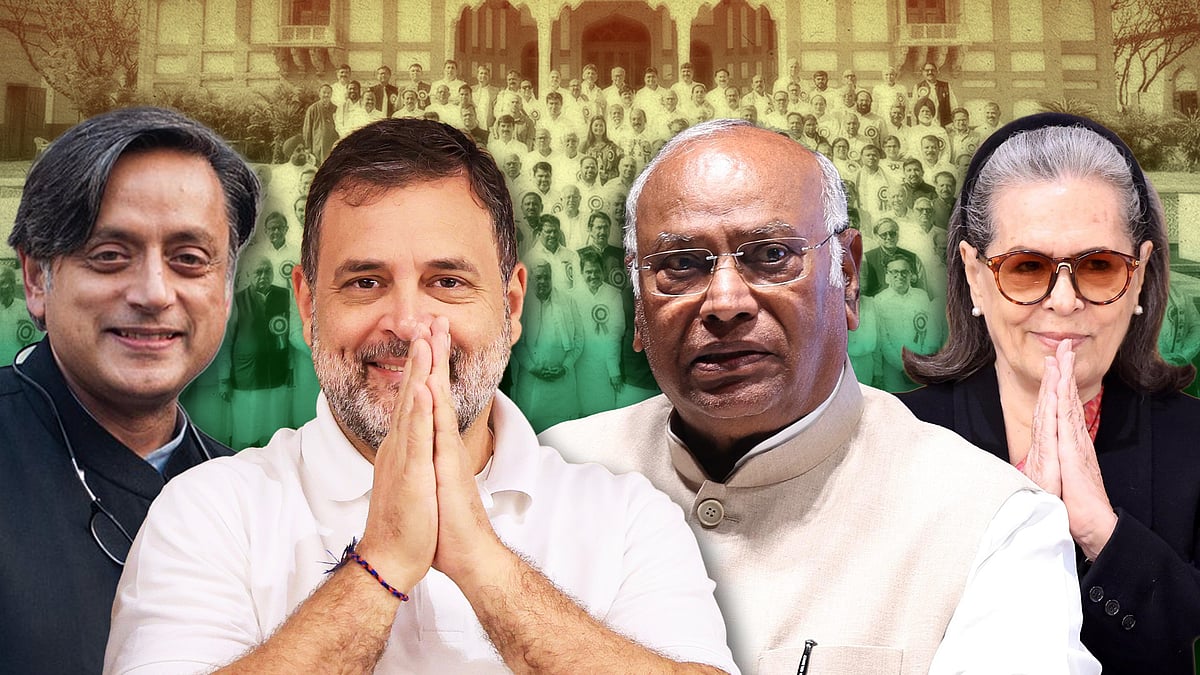
The 140th foundation day event of the Congress in New Delhi on Sunday was another occasion for the party to situate itself between a long legacy and an outlook for a changed political landscape. So, while the event turned its gaze back to its past, the reflections were also made on its present capacity and challenges. That meant some murmurs on the sidelines about the need to address the party's organisational weaknesses and to instil a sense of discipline and vitality among its workers at all levels.
These remarks weren’t wholly new, nor did they signal any internal rupture. They only brought back a question that Congress has tried to grapple with only in fits and starts over the last few years: the question of organisation. Long before the present moment, many observers have argued that, apart from electoral decline, Congress’s key difficulty stems from a significantly diminished organisational efficacy at different levels – from Pradesh Congress Committees (PCCs) to district and block levels, and finally at the booth level. In some ways, it also comes across as a crisis of institutional invisibility. The party’s efforts to build a high-octane social media presence or to mobilise for events, such as political yatras, can’t conceal a stark gap – the erosion of the party's visible, functioning presence in everyday political life.
It's a weakness that stares the party in the face, not in an abstract way but in plain sight. It is clear in the absence of the party’s regular political activity or self-reproducing local structures, and of sustained political work on the ground between elections in most parts of the country. Last December, the party president, Mallikarjun Kharge, had marked organisational overhaul as the focus area for the party, but the glaring gaps continue, and, except for a few routine rejigs here and there, one can’t see a restructured party. More significantly, a bottom-up remaking of the party hasn’t even been given a sincere attempt.
As the party marked its 140th year, invoking its legacy since 1885, a brief historical detour can be taken to trace how the organisation got shaped and reshaped in its pre-Independence and became increasingly centralised in its post-Independence journey.
Tracing the party's trajectory
As the Congress first met in 1885, around 72 delegates were present, 39 of whom were lawyers, and a few were invited for their social heft, including the Maharaja of Darbhanga, arguably the wealthiest man in India at the time. It began as a small, professional coterie rather than a mass organisation. To start with, it wasn’t even a full-time forum for political activity, sometimes mocked by critics as an “annual tea party”.
But its subsequent growth as a mass movement calling for reforms, later for self-government, and finally for Independence is part of the national mobilisation in the first half of the last century. This obviously was accompanied by sustained organisational spread of the party, and by the time of Independence, it had become the dominant electoral force. It had the structure to match its ambition, but two features were important in the party’s journey in the post-Independence phase.
First, the tendency towards centralisation and a high-command culture was also evident in the early years following Independence. It took shape early, even during periods of strength. By the late 1950s, there was already disquiet within the party about the concentration of authority and the thinning of internal deliberation.
As recalled by former bureaucrat and former West Bengal Governor Gopalkrishna Gandhi in his recent book Undying Light, his grandfather C. Rajagopalachari, one of the tallest Congress leaders of his generation who later formed the Swatantra Party, warned that the party had become a “one-man party” under Jawaharlal Nehru. The remark was not a rejection of leadership, but an organisational caution: authority was increasingly substituting for structure. The replacement of chief ministers and even the dismissal of a state government had the imprint of centralised control.
Second, there was also the fact that Congress was not conceived, nor did it function, as a disciplined cadre organisation. It grew into an umbrella organisation, trying to absorb varying political interests and affiliations until it couldn’t challenge its central command. For the first three decades after Independence, it functioned more like a political system of absorption of interests into a central fold, something political scientist Rajni Kothari famously termed as “Congress system”. If a central command was guaranteed, the conflicts could be mediated in this system. So, the organisational looseness was not immediately a problem in the heyday of its electoral dominance. Authority and centrality in power are often substituted for routine organisational maintenance.
There was a brief interruption to this trend during the tenure of Lal Bahadur Shastri, whose leadership style was less driven by personal pull and, thus, less centralising. But that was short-lived, almost an aberration. From the late 1960s onward, centralisation deepened decisively under Indira Gandhi, reaching its organisational apogee by the mid-1970s. Internal autonomy eroded, institutional checks weakened, and the party became increasingly dependent on command rather than mediation. Elements of this pattern resurfaced in modified form during the 1980s under Rajiv Gandhi, when authority was again concentrated in the name of decisiveness and reform. By the early years of the present century, as Congress struggled to adapt to a fragmented political landscape, the high-command culture reasserted itself, not as an instrument of dominance, but as a substitute for organisational depth.
Seen across this long arc, centralisation appears not as a response to weakness, but as a habit formed during strength and retained during decline. Its cumulative effect seems to have undermined the party’s capacity to initiate, and discipline from below. When Congress eventually lost its hegemonic position, it lacked the organisational resilience that decentralised structures might have provided.
Organisational atrophy
The most visible marker of this atrophy today is organisational invisibility. In much of the country, Congress does not function as a routine political presence. Committees exist, but they are rarely centres of continuous activity. Workers mobilise during elections, but the party does not inhabit everyday civic or political life in the intervals between them. Organisation appears episodically, not organically.
The condition of the Congress Seva Dal illustrates this erosion with particular clarity. Founded in 1923 as the party’s most basic organisational unit, the Seva Dal was conceived to provide direction, continuity, and everyday presence of the party through a chain of workers. It was meant to root Congress not merely in electoral mobilisation but in routine civic and political life. Its near disappearance from public visibility in most regions today is therefore not a symbolic loss. When the most elementary organisational cell of a party becomes largely non-functional, higher structures cannot compensate. An organisation cannot be reconstructed from the top alone.
It is against this background that the remarks made on the sidelines of the foundation day event acquire their significance. The unease that followed one leader’s praise of organisational cohesion elsewhere was not about ideology. It was about exposure. No one seriously denied the organisational deficit. What caused discomfort was the public articulation of that deficit through an external comparison. The disagreement was less about diagnosis than about the language used to express it. Organisation has become a sensitive subject because it reveals vulnerability.
Recent electoral experience reinforces this pattern. The 2024 general election produced a modest improvement for Congress, enough to alter the tone of opposition politics but not enough to restore power. More importantly, it did not trigger organisational consolidation. There was no visible revival of routine political presence, no systematic rebuilding of local structures. When subsequent Assembly election setbacks followed, the party lacked the institutional depth to absorb them. The brief momentum that the party was believed to have in some parts of the country proved fragile.
Seen in this light, the remarks made at the 140th foundation day are neither signs of renewal nor symptoms of sudden crisis. They are confirmations. They confirm that the organisational question has not been resolved, but it has only been deferred.
There seems to be a growing realisation that the organisation must be treated not merely as an adjunct to electoral strategy but as the condition of constant political presence, and more importantly, with a bottom-up view of the party structure and leadership-worker synergy. Such murmurs aren't meant to ring alarm bells, but are necessary notes of stock-taking at events that tug at the historical memory of continuity and change in the party.
The first quarter of the century is coming to an end – a period that’s changed everything about technology, politics and the press. Make it count by supporting reporting that still puts truth first.
Newslaundry is a reader-supported, ad-free, independent news outlet based out of New Delhi. Support their journalism, here.