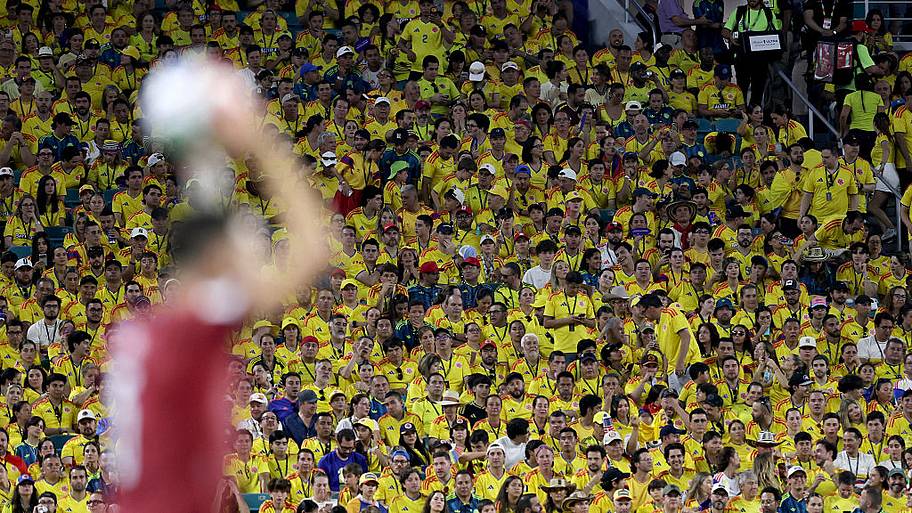
MIAMI — In a sea of yellow, one had to strain to see red.
It’s a common occurrence when Colombia plays and precisely why its fanbase is called “La Mancha Amarilla,” or “the Yellow Stain.” One of the most passionate fanbases in the soccer world, it overpowers opponents in sheer numbers, giving an overwhelming home field advantage.
Colombian fans arrived in throngs to the sold-out Hard Rock Stadium on Saturday for the decisive World Cup Group K finale against Portugal, which ended in a 0–0 draw. They made any display of affection from their red-donning Portuguese counterparts feel completely hopeless.
Their fervent passion was on full display before the matchday even started. Thousands in yellow crowded outside of the team’s hotel, the Dalmar Hotel, in Fort Lauderdale on Friday night to serenade Los Cafeteros, who expressed their gratitude with smiles and waves from the rooftop pool deck.
WIN FIFA WORLD CUP 2026™ FINAL TICKETS
Fans began gathering in Miami Gardens as early as 8 a.m. the following morning, almost 12 hours before kickoff, despite not being allowed to tailgate with food and drinks. They simply just wanted to be together.
Once inside the stadium, boos reverberated off the concrete as Cristiano Ronaldo and Co. took the pitch for warmups. When the Colombian team emerged minutes later, the high-pitched whistles and boisterous cheers were deafening—and the game hadn’t even started, nor were the stands completely full yet. Those not dominating the airwaves chose instead to shake their tricolored flags—anything smaller than four feet wide did not appear permitted.
Copa America Chaos
The greater Miami area is known for its large Colombian community, especially in the southwestern region. There are around 250,000 Colombians living in Miami-Dade and Broward counties. It is the largest concentration of Colombian immigrants in the U.S., aside from New York City, so it was always going to feel like a home game for Los Cafeteros.
For many local fans, it was their first time returning to Hard Rock Stadium since the 2024 Copa América final between Colombia and Argentina, a horror-filled scene that witnessed the worst in the team’s history passionate fandom.
Nearly two years ago, thousands of supporters rushed the stadium gates, adamant to see the title match whether they had tickets or not. They leaped over the stadium railings and darted past police officers. Many were crushed as hordes of people pushed towards the entrances, the barriers eventually breaking under the pressure. Children were left screaming and crying, while some people were bruised and bloodied from all of the shoving.
A few even climbed through the stadium’s air vents just to get a glimpse of the field.
The match was delayed for over an hour, and security was eventually forced to surrender, unlocking the gates to avoid more injuries. Fifty-four people ended up ejected, and 26 others were arrested, according to the police report.
¡Portazo en la final!🙃
— TV Azteca Deportes (@AztecaDeportes) July 15, 2024
Lamentables imágenes en lo que debería de ser una fiesta total de la Copa América.
Las autoridades se han visto rebasadas por el número de aficionados que han asistido al #HardRockStadium #FinalDeVerano #LaSensacionDelVerano pic.twitter.com/ZUynVgInzf
Although a runner-up finish at the Copa América re-instilled confidence in a Colombian team who had failed to qualify for the 2022 World Cup, the affair itself left a lasting fear in fans, especially those planning to attend the World Cup back at Hard Rock Stadium.
Colombian-American fan Carolina vividly remembers being pushed and shoved at the Copa América final.
“It was scary,” she tells Sports Illustrated before the game. “You’re coming in, and they’re scanning your tickets. The people behind, their tickets didn’t work. The people in front of me, their tickets did not work. They are pushing, pushing, pushing. There was so much fraud. It was not a good experience.”
Germán, who moved to Miami from Bogotá eight years, also recalls the horrific scene from two years ago. “It was a disaster. It was really scary. It was really hard for me to get inside of the stadium, even though I had a ticket. I eventually found [my seat], but there were so many people crowding around. It was a disaster.”
FIFA Takes Necessary Precautions
FIFA ensured nothing like that would happen at the World Cup. A tall perimeter, reinforced by steel fencing, wrapped around the stadium, nearly a mile away from the arena itself. Fans without tickets could barely see the stadium, let alone break into it.
There were hundreds of police cars blockading every major entry point, with even more on stand-by. There were police officers on foot, walking down the clustered streets, flagging down every driver to flash the necessary parking pass. Ticketed fans without entry to the parking lot had to be dropped off several blocks away.
Both Carolina and Germán, neither of whom parked at the stadium, had to go through three separate ticket checkpoints to enter the Miami stadium. They were relieved.
“This is much more organized,” Germán adds, dressed as Colombian legend Carlos Valderrama, donning his No. 10 jersey and a blonde, curly afro wig. “They have a lot of security ranks all over the place. There was really nothing at all [in terms of security] at the Copa América game.”
Carolina, who paid $7,000 dollars for two tickets, was worried her money would go to waste should a similarly chaotic scene occur.
“Even though I paid so much money for these tickets, I was thinking about my security,” she says. “I was thinking, ‘I paid all of this, what am I going to do?’ I was a little scared actually.”
Carolina was not in the minority for having shelled out thousands of dollars for a ticket. The few tickets left on FIFA’s official resale website ranged from nearly $4,000 to $13,800 a piece, an increasingly standard price tag for a seat at this summer’s showcase event. The prices may have been exacerbated, though, by the rare opportunity to see two continental giants clash for the first time ever in their history.
It was a gritty battle, but Colombia prevailed. It walked away with seven points and the Group K crown, earning the right to the easiest-possible path in the knockout stages. Portugal had needed a victory to overcome the South Americans in the standings and, thus, finished second with five points, still automatically qualifying for the round of 32.