Get all your news in one place.
100’s of premium titles.
One app.
Start reading
TechRadar
TechRadar
Max Slater-Robins

Cloud gaming on TVs suddenly looks like the future —2026 is the year the 'no console' world becomes realistic, thanks developments and hardware shortages

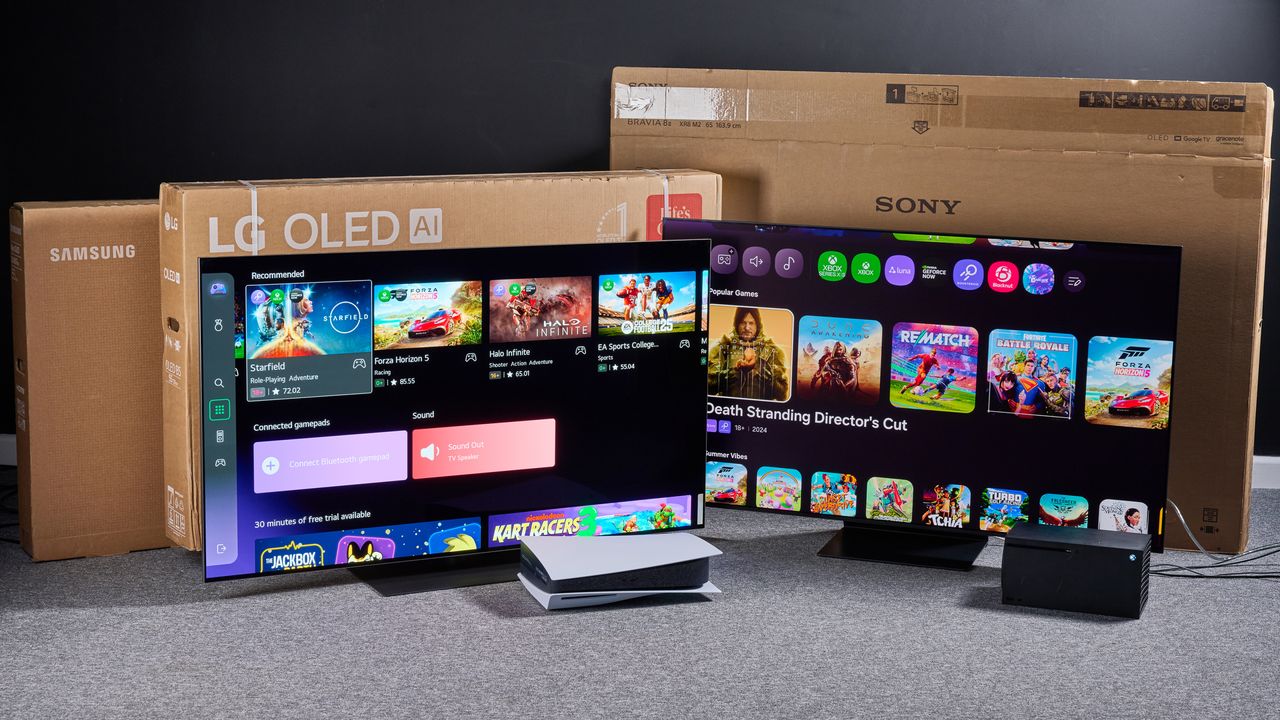
LG and Samsung TVs showing their cloud gaming services on the screen. Traditional Xbox and PS5 consoles sit in front of them, while TV boxes stand in the background.

TV-based cloud gaming has been 'nearly there' for a while – the kind of feature you’d spot in a smart TV menu, try once, then forget about. More recently the TV industry started talking about cloud gaming like a proper, premium capability, not a novelty app tucked away behind Netflix – and in 2026, that's ramping up further.

LG, for example, used its new OLED Evo range to push the idea of a big-screen gaming experience that doesn’t need a console at all, being the first TVs to offer 4K 120Hz cloud gaming, via Nvidia's GeForce Now service.

Why does this matter? Because once major TV makers treat gaming ease of access as the goal, everything else – controllers, interfaces, and subscriptions – starts to evolve around it, too.

As recently as last year, we might have said that this is unlikely to disrupt console makers for the foreseeable future – but with memory prices continuing to rise, and Microsoft increasing the price of Xbox consoles, things are changing fast.

The LG G6 will offer 4K 120Hz gaming with no console needed (Image credit: Future)

The big news: 4K 120Hz cloud gaming is here

One particular moment from CES 2026 made cloud gaming on TVs feel properly grown up: seeing 4K gaming at 120Hz being pitched as a built-in capability, not a best-case scenario for the future.

For LG, that message came wrapped in new OLED hardware – it announced the OLED Evo G6 with the kind of premium panel talk you’d expect (higher brightness, lower reflections), but the gaming headline was just as striking.

The company says its new OLED range are the world’s first TVs to support 4K 120Hz cloud gaming, with Nvidia GeForce Now built in at that spec.

And 120Hz isn’t just for bragging rights. In practice, a higher refresh rate can make streamed games feel more immediate and less 'floaty', especially in fast camera movies or twitchier genres, where latency and responsiveness are the whole experience.

The bigger shift, though, is what it says about priorities: cloud gaming is now being marketed like HDR performance or panel tech – a core feature someone might buy the TV for.

As computing components spike in price, it makes more sense to go cloud instead of having your own hardware (Image credit: Future – edited with Gemini)

The GPU crisis makes TV gaming even more attractive

Rising hardware costs due to the AI boom are making a 'no console' feel less like a gimmick and more like a sensible default.

The ceiling for PC gaming parts has moved again – recent pricing of the Nvidia RTX 5090 has spiked as far as double the official list price – and that's if you can find one, as data centers gobble up all the parts.

Memory has it just as bad, with prices have risen massively, and with most future inventory already accounted for, experts say it will get worse amid an 'unprecedented and record-breaking surge' for parts.

Game consoles remain the cleanest plug-and-play route, but they aren’t immune to the same component cost pressures, especially as pre-AI boom inventory runs out and manufacturers raise prices.

In this context, cloud gaming starts to look less like a compromise and more like a smart buying decision.

Instead of paying for a big hardware jump every few years, you’re effectively renting performance, and letting your TV do what it’s already good at: showcasing content on a big screen.

Even if your TV doesn't support cloud gaming, with Nvidia bringing native GeForce Now support to Amazon Fire TV devices, the 'buy a box' decision can shrink down to 'grab a controller and use the streamer you already have'.

(Image credit: Razer)

Accessories are adapting to TV-first gaming

The other thing that's truly evolving in 2026 is the ecosystem around cloud gaming on TVs.

Razer’s Wolverine V3 Bluetooth is a good example: it’s built specifically with LG smart TVs in mind, and it’s the first controller to carry the Designed for LG Gaming Portal certification – and, more importantly, to use new next-gen lower-latency Bluetooth tech.

What’s interesting here is the direction of travel. Once you’ve got a controller that’s been designed around the TV interface as much as the games themselves, it suggests that accessory and TV makers are trying to remove the little bits of friction that make cloud gaming feel a step behind actually owning a console.

In other words, this isn’t just a peripheral launch, it’s a sign that smart TV gaming portals are starting to behave more like proper platforms, with hardware partners and certification programmes.

(Image credit: Future)

TV operating systems want to be gaming storefronts

The sets that win the war for gamers' cash won’t just have great panels – they’ll make it effortless to discover a game, sign in, and jump back into a session without digging through menus. And two moves we've seen in 2026 underline this.

Amazon’s Fire TV got its first major interface refresh in years, with a stronger focus on discovery, a reorganized navigation bar, and more emphasis on pinned apps, from streaming to gaming.

Google TV, meanwhile, is pushing a Gemini-led upgrade that’s designed to make the interface more helpful and conversational, which inevitably shapes what gets surfaced, and how quickly you can act on it.

TV makers are leaning into the same logic. LG’s OLED messaging frames cloud gaming as part of webOS, complete with 'portal' language and accessories built around it, for the complete package.

(Image credit: 123RF/nuclearlily)

Why 'no console' is more plausible in 2026 than it was a few years ago

The big change isn’t that cloud gaming suddenly works perfectly everywhere, it’s that the number reasons not to choose it is being reduced smartly.

We're seeing more end-to-end thinking this year: TV makers are pitching cloud gaming as a flagship capability, and accessory partners are optimizing around TV gaming portals rather than treating them as a compatibility afterthought.

Nvidia’s CES 2026 move to bring native GeForce NOWow support to Amazon Fire TV devices pushes the idea that you don’t even need a premium TV for a credible setup – a streaming stick plus a controller can do it all.

Then there’s the ecosystem overlap with the traditional console world. An Xbox app on LG TVs, offering Xbox Cloud Gaming streaming via Game Pass Ultimate, is the clearest expression of the idea. Pair that with Samsung’s long-running Gaming Hub approach and the direction is hard to miss.

None of this makes a console obsolete right now, but it does make the 'no console' route feel less like a compromise, and more like it might be the right choice next time you're facing a decision on what platform you'll invest into.

(Image credit: Shutterstock / Mohsen Vaziri)

Hold your horses – why you might still want a PS5

The most realistic outcome isn’t a living room with zero consoles overnight – it’s a wider spread of 'good enough' big-screen gaming setups that make a dedicated box feel optional.

For plenty of people, cloud gaming on the main TV becomes the easiest on-ramp because it’s instant, it’s already on the screen you own, and it avoids a big upfront spend just to get started.

Consistency is still the make-or-break factor, because stability, latency, and packet loss decide whether a game feels sharp or slightly off, especially at higher resolutions and frame rates.

So the console doesn’t disappear: it stays the simplest route to fewer caveats, offline resilience, and the same experience every time you press play.

With component costs rocketing due to the AI boom, shifting towards a software-first model, combined with a top-end TV, seems pretty smart in 2026.


Thinking of buying a new TV?

Try our TV size and model finder! You tell it how far you sit from your TV, we'll tell you what size to buy based on viewing angle advice from image quality experts, and we'll recommend our three top TVs at that size for different prices.

Follow TechRadar on Google News and add us as a preferred source to get our expert news, reviews, and opinion in your feeds. Make sure to click the Follow button!

And of course, you can also follow TechRadar on YouTube and TikTok for news, reviews, unboxings in video form, and get regular updates from us on WhatsApp too.

Sign up to read this article
Read news from 100’s of titles, curated specifically for you.
Already a member? Sign in here
Related Stories
Top stories on inkl right now
Our Picks
Fourteen days free
Download the app
One app. One membership.
100+ trusted global sources.