Get all your news in one place.
100's of premium titles.
One app.
Start reading
The Independent UK
The Independent UK
Nick Ferris

Climate aid driving up public debt of poorest countries by billions of pounds each year

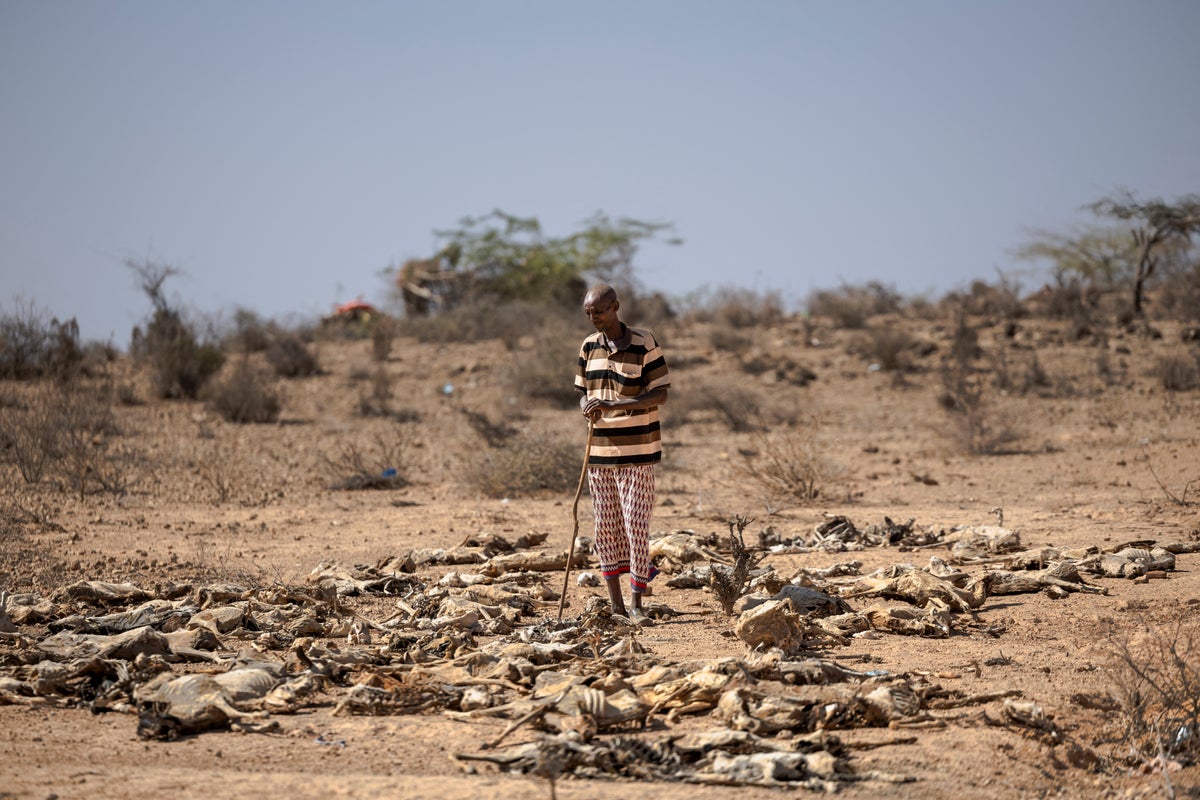
Bishar Maalim Mohammed, 60, stands among a cluster of goat carcasses outside his homestead in drought-hit northeastern Kenya earlier this year. There are growing calls for much more grant-based climate aid to support countries like Kenya as climate impacts intensify - (AFP/Getty)

The system for distributing climate aid from rich countries is leaving some of the poorest and most vulnerable countries struggling to access finance – while piling billions onto the public debt of a significant number of nations, new analysis by The Independent shows.

Data from the Paris-based Organisation for Economic Co-operation and Development (OECD), shows the value of “climate-related development finance” – money from governments and development institutions such as the World Bank – has hovered around the $140 billion (£106bn) mark for each of the last three years for which data is available.

These flows of money are considered critical to both decarbonisation and climate adaptation efforts, given the difficulties many countries face attracting investment from private sources, as well as the increasingly severe climate impacts they are facing. At each annual UN climate conference, the amount of “climate finance” that rich countries agree to provide tends to be a key point of contention.

Around half of this money is being provided in loans that add to recipient countries’ public debt, The Independent’s analysis shows, while a far smaller proportion comes as grants. This latter form of finance that does not have to be repaid and which is particularly important for helping vulnerable countries adapt to climate change.

The data reveals how some of the poorest, most climate vulnerable countries – most of which have done very little to contribute to the climate crisis – are essentially priced out of the climate aid system due to their inability to apply for loans.

Among the wealthier countries that can apply for the loans, meanwhile, the data shows climate aid is making a significant contribution to debt levels that governments are increasingly struggling to manage.

“Climate finance should be a form of compensation for the damage caused to lower income countries that have not caused the climate crisis,” says Tess Woolfenden, policy advisor at advocacy group Debt Justice. “Instead, this research shows that the vast majority of climate finance is in the form of loans, adding to debt levels, while rich countries get their money back, potentially with interest on top.”

Lydia Darby, senior financing advisor at Save the Children, adds: “Low-cost and highly concessional loans have a place in climate action, but climate finance must be delivered through affordable and appropriate instruments that do not lead to unsustainable debt burdens for countries, whilst remaining rooted in principles of climate justice.”

Poorest countries ‘priced out’ of climate aid

Over the past five years, Africa’s biggest recipients of climate aid have been wealthier countries such as Kenya, Nigeria, South Africa and Côte d’Ivoire, reflecting the fact that they are more integrated into the global financial system – and therefore more able to take out loans. Poorer countries, which rely more heavily on grants, have struggled to access climate finance despite often facing the greatest risks from climate change.

“Not every dollar of climate finance needs to be a grant, but loans should not be the default mechanism for transferring the costs of a crisis from historical emitters to vulnerable countries,” says Emma Burgisser, global policy and analysis lead at Christian Aid.

“This data demonstrates that, in large part, revenue-generating projects are where the majority of climate finance is going, leaving the poorest and most fragile countries that cannot sustain large amounts of additional debt out of the system,” Burgisser continues.

Speaking as his government tries to prepare for what is expected to be a devastating super El Niño climate event, Liban Obsiye, executive director of the National Climate Fund of Somalia, adds: “Our ability to mobilise climate finance for support in times of crisis such as this is almost impossible because the climate finance architecture really depends on borrowing, and borrowing depends on your balance sheet and credit rating – both of which are big problems for us.”

A donkey cart wades through flood waters following a heavy rainfall in Mogadishu, Somalia, earlier this month (Reuters)

The major US-based credit ratings agencies do not even give Somalia a credit rating due to the long-term economic challenges facing the country. This limits its ability to attract climate aid - despite its population of 20 million, and its status as one of the poorest and most climate vulnerable countries in the world. OECD data shows that it has received just shy of $2.5bn over the last five years, which is far below the likes of Kenya, South Africa, Ethiopia, and Nigeria, all of which received more than $8bn.

“Many African governments are now arguing for international financial institutions to base their lending on criteria such as vulnerability to climate change, so that they can access a fair level of climate finance in advance of any climate-driven disaster, rather than borrowing at expensive rates after the shock has hit,” Obsiye says.

Climate aid driving up public debt

Among African countries that have successfully accessed climate loans, a comparison of the OECD climate aid data with World Bank debt stocks data shows how significantly these loans are adding to public debt - at a time when many countries are already struggling under the weight of a global debt crisis.

Niger, Rwanda, and Madagascar, for example, have received $1.9bn, $2.3bn, and $5.8bn respectively in climate aid in the form of public debt between 2020-4, which is here defined as direct lending to central or local governments, public corporations, or other public entities of the recipient country. At the same time, the public and publicly guaranteed debt of these countries stood at $4.5bn, $8.3bn, and $24.3bn in 2024, meaning that climate aid was the equivalent to at least 41 per cent, 28 per cent, and 24 per cent of each of their outstanding debts at that time.

These climate loans are coming when economists are increasingly sounding the alarm over the soaring levels of unmanageable debt faced by developing countries.

After a series of global shocks including the Covid-19 pandemic and Russia’s invasion of Ukraine, low-income countries now spend an average of 18 per cent of government revenue servicing external debt, while 3.3 billion people live in countries that spend more on debt repayments than on health or education. Countries are also paying billions more to service debts than they are receiving as aid to fight the climate crisis.

"Not all debt is created equal, and high levels of debt do not necessarily mean a country is in debt distress," said Save the Children's Lydia Darby. "But this analysis highlights that a significant share of climate-related development finance is being delivered through debt-creating instruments at a time when many countries are already facing mounting debt vulnerabilities and record debt-service costs.

"High-interest loans to international creditors are squeezing fiscal space, limiting country-led development plans around education, health, and climate resilience. Instead, we need a financial system that puts global public goods at the heart of it, which can give countries that need the money most a fair deal."

Pressure on government budgets from debt servicing costs means that governments are being forced to spend less tax revenue than they might otherwise do on climate adaptation. High debt service costs also means that some countries - including Colombia, Egypt, Jordan and Sri Lanka - are being encouraged to explore for oil and gas in an attempt to more easily service debt, a report earlier this year from NGO Oil Change International found. Such a strategy can bring in yet more debt, expose economies to volatile commodity prices, and the risk that fossil fuel investments become ‘stranded’ and worthless as countries transition to renewables.

Not all climate aid loans will have the same impact on countries’ balance sheets. Lending from the International Development Association, which is the fund from the World Bank that supports the world’s poorest countries, tends to be over very long periods and with zero or very low interest. It is “hard to argue that such loans are making debt problems worse,” says Tom Hart, from the think tank ODI Global.

Receiving climate aid in the form of loans also increases the amount of money that is available to support climate aims, due to the fact that rich countries - particularly after the drastic foreign aid cuts of recent years - are ultimately limited in their abilities to provide grants. Loans from development banks, which can be much cheaper than the market rate, also attract private finance that would otherwise be unlikely to come to developing countries considered “risky” - and it is also unrealistic for big, expensive clean energy projects to ever be paid for substantially with grant-based finance.

“There are huge infrastructure projects in developing countries that depend on loans for them to happen,” explains Euan Ritchie, from the Center for Global Development. “If this lending is also substituting more expensive private debt, these countries can save billions on interest they might otherwise have to pay.”

Not all lending is on as good terms as that from the World Bank, however. Among the biggest providers of climate aid through public debt – shown in the chart above – Japanese loans have historically been among the cheapest available from major bilateral, or country-to-country, lenders, with interest rates as low as 0.01 per cent a year for some of the poorest countries. But other multilateral development banks lend at rates that can, in some cases, be close to commercial rates. France and Germany - who each funded around $40bn via public debt of recipient country over the past five years - provide a mix of cheaper and more expensive loans, with their development banks raising much of the money they lend through private capital markets as well as receiving funding from government budgets.

The UK does not feature among the biggest providers of climate aid through public debt, having traditionally focused much more heavily on grants, as well as financing lending indirectly by giving money to institutions like the World Bank.

For Ritchie at the Center for Global Development, there are a number of actions that can be done to make the provision of these climate loans fairer. “Things like lending in local currency, fairer credit ratings agencies, as well as improving governance and transparency could all really help,” he says. “It is also clear that much more money should be being provided as grants, so that countries can better fund crucial climate adaptation projects that are hard to make a business case for.”

Development charities are working to fill the gap with grants for climate adaptation, even as their budgets are squeezed. Christian Aid, for example, has just launched a £20m “Resilient Futures Fund” to help business owners in developing countries who cannot afford to take on loans adapt to the impacts of climate change.

Christian Aid’s Emma Burgisser says: “The Independent’s data findings point to a key idea: that the climate crisis requires a fundamental rethink of how we build economies.

"In the 21st century, it is no longer credible for critical decisions on global economic security to be left in the hands of a small handful of global North countries,” she continues.” ”We need to have serious conversations about how to reform tax systems and debt dynamics so that all countries can have a fighting chance at development during the climate crisis.”

This article was produced as part of The Independent’s Rethinking Global Aid project

Sign up to read this article
Read news from 100's of titles, curated specifically for you.
Already a member? Sign in here
Related Stories
Top stories on inkl right now
One subscription that gives you access to news from hundreds of sites
Already a member? Sign in here
Our Picks
Fourteen days free
Download the app
One app. One membership.
100+ trusted global sources.