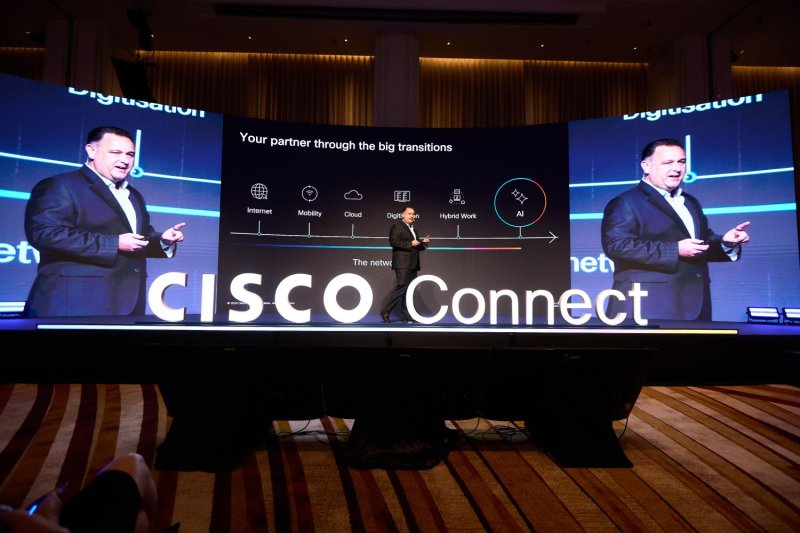
Modernised network infrastructure and cybersecurity are critical foundations for business transformation in the agentic artificial intelligence (AI) era, says Cisco Systems.
Only 21% of Thai organisations are fully AI-ready.

Growth is hindered by infrastructure constraints, a persistent trust deficit, and significant data gaps, according to Cisco.
"Thailand is at a turning point as we shift to a world where AI agents execute trillions of actions autonomously. The window between the discovery and exploitation of a threat has shrunk from years to mere hours," said Ben Dawson, president for Asia-Pacific at Cisco Systems.
To thrive in this era, Thai organisations need to scale AI securely and economically, manage a human and agentic workforce, and address risks that are evolving faster than traditional controls, he said.
Cisco is partnering with Thai organisations to bridge this gap, driving security and infrastructure modernisation to help businesses in the AI era.
A company survey found 98% of organisations in Thailand plan to deploy AI agents within the next year, yet over half (52%) risk losing value due to AI infrastructure debts: the accumulation of gaps, trade-offs, shortcuts, and lags in compute, networking, data management, security, and talent that compound as companies rush to deploy AI.
In a recent Cisco AI readiness index, Thailand scored 21% for AI readiness, beating the global average of 13%. Some 92% of Thai respondents plan to deploy AI agents alongside their human workforce this year.
Despite this strong regional performance, readiness remains low.
These "pacesetter" Thai organisations succeed because they embed AI directly into their core business strategies, ensure their networks are prepared, allocate proper funding, and have clear processes to move from concept to production, he said.
The remaining 79% often struggle with a lack of clear business cases or return on investment models.
Mr Dawson foresees network modernisation as a critical need because old networks built over the last 5-10 years simply cannot handle the demands of AI and act as bottleneck for adoption.
According to Cisco blogs the refresh network modernisation opportunity will be worth around US$43 billion over the next five years.
Cybersecurity is another focus as AI is drastically altering the cyberthreat landscape, which now operates at machine speed while human-speed security responses are insufficient, he noted.
Security must be fused directly into the infrastructure and fabric of the network rather than layered on top, said Mr Dawson.
Cisco found 90% of Thai organisations have already experienced AI-related security incidents, including model theft, AI-driven social engineering, and data poisoning.
He said Cisco is moving beyond static defences to "a model where security is deeply integrated into the network fabric", enabling organisations to manage risks that scale faster than traditional controls.
Cisco is also investing in the region and has trained more than 100,000 Thai students through its Cisco Networking Academy.
Weera Areeratanasak, managing director of Cisco Thailand and Myanmar, said since February, it changed its long-time partner programmes to the Cisco 360 Partner Program to build specialised partners and help partners meet customers' needs.