
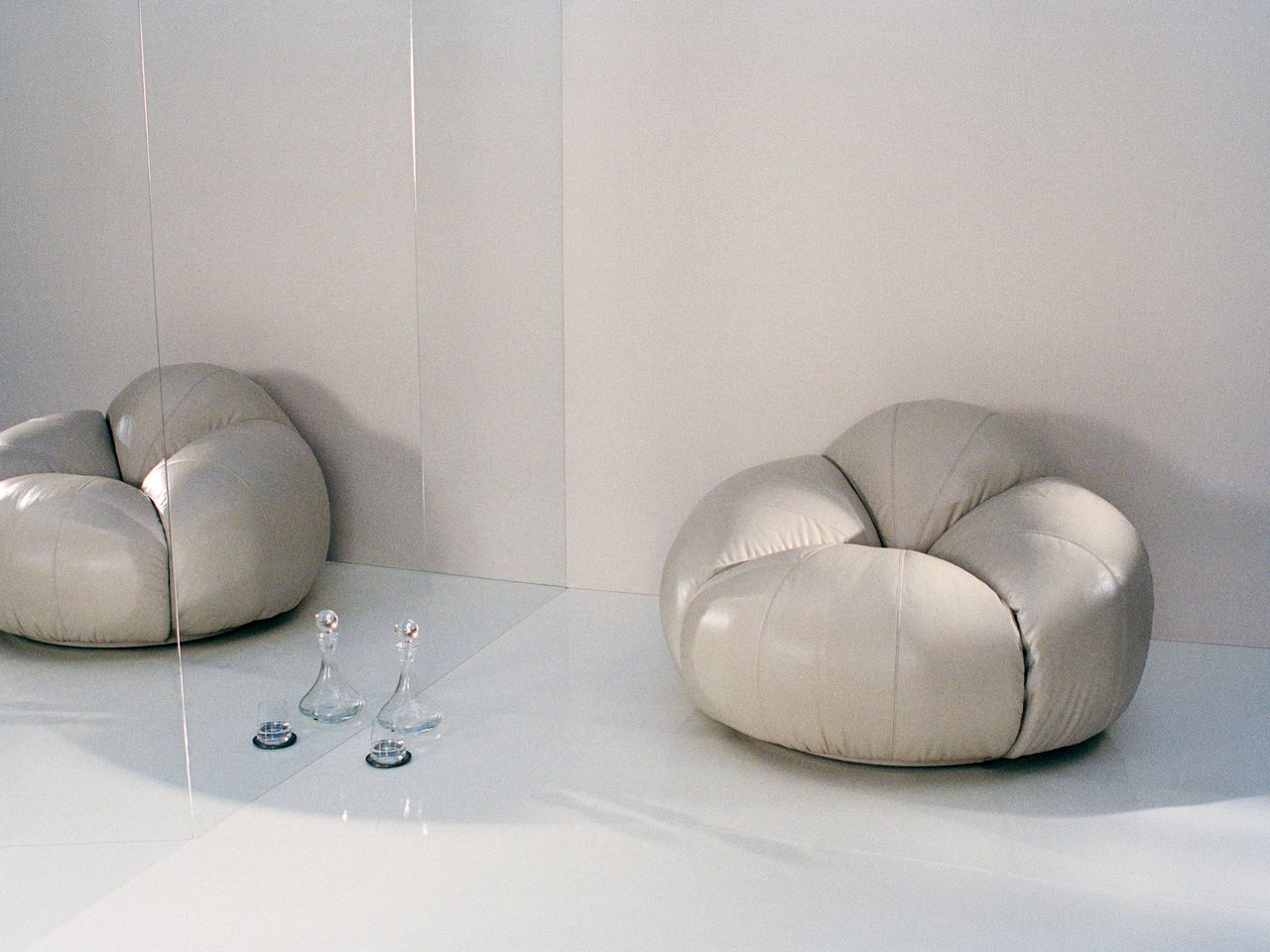
In 1970, a chair shaped like a tomato became a playful affront to the solemnity of modernism. The chair was originally designed in 1970 by French designer Christian Adam, in collaboration with Italian manufacturer Poltronova, known for its role in the Italian Radical design movement.
More than half a century later, the iconic chair has returned, and not just as a nostalgia object for collectors. It's a reminder that contemporary interiors need emotion, theatricality, and perhaps most importantly, fun.

For Milan Design Week 2026, Chloé unveiled an exclusive re-edition of the cult Tomato chair, presented inside Chloé’s Via della Spiga boutique in Milan.
After decades of interiors being dominated by austere minimalism and algorithmic sameness, they are softening again. Curved silhouettes, tactile materials, and exaggerated furniture are no longer considered eccentric touches in interiors; they feel psychologically necessary. The Tomato chair, with its swollen upholstered segments and comic sensuality, has the sophistication of style at the moment, but also a glimmer in its eye.
Yet this is not fundamentally a story about a chair. It is a story about how in design, objects have the power to move across time and subvert a single meaning.

Neither fully furniture nor sculpture, neither ironic nor sincerely serious, I think that the Tomato has returned in 2026 because it resists categorization. Its appeal lies in its voluptuous ambiguity.
Adam himself belonged to a generation of postwar designers increasingly interested in dissolving the hard boundaries between utility and emotion. Born in 1945 and trained at the École Nationale des Arts Appliqués in Paris, he experimented early with polyurethane foam and modular seating systems, furniture with a sculptural approach. His designs moved fluidly between precise geometry and organic softness, often anticipating the emotional language that contemporary interiors now embrace so eagerly.
That spirit found its natural home at Italian design brand Poltronova. During the late 1960s and 1970s, the Italian company became synonymous with Radical design, producing some of the movement’s most iconic provocations, from Joe to Superonda and Safari. These objects challenged the rigid functionalism that had long defined modernist interiors. Furniture no longer needed to be purely practical; it could be irrational, humorous, and emotional.

The Tomato chair distilled that ethos into a single object. Inflated, playful and surreal, it rejected the disciplined seriousness associated with “good taste.” Instead, it proposed the home as a site of imagination and emotional experimentation, a place where softness itself could become radical.
Under the creative direction of Chemena Kamali, the chair is integrated seamlessly into Chloé’s visual world, increasingly defined by its fluidity and luxury. Rather than treating Radical design as a historical design artefact, the installation reanimates it as something current and alive.
The re-edition evolves the chair, rendered in naturally tanned leather in cream, cognac, sand and black, but preserves the integrity of Adam’s original design. Installed within Kamali’s soft vision of the house, the archival chair is an extension of the garments themselves, characterised by their softness and movement.
In 2026, fashion houses increasingly construct retail spaces as emotional universes; they no longer exist simply to display products. In Chloé’s Milan boutique, atmosphere has become as valuable as the object itself; in this context, the Tomato chair infuses the room with humour and somehow sensuality.

What makes the installation compelling is not just the connection between fashion and furniture, but the way it reframes domestic imagination. The boutique creates an interior organized not around efficiency or function, but around emotion and theatricality.
There is something unexpectedly expansive about such a niche object. A tomato-shaped chair should, theoretically, remain trivial, a design curiosity destined for the archive or collector obsession. Instead, it opens larger questions about taste, memory, and the emotional function of interiors. Why do playful forms suddenly feel important? Why does softness now carry such power in interiors now?

SHOP THE LOOK
Perhaps because softness no longer feels passive. Increasingly, it offers resistance to the cold efficiencies and severities that have shaped contemporary visual culture for the last two decades. The return of the Tomato chair suggests that comfort today is not just physical, but psychological. We want interiors capable of absorbing feeling rather than suppressing it.
Originally produced in limited numbers during the 1970s, the Tomato chair has since acquired status among collectors. This re-edition, developed with Adam’s heirs and produced by Poltronova, marks the first stage in its contemporary reintroduction.
Half a century after it first appeared, the Tomato chair continues to ripen.
For more inspiration that Milan Design Week had to offer, read our trend report.