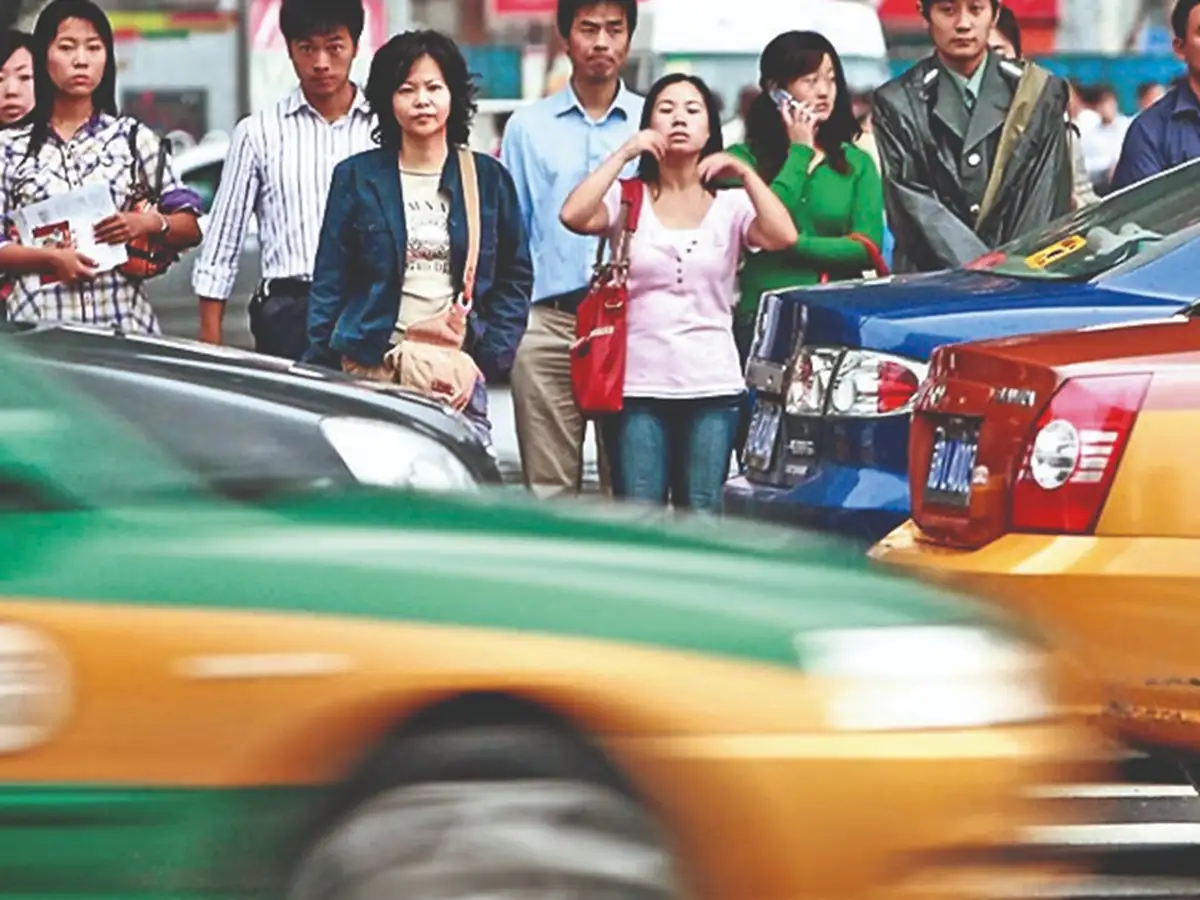
Last month, on a visit to a machinery factory near Qingdao in China's eastern Shandong province, I saw what seemed to be an unseemly number of cars - probably over 60 - parked in and around a complex that, at best, employs 100 workers at full capacity. The explanation given was that most workers drive to the factory.
Cars parked at an average Indian factory overwhelmingly belong to the managerial class - owners, senior executives and managers overseeing production and assuring quality. Wages of the average Indian factory worker are too low to afford a 4-wheeler.

China, in contrast, has reached its 'Ford moment', that 1914 threshold when Henry Ford doubled wages of Ford Motor Company workers, so they might consume the very vehicles they produced, furthering production.
Manufacturing is an increasing returns-to-scale activity. The more you produce, the less each unit costs to make, as mechanisation and automation increase. The more mechanisation there is, bigger the increase in the productivity of the average worker. And since the worker is so productive, he can be paid more.
China's scale of production is enormous. It produces more than 1,000 mn MT of steel, over 30 mn vehicles, and more than 10,000 TWh of electricity every year. Compare this to India's 150 mn MT of steel, 6 mn vehicles, and around 2,000 TWh of electricity.
The wage gap follows. Manufacturing wages in China ran to about $16,000 a year for a worker. The average Indian factory worker, according to Annual Survey of Industries, takes home closer to $3,000. The difference is 5x.
Consumption numbers tell the same story. India's car ownership is roughly 34 cars for every 1,000 people, against China's 185 per 1,000. More than 60% of Chinese homes have an AC, against less than 10% of Indian homes. The India-China gap is far larger than most Indians think.
China's cities are clean, its infrastructure well beyond what one would find in most American cities. There are more auto brands on the road than one could count. And its EV adoption is extremely widespread. Some of its cities like Shenzhen feel incredibly futuristic. The China of 'cheap plastic toys' is gone. This is the China of smooth EV cars that are giving the German and Japanese carmakers a run for their money.
The same logic has now played out in the tech ecosystem. Almost none of the usual apps we are familiar with in India - WhatsApp, Slack, Claude, Gmail, Instagram - work in China. The Great Firewall is to 'blame'. But the Great Firewall has done to Chinese software what scale did to Chinese steel. It handed domestic companies a billion users to iterate against, with no foreign competition to lose to while they were still bad. Overwhelmingly, all tech is local.
AI agents are a frequent sight on phones and in cars - except they are Doubao, not Grok or Claude. Addiction to phones and reels is endemic, except folks here are swiping Douyin, not Instagram. Didi instead of Uber for cabs, Amap instead of Google Maps for navigation.... These champions, reared under the Great Firewall, are now battling US giants in the AI turf wars.
India imported over $110 bn of goods from China last year, and at least $30 bn of that was machinery and capital equipment for factories. Every Indian industrial project of any scale now entails a purchase order sent to a Chinese machine tool company. We are paying China to build our factories.
The China example should instruct us. There is no shortcut to reaching 'first world' status - not a service-led growth model, not the yet-unproven promise of AI-led prosperity, but the same 'unglamorous' things every country that has caught up in the last hundred years has built: steel, energy, cars, cement, aluminium, production machines, among other things. And it has to build them at a scale commensurate with its population.
The reward is a car park at a factory in Haryana, slowly filling up with cars that belong to the people on the shop floor and not just to the people in the swanky office.