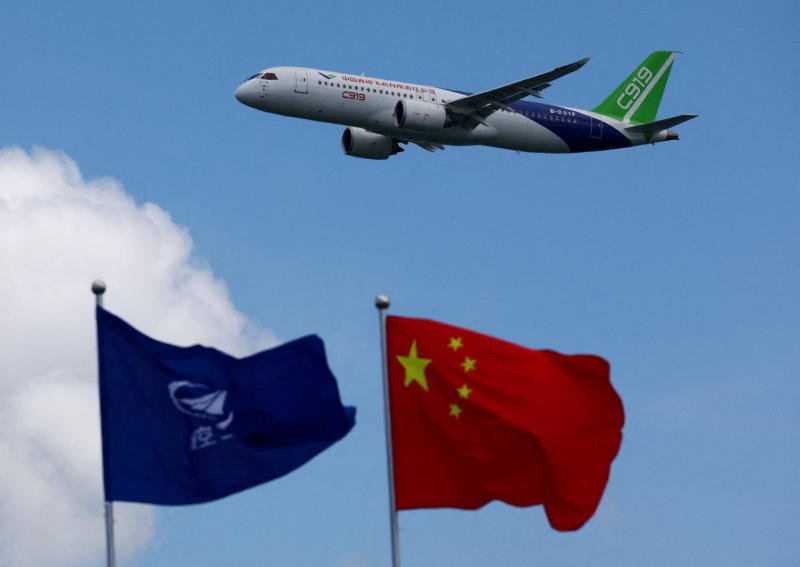
The Chinese-made C919 passenger jet will make its first scheduled international flights next month in a significant milestone for the country's ambitions to become self-sufficient in aerospace.
Planes, operated by national carrier Air China, will start flying between Beijing and the Mongolian capital Ulaanbaatar on Aug 12, making one flight from each city every day, according to state news agency Xinhua.

The plane has already been making regular commercial flights to and from Hong Kong, its first non-mainland destination.
China Eastern Airlines started using the plane on the Shanghai-Hong Kong route in January last year, while Air China began operating the C919 on its Beijing-Hong Kong service in November.
Produced by the state-owned manufacturer Comac, the single-aisle plane is China's alternative to Boeing and Airbus's narrowbody jets that currently dominate the commercial market.
The massive state-backed effort to develop the plane was approved in 2007, with the first aircraft rolling off the production line in Shanghai in 2015.
More than 300,000 people were involved in the project, according to the government, along with over 1,000 businesses, universities, and research institutions. The authorities added that the project had made a number of technological breakthroughs along the way.
The plane made its maiden commercial flight from Shanghai to Beijing in May 2023 and started regular flights along that route in January the following year.
By the end of last year, 31 C919s had been registered domestically while the planes had carried more than 4 million passengers, according to the Civil Aviation Administration of China.
However, although it was designed and built in China, the plane is powered by CFM International LEAP engines, which were jointly developed by American and French companies.
So far Comac has received more than 1,200 orders for the plane from around the world, but delivery is falling behind schedule.
Last year it only delivered 15 of the jets - well short of the target of 75 - after escalating trade tensions prompted the United States to temporarily suspend exports of the engines.
The South China Morning Post reported in January that Comac expected fewer supply chain problems this year and aimed to deliver at least 28 jets to customers.
However, last year's disruption highlighted a fundamental vulnerability for China's commercial aviation programme, which remains heavily reliant on Western-made components.
The C919's global reach also remains limited because it has yet to gain the airworthiness certifications it needs to operate in several major Western markets.
The European Union Aviation Safety Agency is carrying out in-flight evaluations and technical verifications in Shanghai, but full European certification is a lengthy process that is not expected to be completed until some time between 2028 and 2031.
Until then, the C919 is likely to be restricted to the domestic market and some regional ones, including Southeast Asia.
Comac has set up an Asia-Pacific office in Singapore in the hope of capitalising on the momentum of the smaller C909 passenger jet, which has been ordered or bought by airlines in Vietnam, Laos and Cambodia.