
Get all your news in one place.
100’s of premium titles.
One app.
Start reading
Space
Space
Science
Brett Tingley

China to bring damaged spacecraft back to Earth after sending up replacement for stuck astronauts

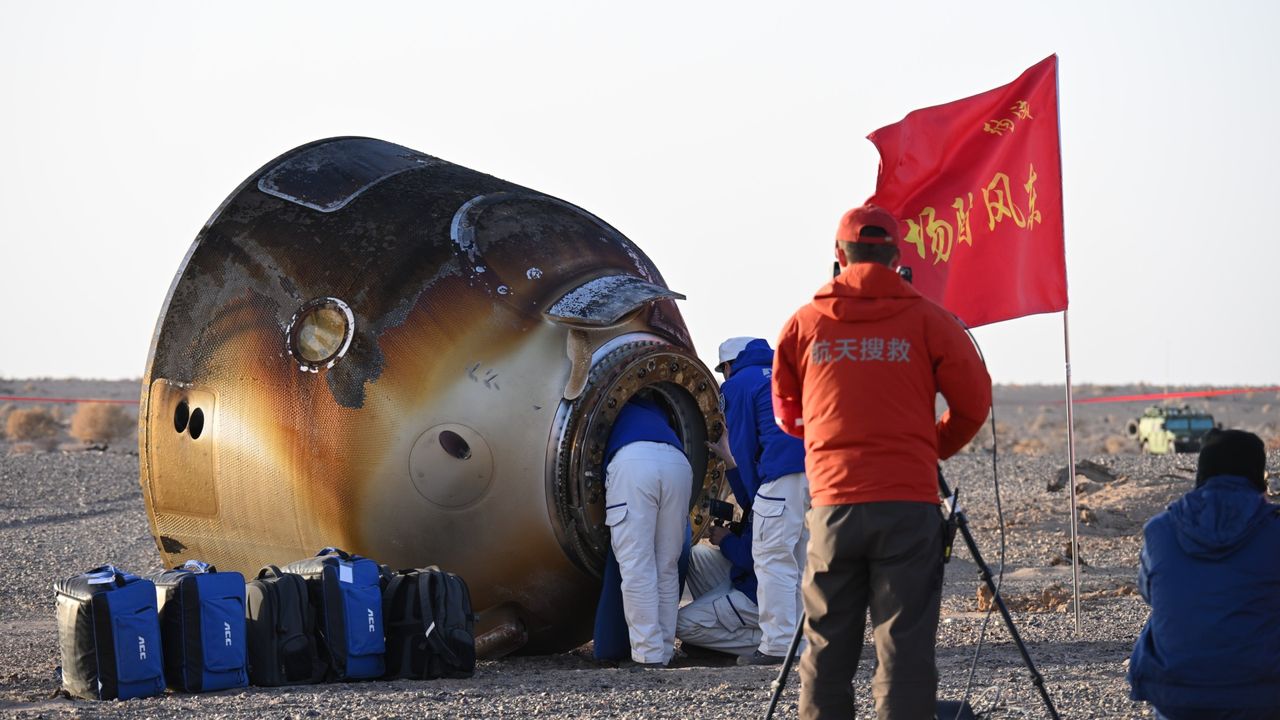
People in blue jackets lean into the opening of a charred cone-shaped spacecraft lying on its side on the rocky floor of a desert.

China's space agency has announced it will return a damaged spacecraft docked on Tiangong space station to Earth without crew after a suspected debris strike left it unfit for flight.

The three astronauts of China's Shenzhou 20 mission were set to depart the nation's space station on Nov. 5, but that same day, a surprise statement from China's Manned Spaceflight Agency (CMSA) announced the crew would be staying aboard the orbital lab for a little longer. Their spacecraft had been damaged after a suspected debris strike left a crack in the spacecraft's viewport, making a return to Earth in it too risky.

As a result, the three Shenzhou 20 astronauts later returned to Earth in their relief crew's spacecraft on Nov. 14. However, this left the three-person relief crew of the Shenzhou 21 mission, temporarily without a lifeboat that could bring them home in the event of an emergency. China launched a new craft on Nov. 22, bringing an end to the temporary emergency aboard Tiangong. And now, on Dec. 1, the CMSA has announced it will bring the damaged Shenzhou 20 craft home to Earth for inspection in order to "generate meaningful real-world experimental data for subsequent missions," according to state news agency Xinhua. A return date has not yet been announced.

Xinhua cited CMSA officials who went into greater detail about the damage the Shenzhou 20 craft suffered, describing "penetrating cracks" caused by a piece of debris less than a millimeter in size that struck the craft at "extremely high speed."

With this in mind, officials acted out of caution to bring the craft home uncrewed to avoid the possibility of a worst-case scenario in which these cracks could spread due to the pressure and heat of reentry. This could have caused the outer pane of the viewport to potentially detach and cause a total structural failure.

China's Shenzhou 21 crew will now spend the remainder of its six-month mission aboard Tiangong, carrying out scientific experiments and outreach. They will be relieved by the Shenzhou 23 crew, which is expected to launch in April 2026.

China's recent Shenzhou 20 incident echoes last year's somewhat similar situation with the astronauts of Boeing Starliner's first crewed test flight, who were left aboard the ISS without a dedicated ride home. The difference, however, was that there was a plan in place to bring that crew home in the event of an emergency; they could have squeezed into extra seats inside a SpaceX Crew Dragon spacecraft. Still, some spaceflight experts say these incidents are a "wake up call" for the need for dedicated space rescue services and increased international cooperation to avoid future disasters during these types of emergencies.

Sign up to read this article
Read news from 100’s of titles, curated specifically for you.
Already a member? Sign in here
Related Stories
Top stories on inkl right now
One subscription that gives you access to news from hundreds of sites
Already a member? Sign in here
Our Picks
Fourteen days free
Download the app
One app. One membership.
100+ trusted global sources.