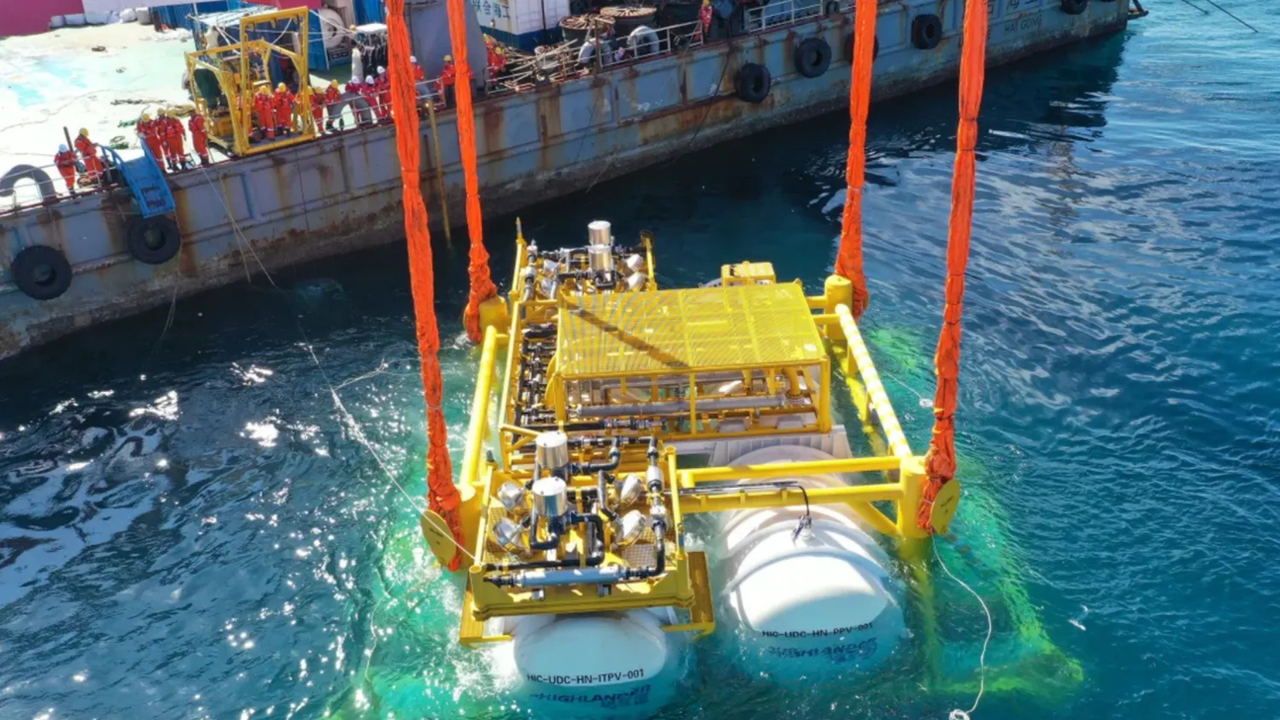
China’s “world's first” offshore wind-powered underwater data center (UDC) has begun operations, according to reports from Chinese media. The project, officially launched in June 2025 and completed in October 2025, hit full commercial operation last week, after successful initial trials in February.
Located off the coast of Shanghai's Lingang Special Area, the $226 million data center was built and is managed via a direct partnership between the Chinese government and HiCloud Technology (the primary private engineering contractor specialized in subsea data centers), along with state-backed telecom providers like China Telecom.
The 24 MW facility houses nearly 2,000 servers (including GPU clusters from China Telecom and LinkWise), and is expected to process artificial intelligence, big data annotation, and 5G infrastructure workloads. Unlike conventional land-based data centers that rely heavily on industrial chillers and large HVAC systems to remove waste heat, the Shanghai UDC uses the surrounding seawater as a massive passive heat sink. The servers are sealed inside pressure-resistant subsea modules deployed roughly 35 meters beneath the surface, where stable ocean temperatures continuously absorb heat generated by the computing hardware.
Cooling has become a major bottleneck for modern AI data centers, where dense GPU racks can consume hundreds of kilowatts, converting nearly all of that energy into heat. The underwater design uses surrounding seawater as a passive heat sink, sharply reducing cooling power requirements.
Chinese media reports claim the facility achieves a Power Usage Effectiveness (PUE) below 1.15, placing it among the most energy-efficient large-scale data centers in operation. Traditional enterprise data centers often operate closer to 1.5 or higher, meaning a significantly larger portion of their total electricity consumption goes toward cooling and supporting infrastructure rather than computation itself.
The project also reflects China’s broader push to integrate renewable energy directly into digital infrastructure. The underwater data center is connected to nearby offshore wind farms, allowing a substantial portion of its electricity demand to be supplied directly from renewable generation sources. As AI expansion drives explosive growth in electricity consumption worldwide, countries and hyperscalers are increasingly exploring unconventional infrastructure approaches to address both energy availability and thermal management constraints.
However, underwater data centers also introduce substantial engineering and operational challenges. Saltwater corrosion, long-term pressure sealing, subsea cable reliability, and maintenance accessibility remain major concerns. Replacing failed hardware is considerably more complex than in conventional facilities, where technicians can physically access racks within minutes. Operators therefore rely heavily on sealed modular designs, remote monitoring systems, and highly redundant infrastructure intended to minimize the need for physical intervention.
The Shanghai project follows earlier experimental efforts such as Microsoft’s Project Natick, which tested submerged data center capsules off the coasts of Scotland and California. Microsoft ultimately discontinued the program commercially, but the trials demonstrated that underwater deployments could achieve lower hardware failure rates.
Offshore-powered, ocean-cooled data center projects are continuing to emerge worldwide as AI infrastructure power and cooling demands continue to soar. Last month, we reported on a Peter Thiel-backed startup, Panthalassa, which is developing wave-powered floating data centers designed to operate far offshore using ocean water for passive cooling while drawing electricity from onboard renewable energy systems.