Get all your news in one place.
100's of premium titles.
One app.
Start reading
The Economic Times
The Economic Times
Neelanjit Das

Children can not have birthright to father’s self-acquired property even if he got it via gift, Will, family arrangement or partition in this case; Know what Mitakshara Hindu law says

In a recent ruling, the Karnataka High Court decided that just because a son inherits property from his father, it does not automatically make it ancestral property. This ruling is significant because once a property is determined to be non-ancestral, then it is classified as self-acquired, and children do not automatically have rights to it by birth. As a result, a daughter lost her claim to this property based on her birthright.

To explain further, the Karnataka High Court said that the daughter failed to prove that the properties in question were ancestral or coparcenary properties and the evidence on record, including admissions by her own witness, indicated that the properties had originally been purchased by her grandfather and were his self-acquired properties. Subsequently, they were allotted to her father under a family partition/arrangement.

The Karnataka High Court held that once self-acquired properties are distributed by the owner among his children, the recipients generally hold them as their separate properties unless there is evidence showing a contrary intention or that the property retained a coparcenary character.

Asha Kiran Sharma, Partner at King Stubb and Kasiva, told ET Wealth Online : "Importantly, the Court did not deny the daughter's rights as a coparcener under the amended Section 6 of the Hindu Succession Act. Rather, it held that those rights arise only in coparcenary property. Since the properties were found to be the father's separate properties and not ancestral/coparcenary assets, the daughter could not seek partition as a matter of birthright."

Also read: Son denies share of ancestral property to 6 half sisters; Andhra Pradesh HC give relief to the sisters and orders property partition

Sharma says that whether the property is ancestral or not depends not only on who transferred it, but also on how the transferor himself acquired it.

Sharma says: “The source of the title is crucial. If the father inherited property that was itself ancestral/coparcenary property and the property retained its ancestral character, descendants may acquire rights by birth.”

However, if the father received property that was self-acquired property of his own father, whether through gift, Will, family arrangement or partition, the property may become his separate property, depending on the facts and circumstances.

Sharma says: “In such a case (of self-acquired property), his children do not automatically obtain coparcenary or co-sharer rights.”

Even though the children do not have a birthright to their father’s self-acquired property, they can still inherit it after he passes away if the Hindu succession law or the father's Will grants them that right.

Also read: Ignoring objection notice for property mutation proves costly: SC rejects relatives' bid to revoke probate of aunt's Will that made nephew sole beneficiary

What does Mitakshara Hindu law say about self-acquired property?

The Mitakshara Hindu Law is applicable to all Indian states except West Bengal and Assam, which follow the Dayabhaga system. Under the Mitakshara Hindu law, merely because a son got the property from his father by any means, does not automatically make it ancestral property, as the source of the father's title matters as it defines whether the property is ancestral or self-acquired.

Sharma explains that the key idea is that a person has full ownership rights over his self-acquired property. He is free to sell, gift, transfer, or bequeath it through a Will to anyone he chooses. Just because the property was inherited from a parent doesn’t mean that the recipient automatically treats it as ancestral property.

Sharma also points out that the Supreme Court, in several rulings, has consistently maintained that the classification of the property depends on its source and the intention of the person transferring it.

Sharma says: “If a father gifts his self-acquired property to a son for the son's exclusive benefit, the property generally remains on the son's separate property. The son's children do not automatically acquire rights in it by birth.”

Example:

A father buys a house from his own earnings and later gifts it to his son. The son becomes the owner. The grandson cannot automatically claim a birthright in that house simply because it passed from grandfather to father.

Under Mitakshara Hindu law, a coparcenary is a narrower body within a Hindu Undivided Family

Sharma explains that under Mitakshara Hindu law, a coparcenary is a narrower body within a Hindu Undivided Family (HUF) where members acquire an interest in the property by birth. Every coparcener has a common and undivided interest in the property, and no individual member owns a specific demarcated portion until partition takes place.

Sharma says: "Community of interest means that all coparceners have a shared ownership interest in the property. Unity of possession means that every coparcener is deemed to be in joint possession of the entire property, even if one member is managing or occupying it."

Here are some examples to help you understand the concept better:

Example 1:

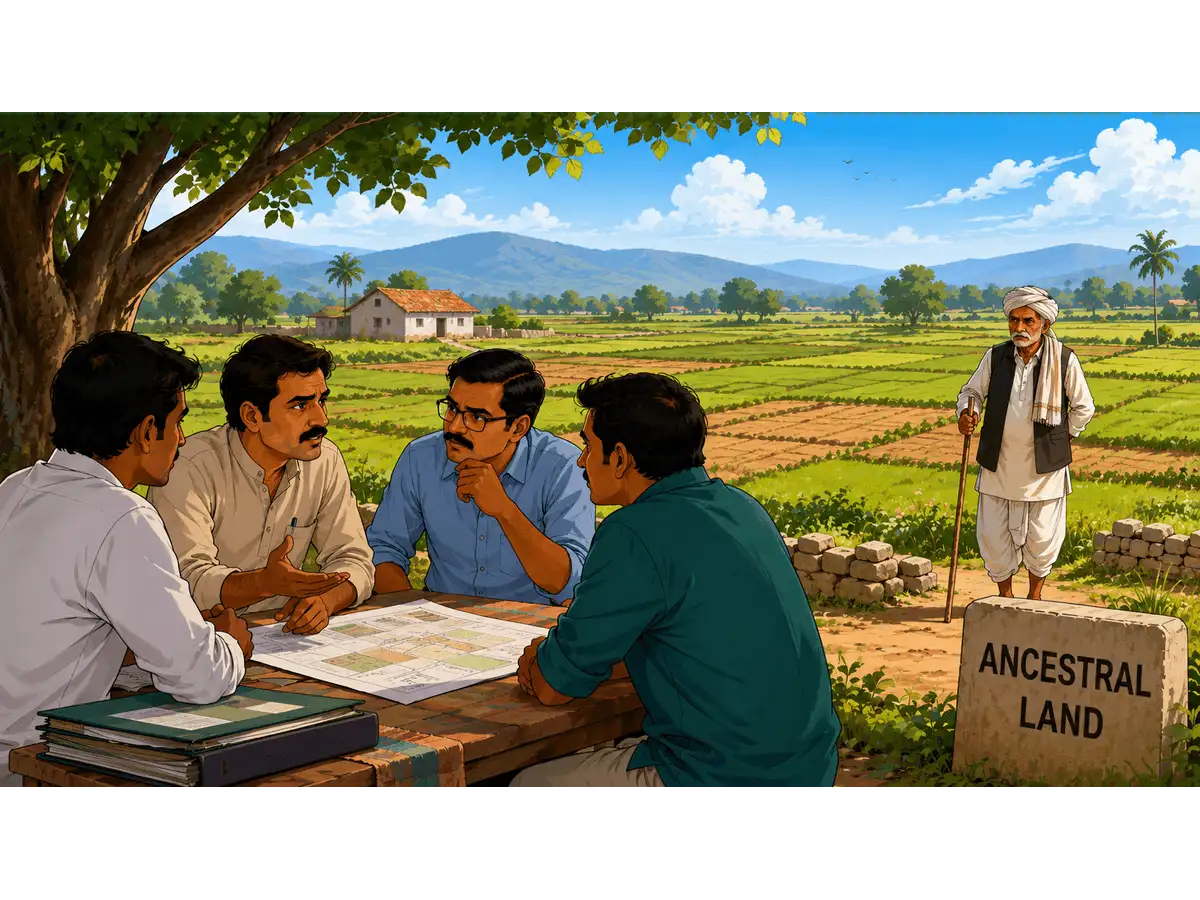
A grandfather, father, son and daughter jointly own ancestral agricultural land. None can claim a specific agricultural land as exclusively theirs until partition. All have a collective interest in the whole property. This is a classic coparcenary.

Example 2:

If a father purchases a flat entirely from his own earnings and holds it exclusively, the son and daughter do not automatically acquire any birthright in that property. There is no community of interest or unity of possession. Therefore, it is not a coparcenary property.

Sharma says: "The concept of coparcenary is not based merely on blood relationships. It is based on the legal character of the property. A family may be related by blood, but unless the property itself possesses a coparcenary character, rights by birth do not arise."

Sign up to read this article
Read news from 100's of titles, curated specifically for you.
Already a member? Sign in here
Related Stories
Top stories on inkl right now
One subscription that gives you access to news from hundreds of sites
Already a member? Sign in here
Our Picks
Fourteen days free
Download the app
One app. One membership.
100+ trusted global sources.