
Get all your news in one place.
100's of premium titles.
One app.
Start reading
Sports Illustrated
Sports Illustrated
Sport
Matt Verderame

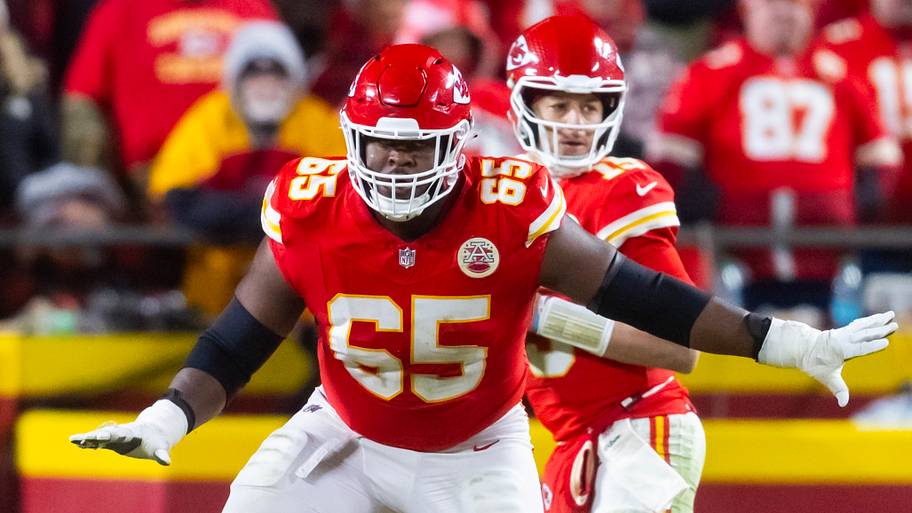
Chiefs Guard Trey Smith Explains How an NFL Player Commits to His Body

It’s August, and Trey Smith is already in pain.

On the morning after the Chiefs’ final preseason game, a scintillating 9–9 tie with the Seahawks at Arrowhead Stadium, Smith opens the door to his modern-style house in a gated community outside Kansas City. At 6'6" and nearly 330 pounds, he fills the doorframe in a pair of Chiefs shorts and a green T-shirt.

In about two hours, he’ll head into the team facility for treatment for a hip issue that will likely bother him throughout the season. He also has a nasty corn on his right index toe and a finger on his right hand that has long been pointing the wrong way—occupational hazards.

Despite the summer obstacles, the Chiefs’ guard feels refreshed. He’s better prepared than at any other time in his six-year NFL career due to a change in nutrition and body maintenance. It’s not bad timing, either, considering quarterback Patrick Mahomes is coming off multiligament surgery after ACL and LCL tears in his right knee last December.

So far, so good. The Chiefs are 2–0, and Smith has played every down.

“It’s the nature of the machine,” Smith says. “At the end of the day, no one really cares. Get your ass out there and do the job. … I can only control two things: attitude and effort; that’s it. So my attitude and how I approach every day, my effort and what I give in the field, in the meeting room, every single rep that I have—that’s all I got, right? And all I can do is build every single day to be the best version of myself. Instead of looking at the outside s---, instead of listening to the outside noise, I can only live in the present moment, trying to be the best version of myself for my team, because I don’t want to be the reason that standard drops off. Because I want Patrick to be the best quarterback, because I want him to be healthy, because Creed [Humphrey] plays beside me as the best center in the league.”

The job isn’t easy: being asked to move 300-plus-pound men against their will in front of millions of people for the glory of a big contract and a glitzy ring. Smith has done it better than most, securing a four-year, $94 million contract in July 2025 while also sporting a pair of Super Bowl rings as Kansas City’s star right guard.

“Hell, it took me years to learn it,” he says. “I feel like, for me, that the biggest evolution was as I get older, the mental side of it has to get better. The approach has to be different, which is the health [aspect]. … Big answer, it’s scary as s---, but I’m the man for the job.”

Kansas City Chiefs guard Trey Smith
Trey Smith's personal chef, Jayaun Smith, is at his house five mornings per week during the season, prepping three meals per day with a target of 600 to 700 calories per meal. | Erick W. Rasco / Sports Illustrated

Smith’s diet plan

All those practice reps and game snaps have taken a toll on his body, one he’s increasingly looking to offset as he turned 27 years old in June.

Part of the plan is a revamped diet, working with Dr. Leon Mellman to focus on eating foods that boost productivity while avoiding meals that increase inflammation.

In Mellman’s plan, Smith gives an annual blood sample, which is then run through 44 machines. From there, software designed by Mellman’s late mother, Sari, interprets the results to determine which foods cause cell death for each athlete. The player then gets an extensive booklet laying out what he should and shouldn’t eat.

In Smith’s case, he avoids many foods, including ones normally seen as healthy, such as tomatoes and salmon, along with beef. Instead, he substitutes bison meat, which he buys in bulk from Batchelder Family Farms in nearby Belton, Mo. From there, personal chef Jayaun Smith (no relation) creates a variety of meals for Trey under the guidelines provided by Mellman.

“I have a lot of body pains, aches, [and I’m] just trying to figure out an avenue that is the best for sports performance. Every year, playing in the league, it becomes harder and harder. I think just one thing I didn’t really take as seriously as I probably should is nutrition.” Trey Smith

“I have a lot of body pains, aches, [and I’m] just trying to figure out an avenue that is the best for sports performance,” Trey says. “Every year, playing in the league, it becomes harder and harder. I think just one thing I didn’t really take as seriously as I probably should is nutrition. Just trying to get an edge and just trying to figure out, O.K., how do I keep sustaining? How do I keep getting years out of my body, essentially? What is the best way to do it?”

Smith isn’t the only NFL player on Mellman’s diet. Other players include Cameron Jordan and Cesar Ruiz (Saints), Tyler Biadasz (Chargers), Calais Campbell (Ravens), Cade Mays (Lions) and others. Smith got involved last offseason after hearing about Mellman’s plan through Ruiz and Titans tackle Dan Moore Jr. while training at OL Masterminds in Dallas with Duke Manyweather, a pioneer in offensive line scouting and development.

After struggling to stick to the diet because of a lack of time and cooking knowledge, Trey hired Jayaun in April, making him the latest Chief to hire a chef, with George Karlaftis, Chris Jones, Sammy Watkins and others having worked with him.

“Trey is one of the easiest athletes I work with, but obviously, this diet is complex but also fun,” Jayaun says. “Trey can only eat turkey, bison, halibut and sea bass, so I’m working with those proteins at all times. So for me, it is challenging myself to make sure that I’m making as much as I can with those items, but also the limited ingredients.”

Part of the food journey is also trial and error. Jayaun pushes Trey’s body with what he calls challenge foods. The idea is to expand the menu and see how Trey’s body responds. If the food is well-received, it’s on the docket, along with other staples such as bison oxtails, ground bison and sweet potato apple hash, among others.

A one-man food service system, Jayaun is at Trey’s house five mornings per week during the season, prepping three meals per day with a target of 600 to 700 calories per meal (interestingly, Mellman doesn’t believe in calories, insisting the government created them to sell food to schools and prisons). Each meal goes into a glass container to avoid microplastics. Any water Trey consumes also comes from a spring or glass bottle.

Kansas City Chiefs guard Trey Smith and his diet foods
Some of the staples in Smith's diet are bison oxtails, ground bison and sweet potato apple hash, among others. | Erick W. Rasco / Sports Illustrated

In this regard, the job becomes easy for Trey: eat without thinking.

“For me, I’ve had a lot of struggles with weight,” Trey says. “But as a bigger guy, you’re trying to get a certain weight range, a certain body fat percentage, et cetera. In years past, I starved myself to make these guidelines, these different goals and things I wanted. I think the liberating part about this program is that I’m not only losing weight, I feel really good. I’m also able to control it, manipulate my weight and not starve myself. I’m satisfied. There’s a huge level of mental clarity and just peace that you get. I know that I don’t have to starve myself for a month.”

On a day when Trey goes into One Arrowhead Drive, he might drink a smoothie for breakfast to sustain him through morning workouts. At night, a sweet treat often isn’t as it appears. If Trey craves apple pie, Jayaun can make a healthier version by reducing added sugar and adding protein, with blended oats and pecans.

“We’re constantly battling inflammation in our bodies,” Trey says. “As an athlete, it’s a war, man. And I just noticed that my body composition was so much better, weight was able to be under control and just, like, the inflammation was under control as well.”

“As an athlete, it’s a war, man. And I just noticed that my body composition was so much better, weight was able to be under control and just, like, the inflammation was under control as well.” Smith on taking care of his body

Trey has also changed his worldview through his newfound nutrition. After retirement, he’d like to return to Tennessee and buy some land. From there, he wants to grow some food and have chickens to lay eggs, allowing him to eat cleaner, something he laments about the United States.

For example, Trey points to his pantry and notes two items. A bag of apple chips and a bag of Cool Ranch Doritos, one of his occasional cheat foods. The apple chips have a single ingredient. The Doritos have more than 20, including many that are hard to pronounce.

“When you’ve been on the diet, when you’re on the program long enough, that initial cheat day, when you finally cheat, you’re going to feel like s---,” Trey says. “That’s one thing I noticed. And I don’t know if it’s a good thing. I haven’t been super fancy [in my life]. You eat food, right? And I think it’s an eye-opening experience for me in terms of the American healthcare system and our food system as well. Shifting from eating organic food to what we are accustomed to and eating every day. It’s a night-and-day difference.”

Smith’s recovery investment

Kansas City Chiefs guard Trey Smith
Smith will sit in a hot tub several times per week to help his aching feet and swollen ankles. | Erick W. Rasco / Sports Illustrated

In the NFL, though, diet is only part of the puzzle.

To stay on the field, Smith has invested more than six figures in recovery equipment at his home, including a sauna with red light therapy (ordered but not yet delivered), a hot tub and a hard-body hyperbaric chamber.

Once the sauna is installed, it’ll be another way for Smith to recover faster, with the red-light aspect as a key added benefit. Dr. Jesse Morse, who is board-certified in sports medicine and works with pro athletes in Miami, regularly treats professional, collegiate and elite combat athletes and believes it’s one of the best ways for them to heal, explains how it works on the body.

“They’re [red light beams] isolated, basically, from the sun, and then they just make them into a super powerful light beam,” Morse says of the process. “… It’s very safe and very effective. Realistically, it can be very, very helpful to optimize healing, increase blood flow, decrease inflammation, and is safe. Most people do it for 15-to-30-minute intervals, multiple times a day.”

Of Smith’s residential treatments, the chamber is easily the most advanced. While most teams have hyperbaric equipment and many players invest in a soft-shell variety, the hard-body is next-level. Smith has a Fortius 420 model made by OxyHealth in his garage, where he’ll lie for a few hours two to three times per week while watching Netflix to pass the time. At first, the chamber was daunting to Smith, who likened it to the sarcophagus of doom. Now, he lies down and relaxes as the chamber cranks up to roughly 28–30 PSI on the pressure gauge.

While the average breath humans take is 22% oxygen, Smith breathes in 60% to 80% enriched oxygen, helping his body repair itself. He’ll also sit in the hot tub multiple times per week, something which helped his aching feet and swollen ankles this summer.

“Trey has over 13% body fat,” Mellman says. “To play in the trenches, you want more than 10%, so that way it doesn’t stress their gallbladder. So as long as the guy is getting in the hot tub at 104°F to 106°F, he can be in there for 12 minutes. Guys under that [body fat threshold], like your linebackers, your hybrid outside defensive ends, who want to look like underwear models, they don’t feel well. If they go into any cold tub, or if they go into infrared saunas, they can actually hurt themselves because their body doesn’t have enough cushioning to repair the impact.”

Smith also uses the NeuFit Neubie, an FDA-approved electric current machine that helps muscles recover with pads that stimulate the intended area. Sessions typically last no longer than 20 minutes. Smith also has turf in the garage and a Sanddune Stepper to improve ankle mobility and foot strength, something he picked up from former Chiefs legend and Hall of Fame right guard Will Shields.

Then there are stem cell treatments in Colombia, something Smith also began this offseason. After missing five games last year with ankle sprains, Smith is seeking out all edges. One was found while working out with Manyweather, alongside 35 to 40 others. The schedule required two to three hours a day for most of three months, from early March through the start of OTAs, focusing on right-hand punch and other techniques.

While there, Smith became interested in stem cell therapy, which has taken hold in Colombia and Panama, among other places. After debating the choice, Smith got treatment, something he plans to make a yearly part of his routine.

“I thought it was great. The one injury I had that was really the most concerning, it’s been a night-and-day difference,” he says. “I’m not fully healed, but it’s way better than what I was experiencing. I [didn’t] know if I could keep this up at this rate, where we’re going. So I think that’s the good part about it, is just finding that relief. It’s been effective.”

“I thought it was great. The one injury I had that was really the most concerning, it’s been a night-and-day difference.” Smith on stem cell therapy

While the science behind stem cells is widely accepted, Morse says there is some concern about the process in places such as Colombia, Panama and Mexico. Although stem cell treatments are legal in seven U.S. states, the Food and Drug Administration (FDA) regulates them under much stricter guidelines. Because of those safety measures, stem cell work costs much more in the United States, which is part of the reason many athletes get injections abroad.

From a medical perspective, the biggest concern is whether the stem cells are harvested from the best locations (the umbilical cord is one of the best spots) and whether the cells are handled correctly.

“If you look at the science, when you culture-expand a cell, meaning if you multiply it 10 million to 20 million, 20 million to 30 million, the maximum amount you should expand it is four-to-five times,” Morse says. “After that, it starts becoming what I call unstable.”

Still, Manyweather is an advocate for players to get stem cell treatment after being severely injured while attempting to lift 660 pounds on his back as a powerlifter in 2021. He broke his right big toe, tore both quad tendons and snapped his left patellar tendon, forcing him to use a wheelchair for three months.

Kansas City Chiefs guard Trey Smith
Of Smith’s residential treatments, his hyperbaric chamber is the most advanced. Smith lies in the chamber for a few hours, two to three times per week. | Erick W. Rasco / Sports Illustrated

Then, after getting 300 million cells injected over seven days at BioXcellerator in Colombia, Manyweather says he saw a stark improvement within two weeks. Today, he can deadlift more than 700 pounds and bench more than 400 pounds.

“What ends up happening is you get these timelines of when guys will be back from injury, and then all of a sudden they’re back sooner, and people say, ’Oh yeah, their sports [medicine] did a great job,’ when the secret, a lot of times, is BioXcellerator,” Manyweather says.

For finely tuned athletes always looking for advantages, seen and unseen, stem cells alongside cutting-edge equipment and innovative diets all fit the bill. In Smith’s case, he combined them in an effort to make a third consecutive Pro Bowl while helping Mahomes avoid another injury.

Now, though, Smith has to get going. He went into the facility for treatment before the start of a long grind, one he hopes will culminate in his fourth Super Bowl appearance and third title. Of course, that would mean more games on the body, only adding to the 13 postseason contests already on the odometer.

The pain never stops, the same as Smith’s quest to conquer it.


MORE NFL FROM SPORTS ILLUSTRATED

Sign up to read this article
Read news from 100's of titles, curated specifically for you.
Already a member? Sign in here
Related Stories
Top stories on inkl right now
One subscription that gives you access to news from hundreds of sites
Already a member? Sign in here
Our Picks
Fourteen days free
Download the app
One app. One membership.
100+ trusted global sources.


