Get all your news in one place.
100’s of premium titles.
One app.
Start reading
TechRadar
TechRadar
Eric Hal Schwartz

ChatGPT now includes ads — and that subtle shift could reshape the emotional bond users have with the world’s favorite AI chatbot

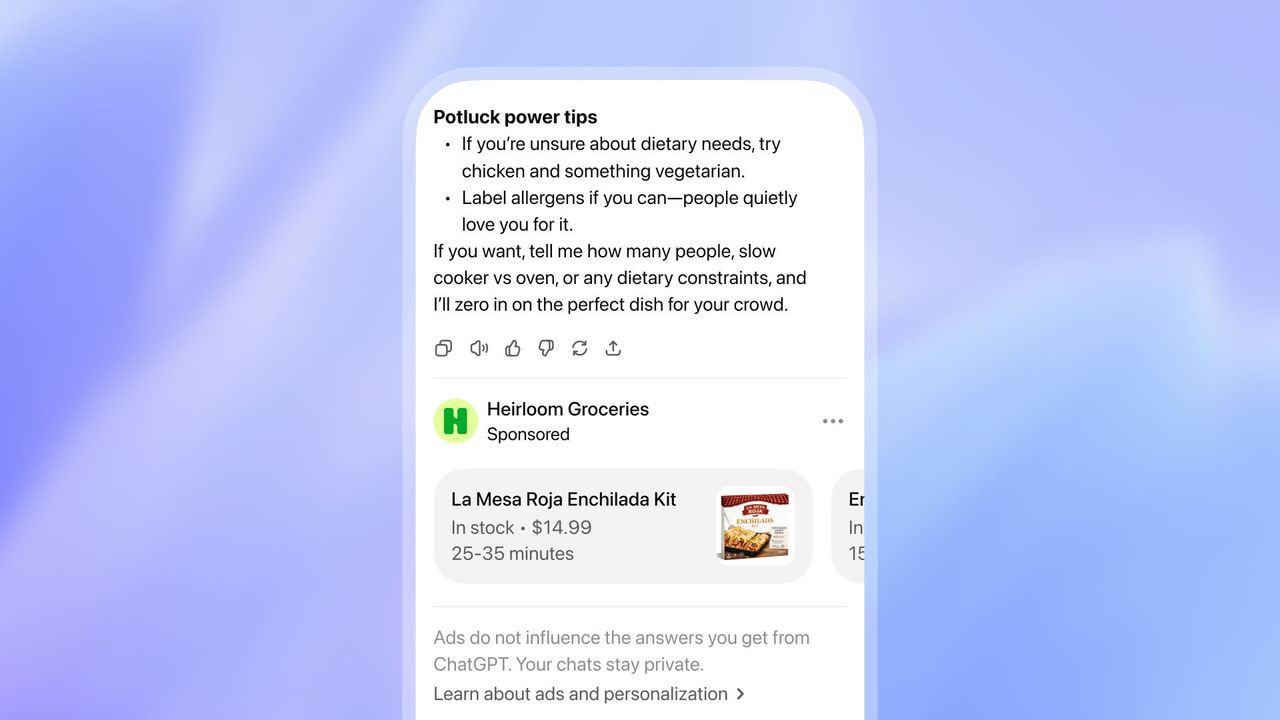
An example of ads running in ChatGPT on a phone.

OpenAI rolling out advertising inside free-tier ChatGPT conversations is more than just an experiment in AI monetization. A commercial message appearing inside a space many users had come to treat as neutral, or at least not explicitly paid for by corporations, has opened a door to the endless ads so central to the rest of the internet.

No matter how careful the product design and deployment, ads in ChatGPT were going to land with a thud for some users. Something about ads in ChatGPT feels intrusive, like a group chat that suddenly had a sponsored post from one of its members.

Not that OpenAI is being irrational. Running large-scale AI systems is staggeringly expensive, and OpenAI has never pretended otherwise. Ads offer a way to keep the core product widely accessible while diversifying revenue beyond subscriptions and enterprise licensing. Still, the introduction of ads changes the emotional framing of ChatGPT overnight. What once felt like a private workspace now feels, to some, like a shared commercial environment.

That perception matters more than it might seem. A lot of people have built very personal environments within the AI chatbot. If that space is no longer solely oriented around the user’s intent, it can be alienating. And alternatives are far from theoretical. Competition in consumer AI has matured, and users who feel friction now have AI chatbot options like Gemini that, so far, promise no ads.

Scaling Gemini

While ChatGPT wrestles with how ads reshape its identity, Google has been building momentum with Gemini in a very different way. Google's AI toolkit recently hit a major milestone of 750 million monthly active users. It's a validation for Google's strategy of making Gemini as ubiquitous as possible and as easy to find as a sponsored link in its search results.

Gemini is positioned as both an independent tool and a feature of every Google product you use. Trying Gemini doesn't require a conscious switch as much as simply looking at the latest update to a product.

That matters in a world where user loyalty is often dictated by habit rather than ideology. People rarely wake up intending to abandon one digital tool for another. They drift. They use whatever is closest, easiest, and least irritating in the moment. Gemini’s growth to more than 750 million monthly users, not far behind ChatGPT, suggests that Google has successfully made it easy for a massive audience to adopt its AI.

ChatGPT’s ads complicate things for the chatbot. Even users who do not actively resent advertising may notice the contrast between a conversation that remains uninterrupted and one that now occasionally pauses to sell something. Over time, those small annoyances accumulate.

Defenders of OpenAI’s strategy can accurately point out that Google is hardly allergic to advertising. Google’s core business has been built on ads for decades. But, so far, any Gemini ads are part of environments where ads have existed for a long time, like search results.

The risk is not that users will suddenly revolt en masse. The risk is that they will quietly recalibrate their habits, especially when Gemini is already embedded into the tools they use daily.

Shifting AI

This is not an abstract concern. Users already navigate a digital landscape saturated with ads, notifications, and algorithmic nudges. One reason ChatGPT gained such rapid adoption was that it felt like an escape from that clutter. Once that's compromised, the experience becomes more like everything else on the internet. For some users, that will be tolerable. For others, especially those who rely on AI for creative or reflective tasks, it will feel like a loss.

Consumer technology history is filled with examples of platforms that underestimated the cumulative effect of small irritations. Individually, an ad here or a sponsored suggestion there seems trivial. Over time, those elements reshape how a product feels.

Gemini’s rapid climb to hundreds of millions of users suggests that Google has successfully framed its AI as a background helper. User behavior rarely changes overnight, and a user annoyed by an ad today might still open ChatGPT tomorrow. A month later, they might lean more heavily on Gemini. Next year, Gemini might be their default AI chatbot.

Google’s Gemini, buoyed by its reach and its integration across familiar tools, stands to benefit from any perception that ChatGPT’s experience is becoming more cluttered or transactional. The fact that Gemini has already grown so much underscores how real this competition has become.


Follow TechRadar on Google News and add us as a preferred source to get our expert news, reviews, and opinion in your feeds. Make sure to click the Follow button!

And of course you can also follow TechRadar on TikTok for news, reviews, unboxings in video form, and get regular updates from us on WhatsApp too.

Sign up to read this article
Read news from 100’s of titles, curated specifically for you.
Already a member? Sign in here
Related Stories
Top stories on inkl right now
One subscription that gives you access to news from hundreds of sites
Already a member? Sign in here
Our Picks
Fourteen days free
Download the app
One app. One membership.
100+ trusted global sources.