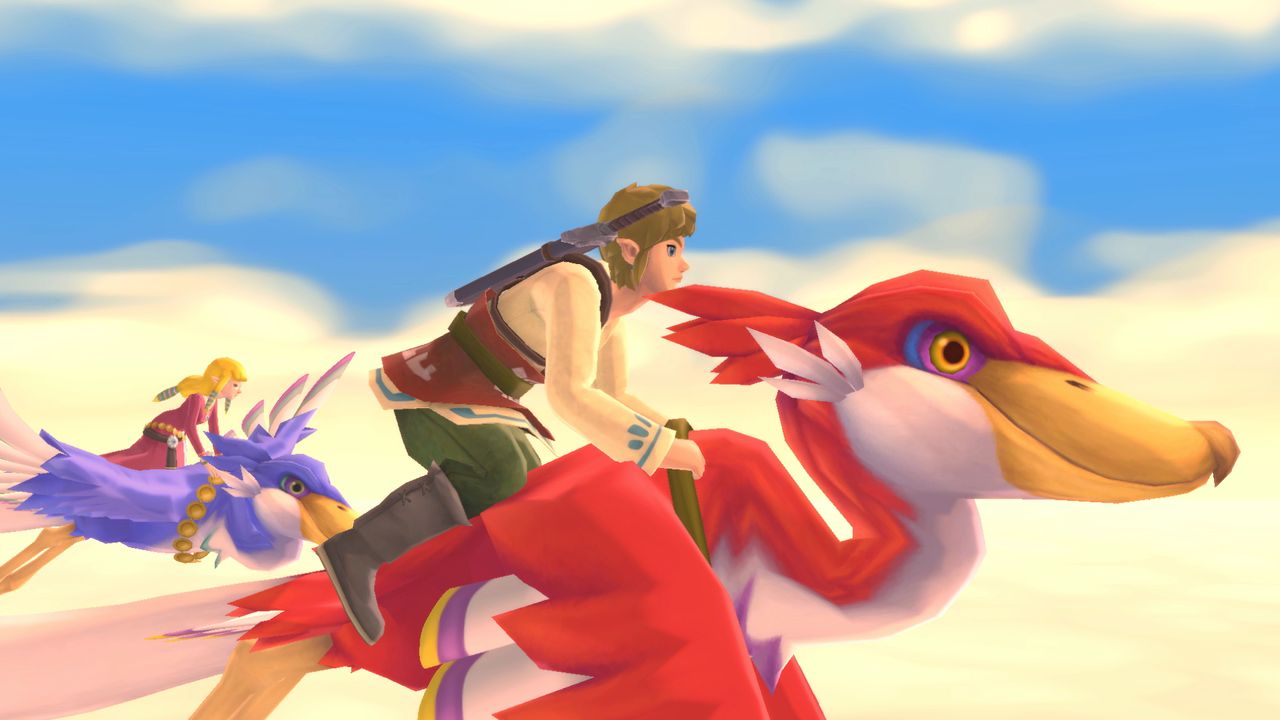
The Legend of Zelda: Skyward Sword HD, a faithful recreation of the 2011 original, is the de facto way to experience one of the series's most slept-on titles. Before that, there was no great way to play Skyward Sword without an original Wii MotionPlus or third-party alternative.
Plenty of DIY solutions were cooked up – and oh boy, were they cooked – but in the end, separating Skyward Sword from its original hardware proved impossible without altering the feeling of the game itself. It stands to reason that Nintendo's controls, bizarre as they can be, are core to the sense of exploration that is The Legend of Zelda's identity.

Reworking the classics

Emulation is necessary to preserve games in a playable state, which is the only way to really preserve them. This is especially true for Nintendo, which is notoriously not very precious about safeguarding even its most beloved franchises.
But for the citizen preservationists who have to translate Nintendo's experiments to more conventional control schemes, the emphasis here is on "playable." And as out-of-production hardware (like the Wii MotionPlus) filters out of the market, they need to get creative.
Dolphin, for example, creates a virtual WiiMote that it maps to regular button presses. Because the WiiMote's accelerometer only recognizes simple movements like "flick" and "shake," these simple actions are easy to translate. The Wii MotionPlus made things complicated by adding a gyroscope to track movement and angle with much higher fidelity. Simple combat encounters in Skyward Sword require enemies to be hit from one of eight directions, Loftwing sections make use of tilts, and bomb puzzles require precise bowling.
The challenge of emulating Skyward Sword isn't that its individual systems are too technically complex: it's the game's willingness to flow between these systems. Once you lock down a good button map for combat, you're out of luck for archery sections. Solutions for playing Skyward Sword on PC typically involve multiple different control profiles and unwieldy keybinds. With effort, the game works. But according to the Dolphin users I spoke to, it's a real challenge… Well, the word they used was "excruciating."

In Skyward Sword HD's joystick-only mode, the right stick simulates most of the motion controls. This solution took a year and a half to create, from a team of designers with full dev tools – and it would be considered modding, which is contrary to the purposes of emulation – but if this square peg of a game requires so much hammering to fit into a round hole, can we really call it the same game?
Maybe that question is too philosophical. Look instead at the DS generation and my own formative Zelda game, Spirit Tracks. Some finagling aside, it's not terrible to emulate through the usual methods, using the mouse as a stylus and hotkeys for fringe mechanics. Your life gets harder if you're hoping to go back to Phantom Hourglass. One puzzle centered around blowing into the microphone necessitates the download of a bespoke .wav file, according to a tutorial published just last year. As soon as one generation of Zelda games is sorted, all of its challenges seem to migrate to the next.
Even when the player isn't literally moving through space in a new way – that is, when the main work they're doing is with their thumbs – just about every main series Zelda game is about Link physically engaging with Hyrule in a new way.
Together, Oracle of Seasons, Oracle of Ages, and The Minish Cap place Link in command of their worlds' climate, time, and size, with the Oracle games changing over multiple playthroughs. Twilight Princess dares to ask, what if Link got to be a wolf sometimes? Even Breath of the Wild, a relatively straightforward open world, takes a more-is-more approach to creating open spaces, pushed further by Tears of the Kingdom. For god's sake, they gave the boy an iPad.
States of play

Zelda's charm has always been something more than world, plot, or progression.
The series engages with a quality of games often minimized in pursuit of maturity; as Moira Hicks puts it, that video games are toys. Citing titles like Katamari Damacy and Papers, Please, Moira writes that a game which embraces its toyness is "impossible to describe without discussing its mechanics."
The Legend of Zelda turns this principle askew. It is possible to describe a Zelda game without discussing mechanics, and they'd all sound pretty similar if you did. "Link journeys across Hyrule (or Termina, or the Great Sea) to rescue Zelda (or Din, or Nayru) by gathering the pieces of the Triforce (or the Eight Instruments of the Sirens, or the blessings of three Great Fairies) and defeating Ganon (or Zant, or Demise)."
But its charm has always been something more than world, plot, or progression. It owes its inimitable to kinesthetics as much as aesthetics: changes in elevation, eyes adjusting to the dark, underfoot mud giving way to stone
Zelda's sense of discovery has persisted across four decades now, and its cultural significance will carry it another four and beyond. In that time, all of these games will probably be slickly remastered and intelligible within modern control schemes. But equally important will be the preservation of the toys these games have inhabited over the years, the vessels that they expand to fill. Without their controllers, none of these experiences are complete.
Which of the best Zelda games do you actually want to see remastered or emulated on modern hardware?