
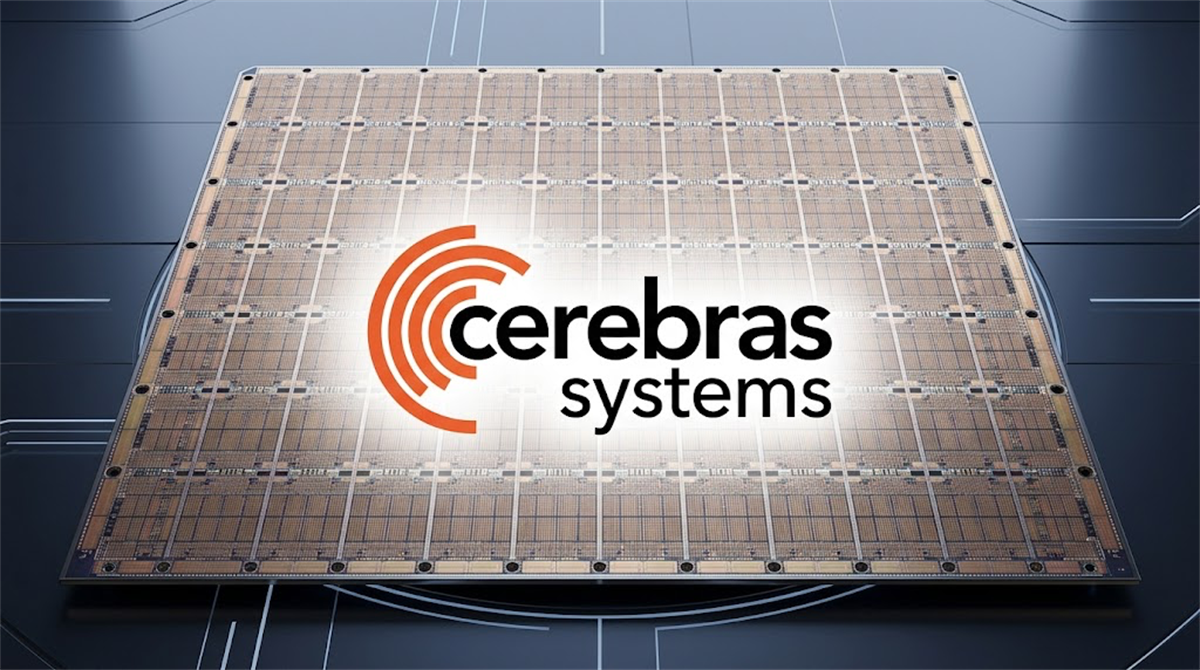
In a world where bigger is better, Cerebras Systems (NASDAQ: CBRS) seems to be well positioned. Instead of linking numerous AI cores together, creating data transfer bottlenecks along the way, Cerebras Systems chips are massive, comparable to dinner plates, housing thousands of cores in each.
The advantage to this approach is simple: speed. Housing AI cores on a single chip enables lightning-fast speeds unparalleled by traditional GPU technology. The disadvantage is memory capacity: NVIDIA’s (NASDAQ: NVDA) Vera Rubin natively supports far more memory, making it a superior choice for training and advanced applications.
Meanwhile, speed makes Cerebras Systems' AI technology well-suited to real-time inference, the far larger market.
Cerebras Set to Dominate in the AI Inference Market
Currently estimated at approximately $125 billion as of mid-2026, the inference market is expected to proliferate at a solid double-digit compound annual growth rate for at least the next four to five years, doubling in that time. While GPUs are the basis for inference, hardware demand is expanding to include more specialized equipment better suited to the task.
Cerebras's other advantages include the far simpler programming required compared to multi-GPU setups, a smaller footprint, as one Cerebras chip can replace dozens of servers, and lower operating costs. For comparable computing power, the chips deliver industry-leading speeds, often double to triple the token-generation throughput of traditional GPU setups, depending on the model.
CBRS Pulls Back to IPO Lows With Catalysts in Play
Cerebras Systems has several catalysts in play, including a growing number of business deals, supply chain insulation, and new product launches. Deals such as those with OpenAI and Amazon’s (NASDAQ: AMZN) Amazon Web Services are generating revenue now and are expected to ramp in upcoming quarters.
OpenAI is currently porting GPT 5.4 and GPT 5.5 to the Cerebras infrastructure and plans to deploy 750 megawatts of its own capacity soon.
The deal with AWS promises to generate a rapidly growing revenue stream through a disaggregated inference setup: AWS's Trainium chips handle the prefill stage—processing the input—while Cerebras's CS-3 systems run the high-speed decode stage that generates the output tokens.
Other catalysts for Cerebras include manufacturing and construction, which do not require high-bandwidth memory (HBM), insulating the firm from industry bottlenecks. The impact is that Cerebras can ramp production of its chips while others are forced to wait on memory modules, putting it in a position to gain market share quickly.
Hurdles Drive Volatility for CBRS Shareholders
However, as robust as the outlook may be, the company has hurdles and headwinds to overcome. Among them are customer concentration, which relies on a limited number of hyperscalers, including the United Arab Emirates-backed G42 Holdings, Ltd. It exposes the company to government scrutiny and export controls. Meanwhile, the intense increase in inference demand forced the company to lease back previously committed capacity, temporarily impairing its margins.
The more pressing concern is competition. In-house chips seek to achieve much of what Cerebras Technology is doing, and there is the memory shortfall to account for. While Cerebras chips are super fast, they have limited on-chip memory, which affects their usefulness in some applications.
While the systems are great at producing output, they struggle with input and need front-end assistance with massive prompts (such as enterprise-quality requests based on potentially endless datasets). The deal with Amazon is an example, as Cerebras systems need the Trainium infrastructure to sort and organize the data into digestible bites it can use to generate super-fast responses.
The company’s plan is to increase its memory capacity over time by shrinking the size of the SRAM modules within each chip. The company has done so successfully across several generations and is on track to do so again with its upcoming technology. The caveat is that there is a physical limit to how much can be placed on a single wafer because nodes can only get so small.
Optimistic Analysts Highlight Value Opportunity in CBRS Stock
The initial analyst outlook for Cerebras is bullish. The first 11 reports to show up on MarketBeat’s tracking page since the IPO include 10 Buy ratings for a 92% Buy-side bias. The group sees the stock as fairly valued near its IPO level, approximately 60% above the late-June price action. The risk is that price action will continue selling off, as is often the case with IPO stocks, but the analysts' chatter suggests otherwise. They view company guidance as conservative, expecting strengths to emerge as the year progresses.
Among the strengths are the potential for accelerated gross margin expansion. The combination of capacity ramping and rising compute costs creates a dual lever for growth. In this scenario, CBRS will likely outperform its guidance in the upcoming quarters and improve its profitability outlook.
As it stands, profits are expected by next year, and profitability is expected to improve aggressively over the subsequent three to five years.
The article "Cerebras Systems, Inc: The Next Rags-to-Riches AI Story?" first appeared on MarketBeat.


