The announcement of a two-week ceasefire has allowed Donald Trump to hail the reopening of the Hormuz strait as a victorious dawn of a new golden age, but it is Iran that enters peace talks with the stronger hand.
The Tehran regime goes to the negotiations planned for Friday in Pakistan bloodied but intact. It still holds a stockpile of highly enriched uranium (HEU) – the original crux of the conflict with the US, Israel and allies – and it now claims at least part-control of the strait, having demonstrated its power to close the narrow waterway and hold the world to ransom.
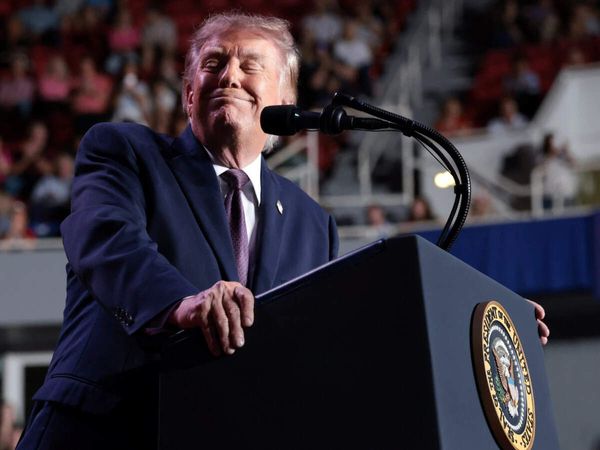
Trump won instant gratification. He got to remain the central player in the drama, having terrified the world with his threat that “a whole civilisation will die” before claiming a few hours later to have dramatically reversed course and to be “far along” along the road to an enduring Middle East peace.
With the president’s words the oil price went down and global stocks showed signs of rallying, demonstrating he still had the power at least to move short-term markets.
However, the actual ceasefire terms remain hazy with varying interpretations in circulation. Pakistan’s prime minister, Shehbaz Sharif, said the ceasefire covered “everywhere including Lebanon”, but his Israeli counterpart, Benjamin Netanyahu, quickly contradicted him, vowing Israel’s campaign over its northern border would go on.
Trump said the ceasefire was contingent on the “complete, immediate and safe opening of the strait of Hormuz”. Tehran agreed that shipping would now proceed through the waterway, but with the caveat that passage would be under the control of the Iranian armed forces.
Reports from the region suggested that Tehran planned to implement its earlier proposal to share control of the strait with Oman and split the proceeds from tolls, set at $2m (£1.5m) a ship. That would represent a significant departure from the prewar status quo, in which the strait was a free waterway, cementing Tehran’s role as gatekeeper and providing it with an entirely new source of income.
The uncertainty over the future of the strait suggests that the hundreds of ships trapped in the Gulf by the conflict will seek to leave, but far fewer will enter through Hormuz given the level of uncertainty for fear of being trapped. Shippers will also be anxious that paying tolls to Iran will violate US sanctions.
Trump made ever more grotesque threats in the five weeks of war, culminating in his genocidal warning that he would bring about the end of Iranian civilisation, in the clear hope of blustering Tehran into last-minute concessions.
That does not seem to have worked. When it came to the wire it was Iran’s 10-point plan, not his own 15-pointer, that Trump referred to when welcoming the ceasefire on Tuesday evening, calling it “a workable basis on which to negotiate”.
On waking early on Wednesday morning, the president appears to have been made aware that Iran’s 10 points include the lifting of all sanctions, the payment of war reparations and the acceptance of Iran’s right to enrich uranium, all conditions that have up to now been beyond Washington’s red lines.
In his first posts of the day, Trump sought to reframe the ceasefire on more favourable terms. It was based on his 15-point plan, he implied in a Truth Social post, and many of those “have already been agreed to”. Most important, he said, there would be “no enrichment of uranium” and the US would work with Iran to dig up Iran’s HEU stockpile, which he referred to as “Nuclear ‘Dust’”.
For its part, the Tehran government included the right to enrich in the Farsi version of the ceasefire terms, but not in the English translation, suggesting it was put there for domestic consumption as the regime boasted victory.
There seems little doubt that Iran will make that right a red line at talks over a long-term settlement, as it has in all its negotiations with the west, and its possession of 440kg of HEU (enough in theory to make a dozen nuclear warheads) will be a powerful bargaining chip.
In negotiations that were ended by the US-Israeli attack on Iran on 28 February, Tehran was apparently ready to surrender that stockpile. That is just one way in which the US has emerged from the war in a weaker position than it was at the last round talks in Geneva, two days before the conflict was unleashed.
The Tehran delegation will arrive in Islamabad having shown the world and the Iranian people that the regime can survive the worst its enemies could throw at it, despite severe losses including the death of the supreme leader. Iranian forces remained in the fight at the time the ceasefire was declared, defying claims they had been obliterated, with missiles still being fired at Israel and other US allies.
The negotiations will also begin under the shadow of a new status quo, with Iran as co-custodian and beneficiary of the strait of Hormuz. The US delegation may bang its fists and threaten to walk away over Iran’s conditions, but it will be in the knowledge that its adversary has the proven capacity to inflict exquisite pain on the Trump administration through its power over the petrol pump.