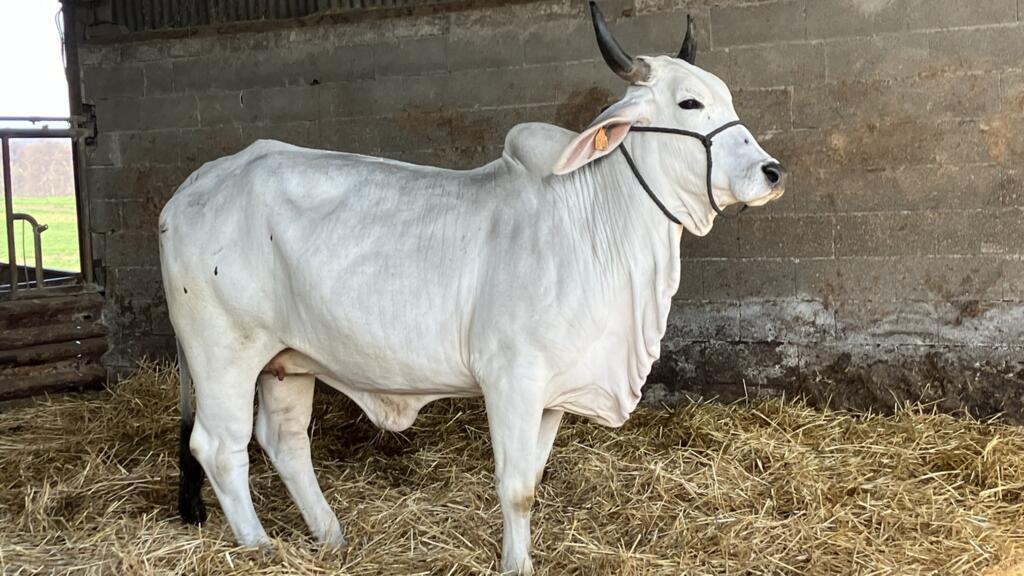
For the first time in 60 years, cattle will be absent from Paris's International Agricultural Show, taking place next month, thanks to an outbreak of contagious nodular dermatosis, also known as lumpy skin disease – meaning the show's planned star attraction, Biguine, a prized Brahman cow from Martinique, will not be appearing.
Biguine arrived by boat several months ago from the French Caribbean island territory to Franche-Comté, in eastern France.

Biguine's owner, farmer André Prosper from the north-east of Martinique, has a herd of 300 Brahman cows – known for their distinctive hump, long ears, and loose skin.
But for him, Biguine stands out – having got her name from how she appears to dance in the Creole beguine style.
"When Biguine was born, she had so much fun with the staff. When we arrived in the morning, one of them said to me, 'She's dancing, and it looks like she's doing the biguine. She was moving around in all directions... she has a real personality," he said.
However, Beguine will not be getting the chance to show off her moves in Paris this year.
Due to an outbreak of lumpy skin disease (LSD) in France, for the first time in its history the Paris International Agricultural Show will not feature any cattle.
"We took the decision last night that there would be no cattle at the international farm show 2026," the show's chairman Jérôme Despey told reporters last week.
"This is a historic decision that has saddened us," he added, stressing that the show would still feature many other animals including pigs, sheep, horses, dogs and cats.
French farmers protest over compulsory cattle culls amid disease outbreak
LSD, which is mainly spread by biting insects, causes fever and painful skin lumps, weakens animals and reduces milk output. There have been more than 100 outbreaks detected in France, mostly near the Alps and in southwestern France.
The ministry of agriculture said the disease was under control in France thanks to vaccination. However, Depsey added, some farmers want to avoid taking any risk while others want to express their solidarity with affected farmers.
'The breed of the future'
The Brahman breed is little known in mainland France. Originally from India, the first Brahman cattle arrived in Martinique in 1950.
Six-year-old Biguine weighs 600 kilograms, more than the average polar bear.
"She has an exceptional bearing and is recognisable by her magnificent horns. She has a fairly broad forehead and very long ears, which allow her to keep cool at all times. She also has a fairly broad black muzzle," said Prosper.
"My father started breeding [Brahmans] and when he died, I took up the torch and continued the exceptional work he had already begun to give Brahman cattle their true stature."
Mercosur trade deal in limbo after EU parliament asks top court to weigh in

Robust and resilient, Prosper says the Brahman's unique qualities could make it the ideal breed to withstand the effects of climate change.
"In our region, temperatures can reach 32, 33 or even 34 degrees during really dry periods. And this animal has no problem with that," he explained.
Climate change threatens Morocco's camels, and with them its cultural heritage
"This exchange with breeders in mainland France will be very interesting because everyone is affected by climate change today. So, having a cow that can withstand these different temperatures and the increase in climate temperature, I think this is the breed of the future."
As for Biguine's future, she will remain permanently in mainland France and will not return to her island.
This article was adapted from the original version in French by Sylvie Koffi, with newswires.