
Get all your news in one place.
100's of premium titles.
One app.
Start reading
Cycling News
Cycling News
Sport
Cat Ferguson

Cat Ferguson's Spring Classics column: Tour of Flanders is the toughest, most powerful race on the calendar, and that is felt in every pedal stroke

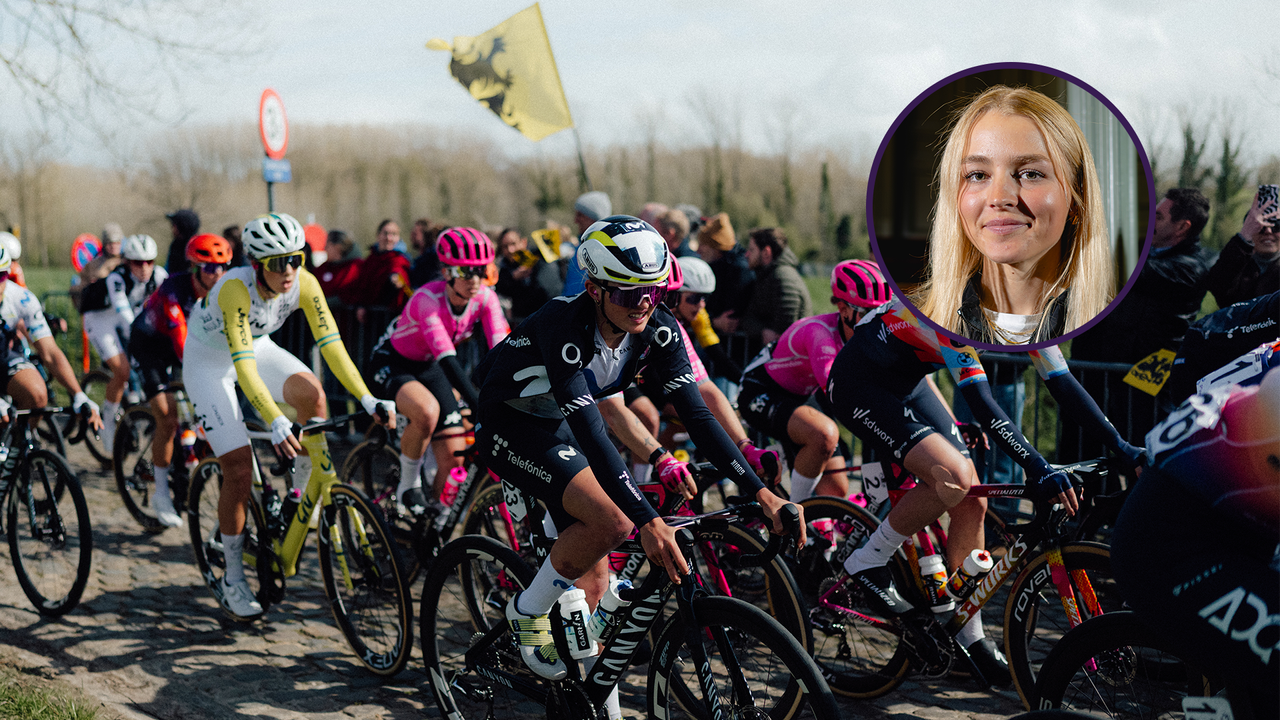
Cat Ferguson at the Tour of Flanders, with a profile picture overlayed.

I'm 19 years old, starting my second year as a professional, and just raced my second Tour of Flanders, a race that, for me, is 100% the hardest race that I've ever done and that there is on the calendar because of its history in cycling, how the women's race has evolved into the level it is today, and the fact that it has been like an unknown World Championships to my team, Movistar, and to our directors - it is the most important one-day race on the calendar.

For that reason, everyone wants to be their best, and for me, it was a brutal, brutal race. It was hard in the moments when people watching on TV don't realize how hard it is, that places that aren't as obvious: the flat roads with corners, the approach to climbs, and the positioning in the peloton. It's out of this world, and it is difficult to describe how much concentration and physical energy are involved. In a race like Flanders, it's constantly positioning followed by a climb. The climbs are short, but that only makes it so much harder because you get over the climb, and if the positioning was good, that's great, you're in the front group, but then the next climb's coming. So you can never, ever rest.

Compared to last year's edition, this year was a lot harder for me. The race split up after the Koppenberg, and last year, I got dropped there, like I did this year, but the race came back together last year, whereas this year it didn't. For my team, anyway, it was a complete disaster on the approach to the Koppenberg; Marlen Reusser crashed, and we were out of position going up the climb, one by one, not with each other at all. Over the top, I fought to try to come back with my teammate, Liane Lippert. We were in the second group, but it was just not possible, and the race was over for us after the Koppenberg, which is still very far from the finish, about 40km to go. It was still difficult, and compared to last year, there were some power records.

Flanders Classics doing it right

Beyond my personal performance, Movistar has a strong history with the race, with Annemiek van Vleuten, who has spoken a lot about the Monuments and the Tour of Flanders and has commented on the progression of women's cycling over the years. And now I'm on the same team as her, much younger and with much less on my palmares, but also talking about the same topics, which are really highlighted at Flanders; everyone is performing at their best, but it's also the time where we are more conscious of how women's cycling has progressed.

The level of the race and the strength of the field have improved, even compared to last year. I don't know if we broke a statistical record, but the level was mind-blowingly high yesterday. It plays a part in the increasing viewership of the women's Tour of Flanders. In my eyes, the level is continually improving, and more people are paying attention to us. Both things go hand in hand; they help and assist each other. It's nowhere near perfect; there are still many things we want to improve, but for example, we now have equal prize money at the Tour of Flanders. It's not the most important thing in terms of equality and sport, but it certainly is something great, and something that we can talk about and be super proud about; that it's now a thing in one of the biggest races in women's cycling.

Movistar has a strong pedigree at De Ronde (Image credit: Getty Images)

'Going up Kwaremont, I honestly couldn't even think about how painful my legs felt because it's so noisy'

Having the races on the same day is a really interesting talking point, too, and many people have different opinions. Some people think that it's great for our race, the women's race, because the fans will stay and keep watching our race, but some people also think that it's better to have them on separate days, so that the women's race doesn't feel like an afterthought.

When Paris-Roubaix was held over two days, most people made a weekend of it, rather than leaving after the men's race. But, as someone who raced Flanders yesterday, I noticed that not many people left after the men's race. Many people were on the roads supporting us. Flanders Classics' system of having both races on the same day works because of the design of the course and the fact that the people on the Kwaremont, if they come and stay there, are actually not allowed to leave until the races are over because there's no way of getting out other than the road the cyclists are using.

In that sense, as someone who hasn't done the Tour de France, the crowds at Flanders were the biggest I've ever seen. Going up Kwaremont, I honestly couldn't even think about how painful my legs felt because it's so noisy. There's too much to concentrate on when you are riding up, and fans were even leaning over the barriers holding out beers - like it was a feed zone - apparently thinking that was exactly what we needed at that moment.

It was quite a powerful race. As I was in heart rate zone 5, I was also subconsciously appreciating the support, and it felt really powerful. I'm a young rider, so someone a bit older could compare it to Flanders five years ago; fewer crowds, more crowds, but for me, as a 19-year-old, I don't know anything different. I'm still very aware that this is not the sort of normal in the women's peloton, and that I'm the lucky one because I'm racing this race, and it's the best version of this race they've ever experienced.

So Flanders Classics' strategy to improve the visibility of its women's races by running them on the same day and having the women's races finish after the men's races has been a big success. As women, we have to use the men's races to grow. The men's cycling world is already so developed, and what Flanders Classics has done by attaching us to that, at least in the beginning, to speed up the growth of women's racing initially, in my eyes, is the best way that a race organizer can help.

Eventually, though, the women's races will outgrow that approach - I think that will happen - and then Flanders Classics might come back and say they actually have to separate the two races because they could potentially make double the revenue by putting the women's race on the Saturday and the men's race on the Sunday.

What they've done so far is great, and it's appropriate for the point we're at right now. Still, I hope in the future it can grow and that they'll have to reassess their strategy because it's worked and we've got the growth we needed, the boost from the men's races, and built our own unique, and of course, crossover fan base as well. Thanks to Flanders Classics.

You can also see how modern their race organisation is through their social media. I follow them on Instagram because their content is exciting, different, and modern. You get to see more riders' personalities, which is contributing to increased followers and engagement. Showing a more personal side of riders and making cycling more fun and interesting on and off the bike are great ways to make the sport more engaging.

The crowds for the women's race were really strong and a testament to Flanders Classics' efforts (Image credit: Luc Claessen/Getty Images)

'There's something to gain by televising more of the women's race'

And that leads me to talk about another part of the race: the coverage. This year, about 100km of the women's race was filmed. The men had around 280km of the race filmed, and I remember watching the men's race before we even started racing yesterday on the bus travelling there. That's almost all of their race filmed on television, and obviously, that's 280km compared to the 160km that we do. I would argue that our race, from start to finish, is a bit more engaging and exciting because it's shorter: we get to the climbs faster, and there's less downtime before racing starts. So, there's something to gain there by televising more of the women's race. We have to keep pushing for that, but the viewers and the general cycling community need to do the same.

I think it would benefit women's cycling as a whole; the sponsors and all the partners who put the money in, but it would benefit the race, and make the race more exciting for the early breakaways to know that if they put themselves in a break from kilometre zero, then they're getting much more television time. Ultimately, that's where the biggest gap in women's cycling lies: smaller teams need more partners and sponsors to close the gap with the top tier, whereas in men's cycling, there is much less disparity.

Gratitude

After my second experience racing at the Tour of Flanders, I'd like to say thank you to all the people associated with the race; the riders for making the level so high and making everyone want to be the best versions of themselves; the race oranisers, teams and sponsors that support the teams and the race; all the people that came to watch, to be in the VIP tent, or just stood on the roadside and cheered us on.

It's a thank you for every race, because this sport is a privilege no matter the day of the week, the place, or whether you're racing the Tour of Flanders or not. These things add up to make it the most special race on the calendar and shape how women's cycling is seen at the highest level. It's the most important race to have everything at 100%.

So, although my race, personally, and from Movistar, was a disappointment, and we were not satisfied at all, I still rode the last 40km in the group, thinking about how lucky I am to be 19 in this race, riding with girls around me who I believe have contributed so much to the sport to the point where I wouldn't be next to them in the peloton at my age and riding for Movistar team without their contribution to women's cycling. Which is quite a concept to wrap your head around as a competitor when you're both grateful for the level of women's cycling while also in that very moment, at the Tour of Flanders, wishing your legs weren't quite having to be ripped off to the same level that they are.

I'm very grateful to all the women in that race who ultimately led me there and also contributed to how women's cycling has grown into what it is today.

Sign up to read this article
Read news from 100's of titles, curated specifically for you.
Already a member? Sign in here
Related Stories
Top stories on inkl right now
One subscription that gives you access to news from hundreds of sites
Already a member? Sign in here
Our Picks
Fourteen days free
Download the app
One app. One membership.
100+ trusted global sources.







