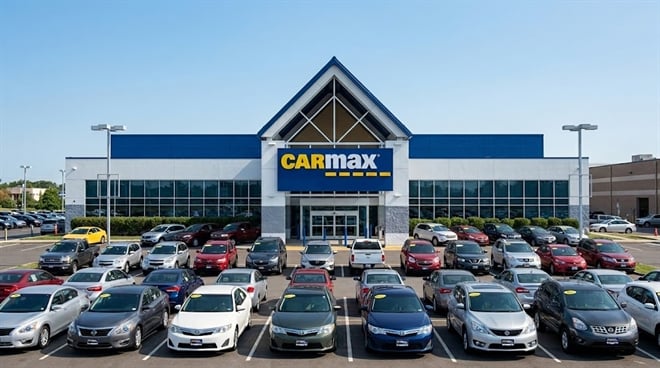
Carmax (NYSE: KMX) shares are trading near five-year lows, offering an intriguing opportunity. However, as insulated as it is from financial implosion, market forces are aligned to keep this stock from rising.
The takeaway from the fiscal Q4 20256 results and foward guidance is that business conditions are less than optimal, so bad, in fact, that management paused its share buybacks in order to preserve capital. This is a very significant detail, as the fiscal year 2025 (FY2025) buyback activity reduced the count by a high single-digit amount.

The likely outcome is that Carmax weathers the changes well and comes out ahead. The question is how long it may take and how low the stock price may go before it does.
Carmax Near Price Floor: Sell-Side Support Isn’t Firm
Technically speaking, this stock is trading near a potential price floor in early Q2 2026, aligned with COVID-19 era lows. The problem is that the 2020 activity led to a quick turnaround, while price action in 2026 languishes at low levels with nothing to invigorate buyers. Analysts, who might put a floor in the action, are unlikely to, given the guidance update and sentiment trend.

The data tracked by MarketBeat reveals a high conviction Reduce rating, based on 18 analysts, and sentiment has been deteriorating. The 2026 trend includes numerous downgrades and price target reductions, with consensus assuming fair value near the technical floor and the low end at $28. In this scenario, KMX stock can easily fall to fresh lows and then shed more than 25% before hitting bottom.
And short sellers are selling into this market. The short interest isn’t astronomically high at 10%, but it has been increasing in recent reports and would be sufficient to provide a headwind for price action. Additionally, short interest may increase, given the pause in buybacks and potential weakness in upcoming reports. The deciding factor will be the institutions. They own a significant 99% of the market, and their activity is ambiguous.
The data reflects institutional accumulation in early 2026, ahead of the Q1 release, but the trailing 12-month balance is even. Selling and buying are balanced, reflecting a market in limbo and highly susceptible to news. The risk is that the 2026 guidance and buyback activity lead them into outright distribution and send the stock price through its critical support target to fresh lows. Short-sellers are likely to lean into their trade in that scenario, adding momentum and depth to any price decline that comes.
Carmax Headwinds Build, Impair Outlook for 2026
Carmax struggled in its fiscal Q4, with margins declining amid weak demand and pricing actions. The company’s total unit sales increased by 0.7%, led by a 3% advance in Wholesale and offset by an 0.8% decline in retail. Comp units fell by nearly 2%. Total retail sales fell by more than 1%, and guidance didn’t leave the market feeling optimistic.
Margin news was also poor. The adjusted earnings per share came in above MarketBeat’s reported consensus, despite being affected by one-offs and overshadowed by weak margin guidance. The critical details are that the adjusted 34 cents in earnings was down more than 40% year over year, including the positive impact of share buybacks. Margin contraction is expected to continue.
Rising Debt and Margin Impairment Sap Enthusiasm for KMX Stock
Other bad news includes the balance sheet and debt levels. The company isn’t on the verge of bankruptcy, but 2025 activities resulted in reduced cash, increased inventory, and less equity, with leverage above target and weakness expected in the year ahead. Guidance forecasts additional cost savings from turnaround efforts, but these are offset by reduced margins and overall profitability.
Risks include a shrinking margin and the impact of intense competition. Carmax is behind the curve on its digital offerings and is struggling to gain share against operators such as Carvana. Its end-to-end digital process resonates with consumers, enabling quick, easy access to hassle-free automobile shopping. Carmax has similar features but achieves only a low double-digit percentage of 100% digital sales. Carvana (NYSE: CVNA), on the other hand, sells more of its vehicles digitally and realizes higher margins as a result.
Catalysts this year will include operational improvements linked to the new CEO. Keith Barr took over earlier this year and is expected to drive operational improvements alongside digitization. Market share gains are also possible, as smaller used-car dealers are forced to consolidate. The question is whether Carmax can capitalize on the opportunity ahead of its competitors and do it profitably. Interest rate trends may also improve, increasing consumer appetite for pre-owned cars. As it is, the market is pricing in a slow pace of rate reduction, with the next cut not priced into futures trading until sometime in 2027.
Where Should You Invest $1,000 Right Now?
Before you make your next trade, you'll want to hear this.
MarketBeat keeps track of Wall Street's top-rated and best performing research analysts and the stocks they recommend to their clients on a daily basis.
Our team has identified the five stocks that top analysts are quietly whispering to their clients to buy now before the broader market catches on... and none of the big name stocks were on the list.
They believe these five stocks are the five best companies for investors to buy now...
The article "Carmax at 5-Year Lows: Is Now The Time to Buy?" first appeared on MarketBeat.