
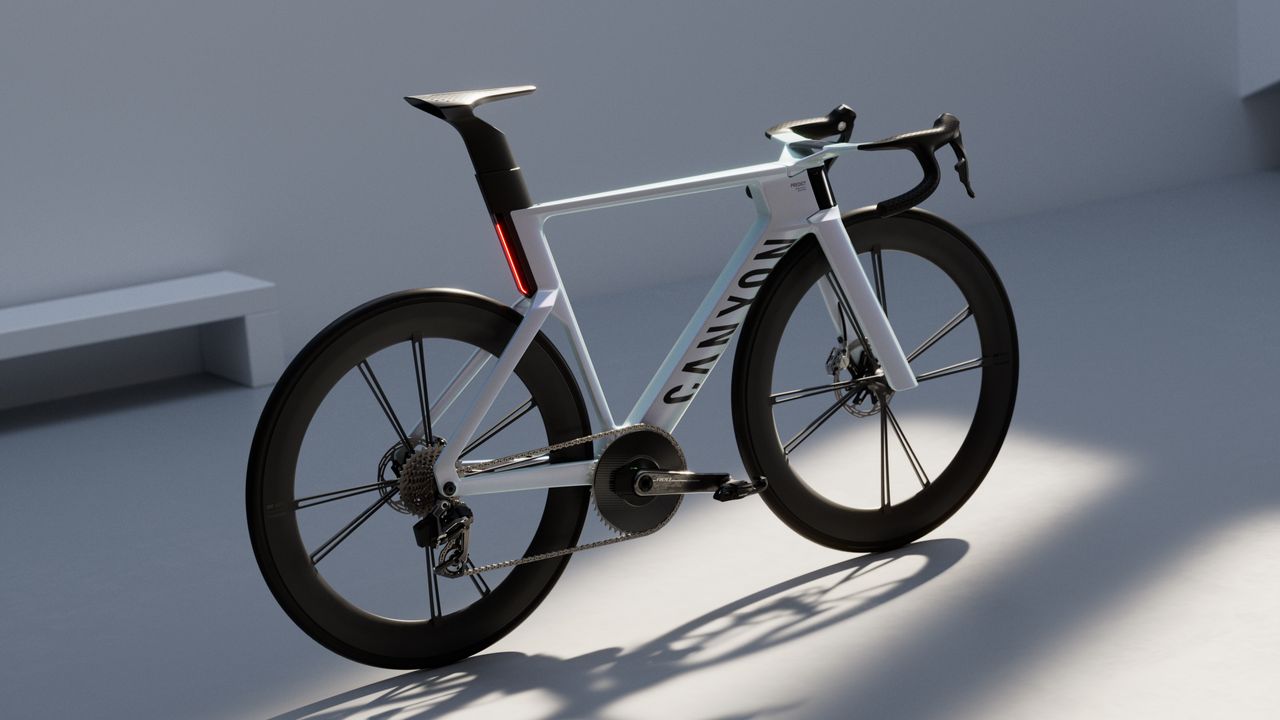
Eurobike is less than a week away, and in a move that will undoubtedly draw crowds to the Canyon booth, the German brand has unveiled a bold new collection of technologies it believes can "define the future of safety" for cyclists.
It says, "Road cycling needs a safety revolution. We are transforming safety from being reactive to being predictive."

It's called 'Canyon Predict', and it comprises a prototype bike and smart helmet that work together to analyse your surroundings and warn you of potential risks and dangers before they happen.
That includes not only the behaviour of drivers, but also other cyclists when you're riding in close quarters in a group, as well as your tyre pressure.
It will even advise on cornering speeds, and predict tricky surface conditions "before the rider notices them."
There's even a suggestion of an onboard wind tunnel being added in the future, although its 'Aero Coach' working title might be up for a lawsuit if Xavier Disley, owner of Aerocoach, catches wind (no pun intended) of it.
Predict Bike
With an aesthetic that puts me in mind of the recently launched Lego road bike, the 'Canyon Predict Bike' - as the brand is calling it - could pass as a typical aero road bike, with its deep tubes, aero gulwing-style handlebar and carbon wheels.
More notably here, however, is the integration of a '360-degree sensor array' that can "anticipate road hazards, other road users, track group-ride dynamics, advise on cornering speeds and predict tricky surface conditions."
This is comprised of an array of cameras and radars that feed into the bike's 'Cognitive Core' – or onboard computer to you and me – to be analysed. This computer has an on-device Large Vision Model AI system that combines this data with more typical ride metrics like speed, steering angle and stability, to predict potential hazards from other road users or the surface.
This is then fed back to the rider via a display integrated into the handlebars, lights built into the shifter hoods, and haptic feedback. This indicates threat severity, direction and even provides recommended actions.
Canyon promises the bike will offer both 'passive and active' safety support, with the aforementioned feedback falling squarely under 'passive'.
And although the idea has clearly been derived from the automotive industry's charge towards safety through technology, the Predict Bike stops short of actively slamming on the brakes for you in an emergency.
It will allow you to drop the seatpost for extra stability, and it will even provide progressively extreme warnings from basic haptic suggestions to visual and audible warnings if it believes you're unsafe, such as being too close to the rider – or vehicle – in front of you.
Stingr Smart helmet
Alongside the bike, Canyon has also revealed a prototype 'smart' version of its Stingr helmet with a retractable visor.
It incorporates a front and rear light, as well as a head-up display inside the visor to provide those aforementioned warnings and feedback about other road users, such as brake light activation and impending crash risk warnings.
It will also provide metrics such as speed, power and heart rate, should you be more performance-minded with your riding.
The visor itself is retractable, as mentioned, but not simply with a shove. It is motorised and retracts via the push of a button or voice command – Star Command, do you read me? – and each time it retracts, it self-cleans not too dissimilarly from the cat’s eyes you see on the road.
No smart helmet would be complete without in-built audio, and the Stingr concept meets this brief with aplomb. It offers a 'near ear' audio system for warnings, navigation, phone calls, and presumably, playing Fields of Gold on repeat. That's accompanied by a duo of noise-cancelling microphones for those aforementioned voice commands, and buttons on the outer shell that let you adjust things like volume or what's being displayed.
Also notable, but less relevant to the topic at hand, is that the helmet uses a traditional fabric strap and buckle, rather than the Highbar plastic retention system it was unveiled with.
For both the bike and the helmet, it'll be no surprise to read that you need to remember to charge them in order for them to work. The bike, Canyon says, should be good for eight hours, while the helmet has a broad eight to fifteen hour claimed range.
Tastefully, Canyon has integrated an element of renewable energy into both bike and helmet to 'top up' these figures, courtesy of a dynamo hub in the bike and a solar panel on the helmet.
How much of all of this is already functional versus simply a theoretical concept is yet to be determined. Canyon says the bike displayed at Eurobike is simply a 3D-printed prototype, but it claims to have already proven the technology can function as intended.
It estimates a market introduction in "approximately three years."