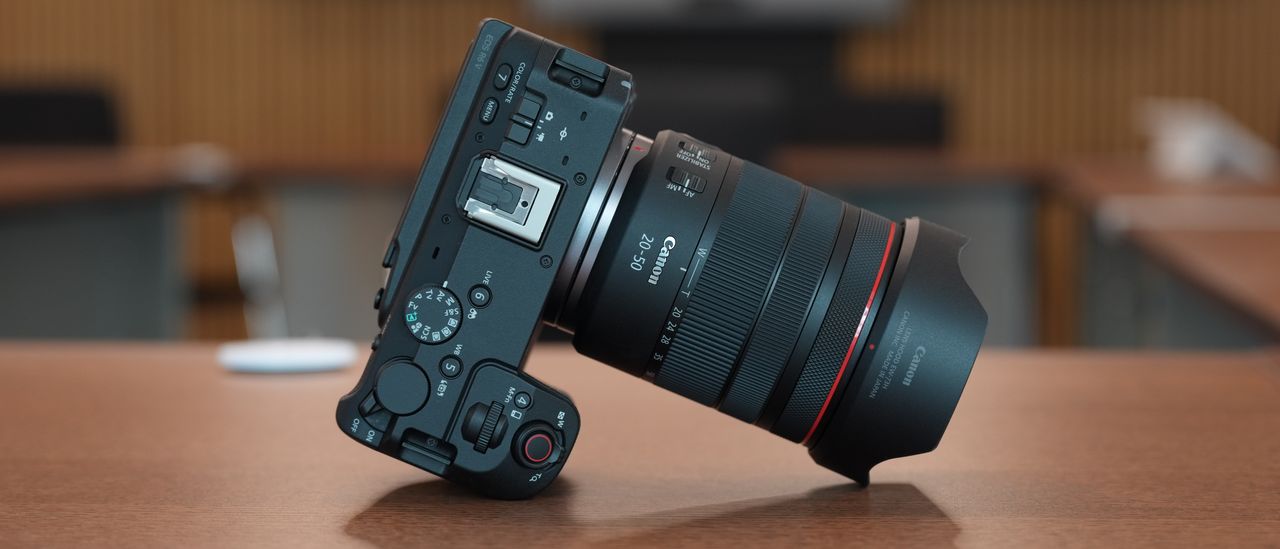
At first glance, the Canon RF 20-50mm f/4L IS USM PZ may not make anyone say "wow". But the closer you look at what this lens offers – such as being Canon's first full-frame optic with an internal power zoom – the more your jaw starts to drop.
It's no coincidence that the Canon RF 20-50mm f/4L IS USM PZ launched alongside the Canon EOS R6 V, nor that it's the lens offered in a kit with the camera. This is an optic that has been engineered for videography – particularly for cameras that support the servo zoom (which also includes the EOS R50 V and the EOS C50) and for remote shooting.

However, between features like its six stops of stabilization (eight when used with a stabilized camera body) and weather sealing, this is also an incredibly capable travel and everyday lens – especially with impressive center sharpness throughout the entire zoom range. The Canon RF 20-50mm f/4L IS USM PZ definitely deserves your respect.
A post shared by Digital Camera World (@digitalcameraworldofficial)
A photo posted by
Canon RF 20-50mm f/4L IS USM PZ: Price
The Canon RF 20-50mm f/4L IS USM PZ carries a price tag of $1,399 / £1,439 / AU$2,199. It is also available in a kit with the Canon EOS R6 V for $3,699 / £3,549 / AU$5,399.
While neither are PZ (power zoom) lenses, there are two stablemates in the RF lineup that offer comparable specs.
First is the premium Canon RF 14-35mm f/4L IS USM, which currently sells for $1,299 / £1,549 / AU$1,997, along with the budget Canon RF 24-50mm f/4.5-6.3 IS STM that retails for $349 / £359 / AU$529.
Canon RF 20-50mm f/4L IS USM PZ: Specifications
Mount options |
Canon RF / RF-S |
RF-S effective focal length |
32-80mm |
Image stabilization |
6 stops (8 stops with stabilized bodies) |
Weather sealing |
Yes |
Focus |
Manual, automatic |
Control ring |
Yes |
Aperture ring |
Yes (for video – stills only for 2024 cameras and newer) |
Lens construction |
13 elements (2 glass- molded aspherical, 3 ultra-low dispersion), 11 groups, 9 aperture blades, Air Sphere and Super Spectra Coating |
Minimum aperture |
f/22 |
Minimum focus distance |
0.24m |
Filter size |
67mm |
Dimensions |
79.9 x 98.4mm |
Weight |
420g |
Canon RF 20-50mm f/4L IS USM PZ: Design & handling
This is a premium-feeling L-series lens with trimmings worthy of that signature red ring. It's suitably chunky, though very lightweight at just 420g, and it's also beautifully balanced with an internal zoom mechanism – which will be important to the target audience that might want to use it with rigs and gimbals.
No shortcuts have been taken with the optical construction, which features ultra-low dispersion elements and glass-molded aspherical elements, along with Canon's Super Spectra and premium Air Sphere Coatings.
If you hadn't twigged by now, the "PZ" in the Canon RF 20-50mm f/4L IS USM PZ name stands for Power Zoom – and this is the company's first full-frame lens where it's integrated. That means you don't need the additional Power Zoom adapter to take advantage of the electronic servo zoom.
As such, it pairs perfectly with the EOS R6 V, R50 V and C50 – all of which have a zoom rocker switch, enabling you to zoom smoothly in and out directly from the camera body. And of course, being weather sealed, it makes an ideal all-weather companion to the R6 V and C50.
Of course, you can also zoom the lens by hand using the zoom ring. You can take advantage of the servo zoom for steady, silky pushes and pulls, or zoom manually with precision via fly-by-wire.
The power / manual zoom is toggled via a switch on the lens body, along with switches for auto / manual focus and stabilization on / off. The lens features six stops of shake compensation, which is pushed to eight stops when used in conjunction with an image-stabilized body.
Like most RF lenses, the Canon RF 20-50mm f/4L IS USM PZ has a customizable control ring on the nose – which, as a video lens, I think most people will assign to adjusting the aperture if their camera supports it.
Something small that I really appreciate is that the filter thread is 67mm. That's the same as you'll find on all the company's VCM hybrid primes (such as my personal favorite, the Canon RF 85mm f/1.4L VCM), at least one of which is likely to be in the kit bag of someone who buys this lens.
Canon RF 20-50mm f/4L IS USM PZ: Performance
I used the Canon RF 20-50mm f/4L IS USM PZ primarily on the EOS R6 V, but I also tried it with the smaller R50 V as I think it's a lens that may also appeal to owners of the APS-C body (where it becomes an equivalent 32-80mm zoom).
Indeed, whether you're using the R50 V for b-roll or you're shooting natively in a Super35 crop on a full-frame sensor, the extra reach transforms this lens from a wide-standard zoom to a standard-light tele zoom – something that's worth considering when assembling your shooting setup.
Obviously the star of the show here is the Power Zoom functionality, and if you own either of the EOS RV cameras or the C50 with built-in zoom rockers this really is a joy to use, both for handheld and remote shooting.
The beauty of a servo zoom is that you get silky smooth pushes and pulls, which adds a lot of production value and makes your footage much slicker than the herky-jerkiness of manual zooming. Though of course, you can quickly snap back to manual for when speed or precision is required.
Where the power zoom truly comes into its own, however, is when controlling your shots remotely – such as filming yourself presenting to camera, for which this lens is ideal.
The zoom on the Canon RF 20-50mm f/4L IS USM PZ can be manipulated either via Canon's Bluetooth remotes or the Camera Connect app. So whether you want to zoom in on a product you're holding up to camera, or pull out to reveal the location in which you're filming, you can do so without leaving your mark.
While the company's APS-C PZ lens, the Canon RF-S 14-30mm f/4-6.4 IS STM PZ, was limited to just a couple of zoom increments, you have much more control on the RF 20-50mm PZ – giving you greater flexibility depending on what you're shooting.
The control ring can be set to an input of your choice, so of course it's ideal for adjusting the aperture if your camera supports it, and there's a customizable button that can also be programmed to suit your needs.
There's really nothing to complain about with this lens in terms of pure performance. The autofocus is snappy and honest, focus breathing is well suppressed and the lens is nimble to use both handheld and remotely.
The only consideration is the f/4 aperture which, while constant, is obviously on the slower side. Truth be told, I don't think this is an issue for video; I'm a hopeless bokeh slut, but f/4 on a full frame camera provides ample subject separation whether you're presenting to camera or shooting b-roll (unless you want to ape Hollywood's horrible and hopefully shortlived trend of obliterating the background).
It's more of an issue if you're thinking about the Canon RF 20-50mm f/4L IS USM PZ as a photographic lens, where it's still capable, but let's be honest – this is a video optic, with its photo chops being a nice Brucie bonus for capturing a nice thumbnail or some behind-the-scenes images.
The 0.24m close focusing capability is very useful, again making this well-suited for product reviews and tutorials where you're holding things up to camera. And its lightweight 420g frame is nicely balanced, handling just as well on a gimbal as it does handheld.
Canon RF 20-50mm f/4L IS USM PZ: Samples
Canon RF 20-50mm f/4L IS USM PZ: Lab results
We run a range of lab tests under controlled conditions, using the Imatest Master testing suite. Photos of test charts are taken across the range of apertures and zooms (where available), then analyzed for sharpness, distortion and chromatic aberrations.
We use Imatest SFR (spatial frequency response) charts and analysis software to plot lens resolution at the center of the image frame, corners and mid-point distances, across the range of aperture settings and, with zoom lenses, at four different focal lengths. The tests also measure distortion and color fringing (chromatic aberration).
Sharpness:
Sharpness in the center of frame is excellent, even wide open at f/4. It's also remarkably consistent throughout the focal range. Corner sharpness isn't quite so accomplished, but it is very respectable for a zoom lens, and is also similarly consistent.
Fringing:
Fringing is well controlled at all apertures and most focal lengths. You may just notice a few aberrations in the corners of frame when shooting at 20mm.
Distortion:
As is now the norm for wide-angle Canon RF lenes, there's a heavy reliance on firmware distortion correction. With this disabled, the lens's true optical distortion is revealed: there's huge barrel distortion at 20mm, and it's still very apparent at 28mm. Only once you zoom into 35mm and beyond does lens distortion become less distracting. Enable distortion correction and all this becomes a non issue, so it's best you do just that.
Canon RF 20-50mm f/4L IS USM PZ: Verdict
There's a reason that the Canon RF 20-50mm f/4L IS USM PZ is being bundled with the EOS R6 V: if I could only have one lens to use with that camera, it would be this one.
Okay, that's a half-truth; it would be this or the Canon RF 24-105mm f/2.8L IS USM PZ. But that's a $2,999 / £3,439 / AU$5,399 lens, and you need to purchase the PZ-E2 adapter for $999 / £1,149 / AU$1,799 in order to use the power zoom function. So that's a much bigger, much more expensive proposition that's also probably much less useful for most videography.
In fact, while Canon's hybrid VCM primes are faster and have better optical bite, the Canon RF 20-50mm f/4L IS USM PZ covers 80% of the focal lengths in the range. I'd be really happy pairing this with the RF 85mm f/1.4L VCM, giving me an all-purpose zoom with a long lens for close-up work.
Equally, you could pair it with the RF 20mm f/1.4L VCM if you want fast wide-angle coverage for low-light scenes. And I think that's the beauty here: this will be your workhorse lens for video work, which you can embellish with whatever prime(s) your outfit calls for.
I love that the power zoom is integrated on the RF 20-50mm, and it's a dream to control directly from the R6 V or the R50 V (though bear in mind that this lens does feel a bit oversized on the APS-C body) or remotely via Bluetooth or Camera Connect.
While there's no doubt that it's a video optic, it's also incredibly useful as an everyday and travel lens for photography, with its standard-wide focal length and close focusing capability. Granted, between the wide zoom and f/4 aperture, you're not going to get much in the way of background blur, but for situations where you actually want to see the environment it's absolutely ideal – though there are undoubtedly better choices out there.
Still, if you're a videographer on the RF system and you're looking for the perfect complement to a couple of hybrid prime lenses, you should absolutely add the Canon RF 20-50mm f/4L IS USM PZ to your setup.