Get all your news in one place.
100's of premium titles.
One app.
Start reading
The Economic Times
The Economic Times

Canada turned discarded aluminum into submarine fuel by reacting it with water; up to 12 Type 212CD boats can use hydrogen fuel cells to remain submerged for 41 days

Canada's planned submarine fleet could eventually be connected to technology that converts discarded aluminum into hydrogen. GH Power, a Canadian company, is discussing with Germany's TKMS how its modular chemical reactor could fit into the industrial base being developed around Canada's future submarine fleet, as per a report.

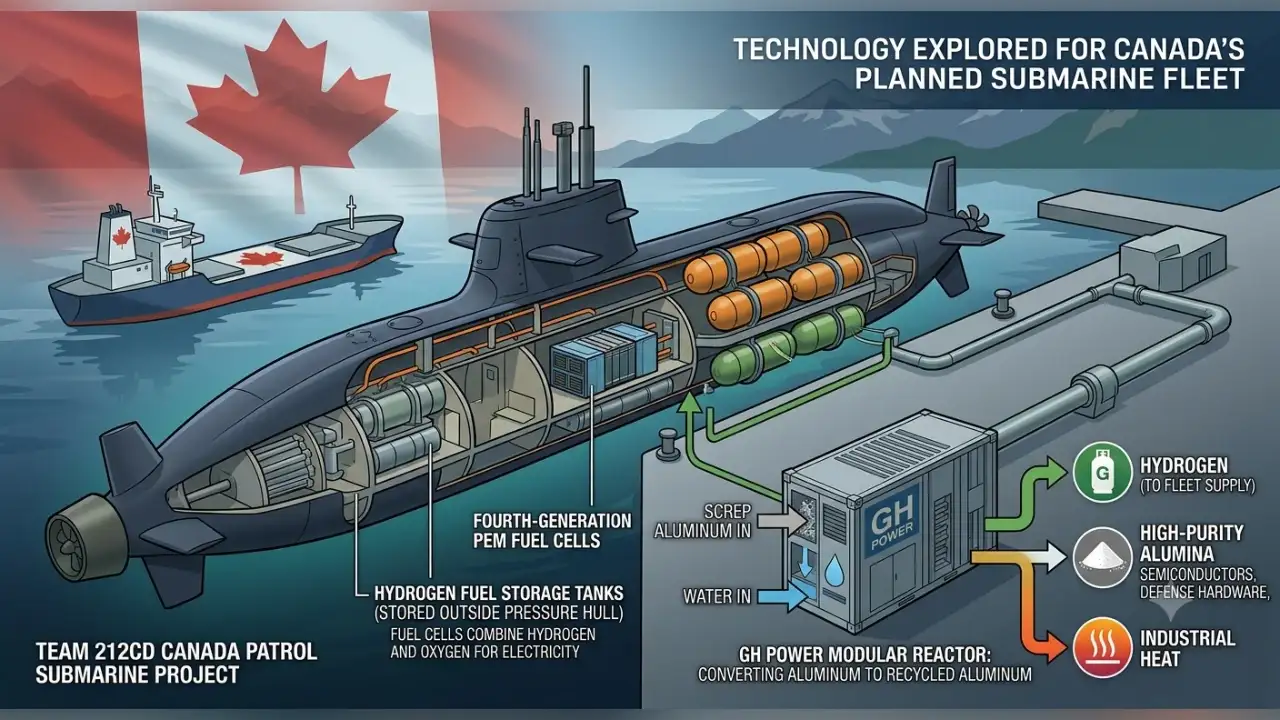
The technology uses scrap or recycled metal, mostly aluminum, together with water to produce hydrogen, high-purity alumina and heat, as per an Autonocion report. The potential connection is relevant because the Type 212CD submarines selected by Canada use hydrogen fuel cells as part of their air-independent propulsion system.

How discarded aluminum can produce hydrogen

GH Power's reactor is a modular chemical unit, not a nuclear reactor. It does not split atoms. Instead, it combines scrap or recycled metal, mostly aluminum, with water to produce three outputs: high-purity alumina, hydrogen and heat.

The alumina can be used in specialty ceramics, semiconductors, lithium-ion battery separators and defense hardware. Hydrogen is the product most relevant to the submarine discussions, while the heat can be used directly in industrial processes.

GH Power and TKMS are exploring a potential collaboration, but their memorandum is non-binding and does not commit either company to a further agreement.

READ ALSO: In the early 1930s, New York State bought 340,000 acres of abandoned farmland for trees. 26 years later, the new forests had significantly reduced runoff, with their effect stable through 1967

Type 212CD submarines use hydrogen fuel cells

The Type 212CD combines two MTU diesel engines, lithium-iron-phosphate batteries and fourth-generation PEM fuel cells. The fuel cells combine hydrogen and oxygen to generate electricity directly, with almost no moving parts and very little waste heat.

TKMS puts the submarine's submerged endurance at up to 41 days when operating at low speed, compared with about three weeks for the earlier Type 212A.

The Type 212CD is about 73 meters long and displaces roughly 2,500 tons on the surface and 2,800 tons submerged. It can travel at more than 20 knots underwater and has a crew of roughly 30.

It was developed jointly by Germany and Norway based on the Type 212A, with a larger diamond-faceted hull intended to reduce its sonar signature.

Canada plans up to 12 submarines

On July 6, Prime Minister Mark Carney announced that the TKMS-led Team 212CD had been selected as the preferred supplier for the Canadian Patrol Submarine Project, as per the Autonocion report. The plan calls for up to 12 submarines, with a reported lifecycle cost of up to CAD 100 billion.

South Korea's Hanwha Ocean and its KSS-III Batch-II design was not selected as the preferred option but remains a reserve supplier if negotiations over cost, technology transfer or industrial benefits do not succeed.

The Canadian program is subject to the country's Industrial and Technological Benefits policy, which requires a foreign prime contractor to create equivalent economic value in Canada's domestic industrial base.

TKMS has said the program could generate CAD 167 billion in total economic activity, more than CAD 86 billion in economic impact and more than 650,000 job-years over its lifetime.

READ ALSO: In 1997, NASA sent a lightning sensor into orbit aboard TRMM to study storms. 29 years later, the mission’s data still helps scientists understand lightning, rainfall and climate

GH Power's role is still unconfirmed

GH Power is among the Canadian companies exploring opportunities connected to the submarine program. The Team 212CD partner group also includes Ontario forging company Patriot Forge and Ottawa-based Kongsberg Geospatial, which has contributed more than 50,000 hours of Canadian software work to the ORCCA combat management system.

GH Power has not secured a submarine contract or a commitment to supply hydrogen to Canada's fleet. Its potential involvement is tied to the Industrial and Technological Benefits program and the development of Canada's domestic industrial base.

The hydrogen would not be made inside the submarine

The potential GH Power application would not involve producing hydrogen aboard a Type 212CD. The submarines store hydrogen as fuel and deliver it to the fuel cells as needed. Because hydrogen is highly explosive, the 212 family stores the fuel and oxidizer in tanks outside the crew's pressure hull, between the inner and outer skins, according to the Autonocion report. The fuel is then piped inward as it is consumed.

GH Power's potential application would therefore be on the supply side rather than as a propulsion system inside the submarine.

READ ALSO: In 1997, America's last bismuth refinery shut down. 29 years later, the metal is crucial to a 240-MW nuclear reactor whose coolant supply is 82% Chinese

The Type 212CD program is still developing

The first Type 212CD boats are under construction for Germany and Norway, and TKMS expects to hand over the first one in 2033.

For Canada, the first four submarines are targeted for 2034, while binding contracts are expected by the end of 2027. The potential GH Power-TKMS collaboration remains at the discussion stage. Whether the company's technology becomes part of Canada's wider submarine industrial program has yet to be determined.

Sign up to read this article
Read news from 100's of titles, curated specifically for you.
Already a member? Sign in here
Related Stories
Top stories on inkl right now
One subscription that gives you access to news from hundreds of sites
Already a member? Sign in here
Our Picks
Fourteen days free
Download the app
One app. One membership.
100+ trusted global sources.