Get all your news in one place.
100's of premium titles.
One app.
Start reading
The Independent UK
The Independent UK
Steve Fowler

Can you build an electric car factory in the middle of a city? BMW has

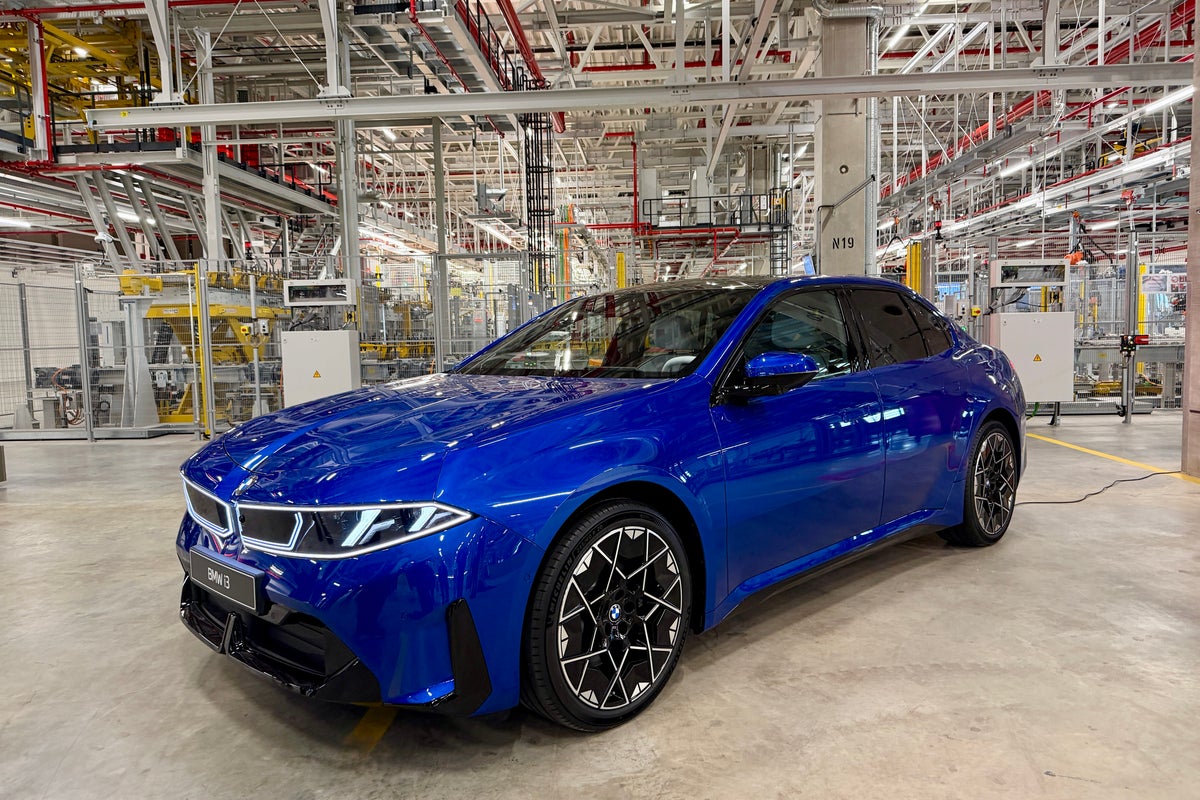
BMW's factory in the heart of Munich has been transformed to produce the new all-electric BMW i3 - (Steve Fowler)

BMW’s Munich plant has always carried a certain weight for the company. It started life in 1917 building aircraft engines, before turning to cars in 1950, and it still sits close to the iconic four-cylinder BMW headquarters that opened in 1972 as the city welcomed the Olympic Games. The Olympic Park is nearby, too.

For decades BMW Plant Munich has been home to the 3 Series, the beating heart of the BMW brand. But from 2027 the factory will transform into something new: a fully electric vehicle plant building the all-new, electric i3 – the second of BMW’s Neue Klasse models following on from the brilliant new iX3.

That factory transformation is already well under way. I was one of the first visitors to walk around the new production plant ahead of full series production of the i3 starting in August, and the scale of the change is remarkable.

Automation plays a big part in the production of the new BMW i3, with robots helping to improve quality (BMW)

BMW calls the whole philosophy the “BMW iFactory,” and Munich is now the latest and perhaps most interesting example of it. That’s because this is not a clean-sheet site on an industrial estate, but a historic factory on an existing footprint in the middle of a major city – the third largest in Germany – and it was still operating while it was being reinvented.

That challenge is part of what makes the factory so fascinating. BMW says the iFactory is about four things: efficiency, sustainability, digitalisation and people. On a brand-new site, those aims would be ambitious enough. On a tight plot in central Munich, while maintaining production, they become something else entirely.

Space is the obvious issue, so BMW has built upwards, but not too high. The body shop is upstairs, and the assembly hall, like the body shop, stretches over three floors as the second-largest of three new buildings. Cars move from the third floor of the assembly hall down to the ground floor and then out onto the test track.

The new i3 production line was added while the existing plant continued to operate, and BMW says 1,000 cars were still being built daily while the plant was transformed to a Neue Klasse factory, giving some idea of the complexity involved. Currently all variants of the 3 and 4 Series are built in Munich, but that will change when the plant goes all-electric.

BMW is investing around €650 million (£565 million) to transform the facility into a fully electric production site, with the new buildings rising on what used to be the engine plant. The Neue Klasse models have also been integrated into the existing body press and paint shops, and there is still room for expansion despite the inherently tight footprint of the city centre location.

The story has a pleasing sense of continuity, too. In 1972, the year of the Munich Olympics, two BMW 1600 2 electric models were built in this very plant, a small but telling sign of things to come. Then in 2008 came Project i and the very first Mini E, BMW’s first modern-era electric car. I can still remember driving the Mini E in Los Angeles at the LA Auto Show and talking to then California Governor Arnold Schwarzenegger about it as he and his security detail walked by. Nearly two decades on, BMW’s electric ambitions are being written into the fabric of its most historic factory.

BMW created a digital twin factory as part of a 'factoryverse' before starting work on the new factory in Munich (Steve Fowler)

Much of that reinvention happened in the digital world before a single physical change was made. Before work started on its new factories, BMW created digital twins of its plants to build what it calls a ‘factoryverse’ to plan the factories and their production.

The company sums it up neatly: “Shop floor data is the movie and engineers are the users. It’s like Netflix”. It sounds slightly odd until you see how deeply the digital thinking runs through the whole operation. This is now a paperless factory with live digital tracking of each vehicle build, and the ramp-up to production has been rehearsed in that virtual environment before being played out for real.

That may explain some of the strange calm that hung over the place during my visit. There was just the odd car, body shell or collection of parts moving around – the calm before the storm as BMW prepares for full production. But even then there was life everywhere.

The robots were practising their work as I walked around, whirring away and dancing like shadow boxers. BMW is using AI agents in the plant and is also piloting humanoid robots, while automated guided vehicles and autonomous transport systems move parts around the site. Logistics is crucial here. “We want the robots to be working all day long - as long as they have the parts,” says BMW.

Around 1,000 trucks a day make their way into the BMW factory in Munich. Fork lifts use hydrogen power (BMW)

The numbers behind that logistics effort are huge. There is storage just outside the city of Munich feeding the plant, with over 1,000 trucks bringing in two million parts daily. A four-hour stock limit on parts ensures everything arrives at the plant precisely when it’s required for production. Many of the HGVs are even named after project members, which perhaps says something about the human touch BMW is keen to retain in such an automated environment.

Automation is central to both speed and quality. BMW says welds and screws are more accurate when automated, which should mean better-built cars, while cameras assess paint quality so there are fewer issues, higher quality and greater production efficiency.

In the new body shop, 800 industrial robots handle most of the joining work, helping deliver an automation rate of around 98 per cent. There is also a broader simplification in the Neue Klasse itself: the new i3 has fewer components than the previous 3 Series, with one third fewer in the front-end assembly alone.

The robots were practising their work as I walked around, whirring away and dancing like shadow boxers Plant Munich

The efficiency gains BMW is targeting are significant. The company says the new plant brings a 10 per cent reduction in manufacturing costs and a 25 per cent reduction in cost per unit. Peter Weber, Head of BMW Group Plant Munich, says: “We have considerably reduced production costs over recent years. With the start of production of the BMW i3, we will reduce overall production costs at the Munich plant by a further 10 per cent, bringing them below the level of the current vehicle generation.”

BMW says there is also enough flexibility in the system that “production follows the market” – an increasingly important point at a time when demand can shift quickly between models and powertrains.

This is not just about speed, cost and automation, though. Munich is also meant to stand as a test case for making urban car production more sustainable. BMW is trying to do all it can within the limits of an existing city-centre site, including solar panels and a living roof on top of the buildings.

Some of the robots are partly powered by the solar panels on the roof, while warm water generated from their movement is used to help heat the building in winter. Scrap metal recovery is another focus, with 99 per cent of any scrap metal produced during manufacturing being reused.

Automated vehicles carry parts around the factory and are named after team members (BMW)

Even some of the industrial vehicles reflect a different approach. The forklifts used in the factory are hydrogen powered. Why hydrogen rather than electric? BMW’s answer is simple: it is quicker to refuel them and keep them working.

There is also a wider regional story around the plant. A new battery gigafactory in Bavaria will help keep production local and transport to a minimum. BMW’s new high-voltage battery assembly plant at Irlbach-Straßkirchen, around 90 minutes away, will supply Gen6 batteries for the Munich-built i3, while the electric motor will come from BMW’s Steyr plant in Austria. It is part of a local-for-local approach, albeit within a much bigger international business.

That matters because BMW is also using Munich to make a point about Europe’s industrial future. Speaking at the plant, incoming BMW chairman Milan Nedeljković said: “Our business model is based on global free trade. Currently, this fundamental economic concept is coming under pressure. We in Europe must be careful not to fall behind. In our view, the current proposal for the Industrial Accelerator Act is not helpful in this regard.

“It focuses on ‘Made in Europe’ while neglecting the supply chains of European corporations operating globally. This will lead to less innovation, lower growth – and finally to reduced prosperity in Europe – a development which is dangerous.”

Incoming BMW Chairman Milan Nedeljković (left) with Munich plant boss Peter Weber at BMW Group Plant Munich (BMW)

Nedeljković added: “Europe needs to act more future-oriented by strengthening free trade – and creating a positive business environment. We are convinced: Europe needs a strong industrial footprint. Since industry is the basis for applied science and innovation. And we are part of it.”

That industrial footprint is still substantial in Munich. More than 7,000 people are employed at BMW Group Plant Munich across all areas, and BMW is keen to stress that the iFactory is as much about people as machines. Workers have had more training, especially around digital processes, while new ergonomic workstations have been introduced to make jobs easier. BMW calls the new plant an innovation hub with cross-functional teams, and there is clearly no appetite for going backwards. There is, as one executive put it, “no way back to manual processes for BMW”.

When production gets fully up to speed, one car will roll off the line every 73.5 seconds. It takes 30 hours to build a BMW i3 in total, including nine hours in the assembly hall. Several Neue Klasse models will eventually be built here, including the BMW i3 Touring.

When you step back from the detail, that may be the biggest point of all. One in four German-built cars in Germany is a BMW, and in the middle of Munich the company is trying to prove that the future of car manufacturing does not have to be on a distant greenfield site. It can still sit in the heart of a city, surrounded by history and reinvented for the electric age.

Sign up to read this article
Read news from 100's of titles, curated specifically for you.
Already a member? Sign in here
Related Stories
Top stories on inkl right now
Our Picks
Fourteen days free
Download the app
One app. One membership.
100+ trusted global sources.