Get all your news in one place.
100’s of premium titles.
One app.
Start reading
The Guardian - UK
The Guardian - UK
World
Tom Phillips Latin America correspondent

Can Venezuela’s Delcy Rodríguez become a Latin American Deng Xiaoping?

Children waving the flags of China and Venezuela
Venezuelan children wave flags as they welcome China’s Xi Jinping at Simón Bolívar airport in Caracas in 2014 Photograph: Jorge Silva/Reuters

After years of political and social upheaval, hunger and despair, the Great Helmsman departs and is replaced by a francophile economic reformer who catapults a traumatised country into a new era of prosperity and growth.

That is what happened in China half a century ago when the croissant-loving communist Deng Xiaoping became paramount leader after Chairman Mao Zedong’s 1976 death and set in motion one of history’s biggest economic booms.
Some believe it might also turn out to be an apt description of the situation in today’s Venezuela after its “Gran Timonel”, Nicolás Maduro, was toppled and replaced by his Sorbonne-educated vice-president, Delcy Rodríguez.

In her first address after filling the dictator’s shoes, Rodríguez hinted at plans to launch her own period of “reform and opening up” – just as Deng did after a heart attack ended Mao’s life and his catastrophic 1966-1976 Cultural Revolution.

“Where Chavismo has had to rectify [itself], it does so,” Rodríguez said in a speech with echoes of Deng’s 1978 plea for Chinese communists to “emancipate their minds” after that decade of bloodshed and upheaval.

Declaring the start of a “new chapter” in Venezuela, Rodríguez called for revamped oil laws to help foreign firms access the world’s largest proven reserves and pledged closer ties with Washington, despite its “kidnapping” of Maduro.

“Venezuela has the right to relations with China, with Russia, with Cuba, with Iran … and with the United States,” said Maduro’s substitute, who some have started calling “Delxiaoping”.

Critics see efforts to portray Rodríguez as a Latina Deng as a spin campaign to obscure her role in helping Maduro wreck Venezuela’s democracy and her responsibility for the feared intelligence agency, Sebin, while vice-president.

They’re trying to make her more palatable. Delcy is now going through a face wash,” said Andrés Izarra, an exiled former minister under Maduro and his mentor, Hugo Chávez.

But sinologists say they understand why leaders of the United Socialist party of Venezuela might look to the Communist party of China for inspiration as they seek to leave behind years of social and economic chaos – without losing political control.

“The Deng Xiaoping reform era is a very interesting model for Venezuela,” said Orville Schell, the Arthur Ross director of the Center on US-China Relations at Asia Society in New York. “They need to open up to the outside world and get the economy going … If she [Rodríguez] has brains, she will economically reform because, my God, she’s got to get their oil industry back pumping and irrigating her government with some funds.”

Venezuela’s interim leader is soon expected to make an official visit to the US – the first by a Venezuelan president in more than 25 years – although it seems unlikely she will appear at a Texas rodeo sporting a 10-gallon cowboy hat, as Deng did in 1979 to signal Beijing’s desire to engage with the world.

But China’s authoritarian experience suggests anyone expecting a political thaw to accompany economic reform in Venezuela will be bitterly disappointed.

Schell recalled how Deng briefly flirted with political reforms in the 80s.

“There were village elections – even some higher-level county elections were allowed … Publishing bloomed. Media suddenly opened up. Universities were much freer and there was almost nothing you couldn’t talk about,” he said.

But deep down, Deng remained wedded to his “four cardinal principles” philosophy that insisted the party’s “dictatorship of the proletariat” could not be challenged. “The fundamental structure of the polity did not change,” Schell said.

Any hope of democratic change evaporated in June 1989 when Deng ordered troops to clear protesters from Tiananmen Square. Hundreds, possibly thousands, of people were killed.

Schell also said he suspected Venezuela’s current leaders would be reluctant to cede power and predicted Rodríguez – who didn’t seem “a Jeffersonian Democrat” – would “go very cautiouslywhen it came to political reform. “They are the elite, and they do not want to give up their privileges … a bit like the Chinese Communist party. They did not want to give up theirs either and migrate into a multiparty [system], where they had to actually compete politically.”

“Venezuela is not China, but autocracies do have some common chords,” Schell added.

Maduro’s heirs have shown clear signs of wanting to follow in the footsteps of Deng, whose economic pragmatism was captured by the phrase: “It doesn’t matter whether a cat is black or white, as long as it catches mice.”

Long before Maduro’s abduction, he and his close allies repeatedly visited China to understand how it became the world’s second largest economy and helped millions lift themselves from poverty after decades of famine and violent political extremism.

During a 2023 trip to Shanghai, one prominent Maduro envoy, Rafael Lacava, told his hosts: “From the economic point of view we are in a transition and this transition looks to the Chinese model … We strongly believe that this is the model we need to follow in the coming years.”

Those visits resulted in the creation of five special economic zones in Venezuela, inspired by the areas Deng set up to attract foreign investment in south-east China in the 1980s.

Phil Gunson, an analyst in Caracas for the International Crisis Group, said Chavista intellectuals had been pondering the need for Deng-style change for several years. Rodríguez, who was put in charge of Venezuela’s oil industry and economy after becoming vice president in 2018, was one of the key proponents of such thinking, alongside her brother, Jorge.

“They have been seeking controlled economic reform for a while,” Gunson said, noting how Rodríguez oversaw a modest economic recovery by partly dollarising the economy and courting business leaders and foreign investors. She has travelled frequently to China since becoming Maduro’s foreign minister in 2014.

A central goal now was reviving Venezuela’s decrepit oil industry by reversing Chávez’s 2007 nationalisation in order to attract tens of billions of dollars of foreign investment. “It was one thing to shut out foreign firms at the height of a commodities boom … while oil was $120 a barrel. But now it’s less than half that and there’s a desperate need for inward foreign investment because [state oil company] PDVSA simply cannot revive the oil industry on its own,” Gunson said.

Ricardo Hausmann, a Venezuelan economist and former minister who runs Harvard’s Growth Lab, said it was possible a China-style economic opening was the “gameplan” of Rodríguez’s new regime, which Donald Trump has unexpectedly backed while sidelining the opposition movement led by the Nobel peace laureate María Corina Machado.

But Hausmann said he believed such an effort would fail, doubting foreign investors and oil companies would risk their money in a place ExxonMobil’s CEO recently called “uninvestable”.

If the strategy does succeed, the long-term consequences for Venezuelan democracy could be dire.

Frank Dikötter, the author of several books about China, said the heirs of the Great Helmsman had used the “socialist modernity” pioneered by Deng to “build up an economy which has given them enough clout to enforce and enhance limits on democracy … with much greater controls on every aspect of life.”

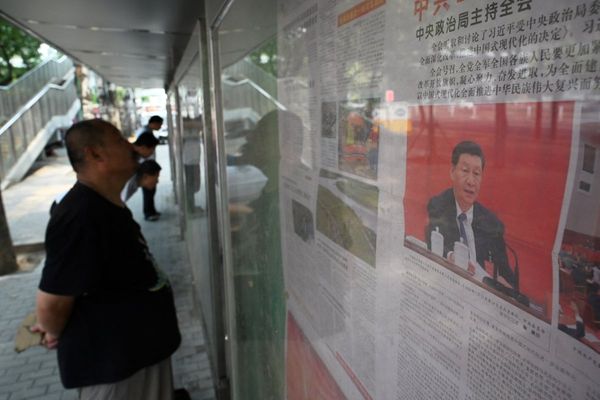
Today, under Xi Jinping, China’s most powerful leader since Mao, the east-Asian country is the world’s No 2 economy, but also its largest and most sophisticated surveillance state.

Schell said he suspected Trump had decided to ditch Machado because he felt comfortable with Venezuela becoming an economically prosperous autocracy, so long as it obeyed Washington. “That’s why he didn’t bring Machado back. He doesn’t want someone with a Nobel prize and a lot of woolly ideas about democracy.”

Sign up to read this article
Read news from 100’s of titles, curated specifically for you.
Already a member? Sign in here
Related Stories
Top stories on inkl right now
One subscription that gives you access to news from hundreds of sites
Already a member? Sign in here
Our Picks
Fourteen days free
Download the app
One app. One membership.
100+ trusted global sources.