
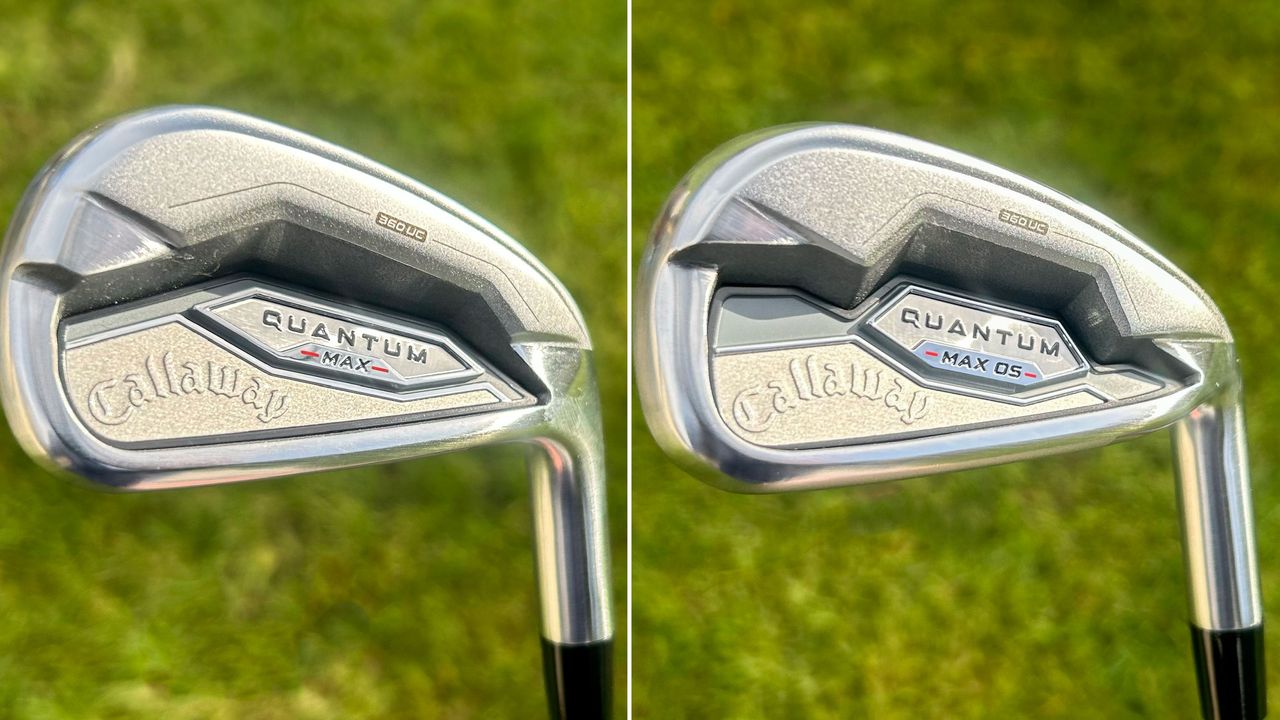
Callaway is a perennial heavyweight when it comes to the best game-improvement irons, and the new Quantum Max and Max OS look ready to fight for that title again. With a clear focus on making the game easier, these two models leverage high-tech construction, hoping to deliver exceptional speed and forgiveness.
While the previous Elyte irons were, in my opinion, a visual masterpiece, they perhaps alienated the core golfer who needed more help. I’ve been testing both new Quantum models side-by-side to see if Callaway has successfully recalibrated its offering to provide the perfect blend of performance and approachability.


The Quantum Max and Max OS share a core technology suite designed for speed. Both feature Callaway’s 360° undercut cavity, a two-piece design with extreme perimeter weighting to maximize forgiveness.
This is paired with a next-generation AI-optimized face, which intelligently shapes the hitting area in an attempt to match real-world impact patterns and boost ball speed and consistency, while the ‘Tri-Sole Design’ aims to ensure clean turf interaction, adapting from long irons to wedges.


In terms of looks, I like the clean, modern aesthetic of the Quantum range. I definitely preferred the visual of the Elyte irons last year, which were stunningly sophisticated. However, that may have been the problem with that iron.
Having spoken to some people at Callaway, an issue they felt was that the Elyte iron almost looked too good! Being as sophisticated as it was, they felt that it actually potentially alienated and intimidated some of the target audience. Better players like me loved the look, but it didn't matter because we'd never play this type of iron!
The Quantum models correct this, looking premium but purposeful and inviting.


The distinction between the two is clear: the Max is essentially 'game improvement,' with a refined shape, while the Max OS sits firmly in the 'Super Game Improvement' category with its slightly wider sole, more offset, and a thicker topline.
I would ordinarily do two separate reviews for these irons, but I found the performance characteristics and data (gathered on my Foresight Sports GC3 launch monitor) so similar that it only warranted one combined review.
Genuinely, the only difference I could find was the larger visual of the OS version potentially inspiring a little more confidence for the higher handicap player, which is no bad thing.

The data, despite being basically identical for me between the Max and Max OS, was still very impressive in terms of ball speed output and carry distance. Both irons are very powerful.
It is worth noting that both have relatively strong lofts (the 7-irons sit at 29°). However, for players who struggle to get the ball airborne, both models can be ordered in a HL (High Launch) specification, which affords you another 2° of loft throughout the set (taking the 7-iron to 31°). This will be an appealing option for many, maximizing carry at moderate swing speeds.


If you enjoy robust and lively feels, then these irons will be right up your street. The inclusion of urethane microspheres does a good job of dampening harsh vibrations, but these irons still offer a very powerful, explosive sensation at impact. There are certainly softer irons on the market in this category, but those who prefer clearer, more direct feedback will certainly enjoy these.
Overall, the Callaway Quantum Max and Max OS are very strong performing irons offering exactly what you would expect from a market leader.
They prioritize forgiveness and power in a package that is easy to hit and easy to look at. While they might lack the "wow" factor of the Elyte's design, they are arguably better suited to the job at hand: helping golfers hit better shots, more often.
Both the Quantum Max and Quantum Max OS models will set you back £167/$164 per club or $1149.99 for a 7-piece set.