Get all your news in one place.
100's of premium titles.
One app.
Start reading
Tom’s Hardware
Tom’s Hardware
Technology
Mark Tyson

California scientists 'FlyTrap attack' on DJI drones demonstrated — patterned umbrellas lure autonomous drones close enough to be captured or even induced to crash

The FlyTrap attack.

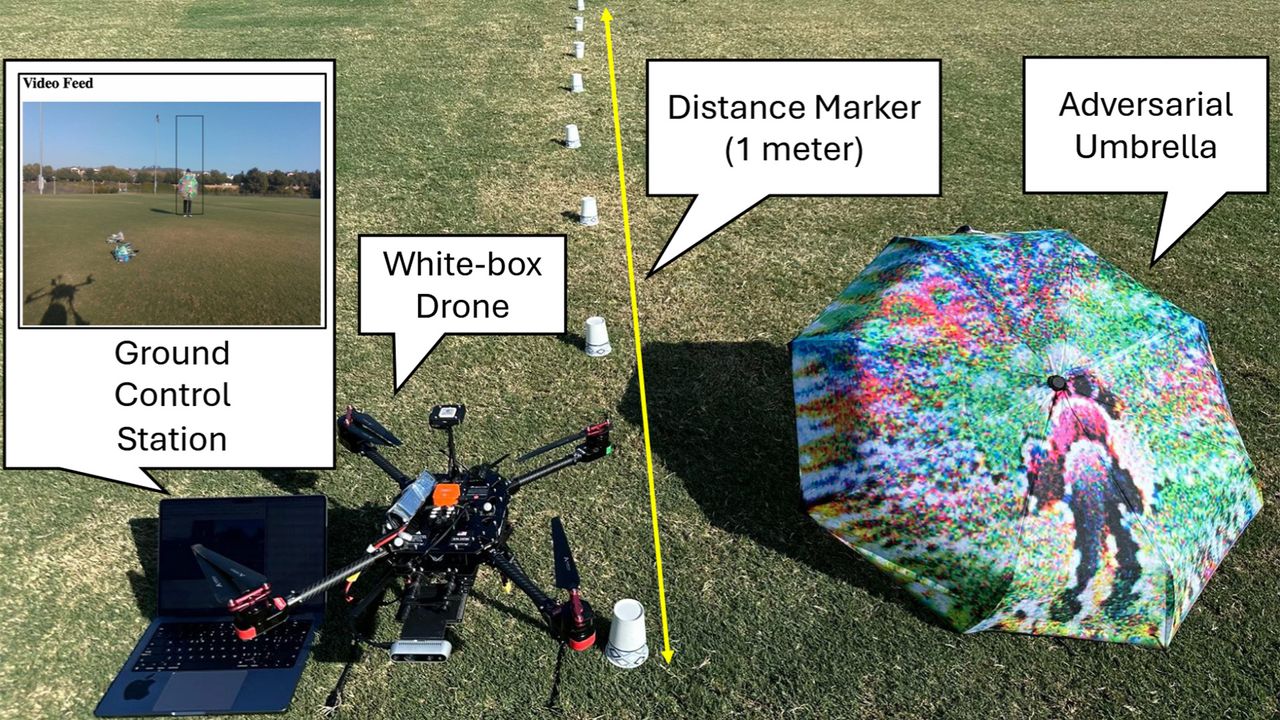
Researchers at the University of California, Irvine (UC Irvine) have developed a drone capture and crash-inducing device. The FlyTrap attack uses special patterns to exploit deficiencies in Autonomous Target Tracking (ATT), often referred to as Active Track, Motion Track, or Dynamic Track. FlyTrap patterns can be easily carried around and deployed by anyone, as the researchers printed them on “adversarial umbrellas.” In essence, this seems like a deliciously lo-fi counter to a hi-tech hazard. Umbrellas are also useful if it rains, or for portable shade.

The FlyTrap attack was demonstrated in the field, literally, by one of the researchers in the video above. A specially formulated AI-generated pattern is displayed by opening an umbrella after a drone locks on to track the person in the field. Specifically, the visual pattern performs a next-gen physical distance pulling (PDP) attack that works across multiple angles, even in motion, and in the real-world. This demo works on three commercial drones that were tested, the DJI Mini 4 Pro, the DJI Neo and the HoverAir X1.

The umbrella-printed visual physically draws victim drones closer as its neural network tracking systems interpret the pattern to be the subject moving further away. As the drone approaches the umbrella, the pattern causes the targeting bounding box to continue shrinking - so the drone moves to get closer. Autonomous drones lured by the pattern can then easily be ensnared using a net gun, or further induced to crash to Earth.

The research shows that FlyTrap is significantly more effective than prior adversarial‑ML techniques like older PDP tech and Targeted Gradient Transfer (TGT).

“Autonomous target tracking represents both tremendous potential and significant risk,” said paper co-author Alfred Chen, UC Irvine assistant professor of computer science. Chen reminds us that autonomous drones are used in areas like border patrol and public safety, but also by malicious actors.

Lead author, Shaoyuan Xie, a UC Irvine graduate student researcher in computer science added that “Our findings highlight urgent needs for security improvements in [autonomous target-tracking] systems before wider deployment in critical infrastructure."

It would be fascinating to see or hear about FlyTrap being used in the real-world. However, both DJI and HoverAir have been responsibly notified about the neural processing vulnerabilities in their autonomous tracking systems.

Sign up to read this article
Read news from 100's of titles, curated specifically for you.
Already a member? Sign in here
Related Stories
Top stories on inkl right now
One subscription that gives you access to news from hundreds of sites
Already a member? Sign in here
Our Picks
Fourteen days free
Download the app
One app. One membership.
100+ trusted global sources.