Under the Supreme Court's 2022 ruling in New York State Rifle & Pistol Association v. Bruen, a law that restricts conduct covered by the "plain text" of the Second Amendment is constitutional only if the government can show it is "consistent with this Nation's historical tradition of firearm regulation." In trying to meet that test, government lawyers frequently cite 19th-century state laws that prohibited people from carrying concealed firearms.
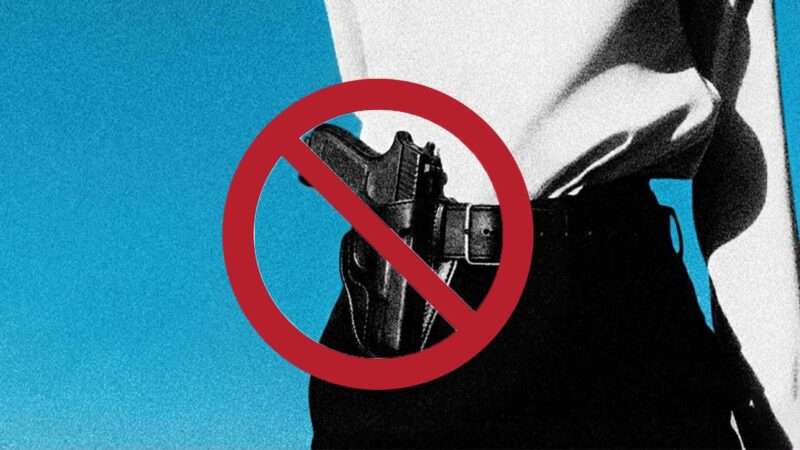
It is therefore not surprising that California relied on those laws in defending its ban on openly carrying guns, which applies in urban counties that include 95 percent of the state's population. But as the U.S. Court of Appeals for the 9th Circuit recognized in ruling against that policy on Friday, those precedents undermine California's case instead of reinforcing it. The laws cited by California preserved the right to openly carry guns, which state courts said was clearly protected by the Second Amendment.
"For most of American history, open carry has been the default manner of lawful carry for firearms," Judge Lawrence VanDyke writes in Baird v. Bonta. "The historical record makes unmistakably plain that open carry is part of this Nation's history and tradition. It was clearly protected at the time of the Founding and at the time of the adoption of the Fourteenth Amendment. There is no record of any law restricting open carry at the Founding, let alone a distinctly similar historical regulation. California's failure to satisfy its burden to present evidence of a relevant historical tradition of firearm regulation is dispositive with respect to California's urban open-carry ban."
For the first 162 years of the state's history, VanDyke notes, "open carry was a largely unremarkable part of daily life in California." That changed in 1967, when state legislators approved the Mulford Act, which banned open carry of loaded firearms without a permit. The Mulford Act was "tainted with racial animus," VanDyke argues, noting that it was "passed during a period of significant racial unrest" in response to "the Black Panther Party's activities, which included openly carrying firearms to protest police behavior in African-American communities." Those activities, as I detail in my new book Beyond Control, also included an armed protest at the state Capitol, which clinched passage of the Mulford Act.
In 2011, California legislators expanded the ban on open carry to include unloaded firearms. At that point, VanDyke notes, "California joined a tiny minority of states" that had "adopted such severe restrictions on open carry." California is "the only state in the Ninth Circuit that has entirely banned open carry for the overwhelming majority of its citizens."
While that law notionally allows residents of counties with 200,000 or fewer people to openly carry guns in those jurisdictions, it requires them to obtain licenses for that purpose, and no such licenses have ever been issued. In 2019, Mark Baird, a resident of Siskiyou County, which is theoretically exempt from the open-carry ban because of its small population (about 44,000 as of the 2020 census), challenged both aspects of the policy.
All three members of the 9th Circuit panel agreed that Baird, who sued California Attorney General Rob Bonta, could not challenge Siskiyou County's refusal to issue open-carry licenses because he had failed to name any local licensing authorities as defendants. But VanDyke, joined by Judge Kenneth K. Lee, agreed with Baird that the ban on open carry in urban counties violates the Second Amendment.
Judge N. Randy Smith dissented from that conclusion, saying California is free to prohibit open carry as long as it permits concealed carry. "Bruen controls this case," Smith writes. "The Supreme Court held that New York—which banned open carry—could not constitutionally require proper cause for a concealed carry license because 'history reveals a consensus that States could not ban public carry altogether.' California does not 'ban public carry altogether.' Californians may publicly carry in a concealed manner throughout the state and in an open manner in less populated counties. California's restrictions on open carry in more populated counties are thus constitutional."
The majority takes issue with that understanding of Bruen. "We wholeheartedly agree with the dissent that Bruen expressly forbids States from 'ban[ning] public carry altogether,'" VanDyke writes. "Where we apparently disagree is that we do not read that statement as somehow meaning the opposite—that so long as a state does not 'ban public carry altogether,' it can do whatever else it wants without violating the Second Amendment. Respectfully, that is not only a basic logical error, but also obviously a wrong way to interpret language in Supreme Court opinions. If the Supreme Court said, 'States cannot ban speech altogether,' nobody would think it was also implicitly saying that as long as the state allows some speech, it necessarily can ban all other speech."
That implausible reading of Bruen, VanDyke says, cannot obviate the need to examine the relevant historical evidence. As of the Second Amendment's ratification in 1789, he notes, quoting a 2014 Yale Law Journal article, "there were no direct statutory bans on the carry of arms." The absence of such laws, VanDyke writes, "is particularly conspicuous because the founding generation was clearly aware of the dangers of gun violence, and states enacted a variety of regulations addressing the lawful use of firearms."
While several states subsequently enacted concealed-carry bans, VanDyke says, "open carry and concealed carry have never been treated as fungible under the Second Amendment." To the contrary: "Between 1822 and 1850, no fewer than six state high courts considered the scope of the right to carry firearms for self-defense and explicitly found constitutional significance in the distinction between open and concealed carry."
Although Americans nowadays may perceive open carry as especially alarming, the attitude expressed in the laws at issue in those cases was diametrically different. State legislators viewed concealed carry as sneaky, dishonorable, and inherently suspect, preferring open carry as the proper way to exercise the right to armed self-defense. The decisions dealing with those laws reflected that distinction.
Upholding a state ban on concealed carry in 1850, for example, the Louisiana Supreme Court noted that the law "interfered with no man's right to carry arms (to use its words) 'in full open view,' which places men upon an equality." That mode of self-defense, the court said, "is the right guaranteed by the Constitution of the United States, and which is calculated to incite men to a manly and noble defence of themselves, if necessary, and of their country, without any tendency to secret advantages and unmanly assassinations."
That court and the others "were not just indulging consequentialist reasoning in finding that open carry was protected while concealed carry was not," VanDyke notes. "They explicitly rejected the argument that the two kinds of carry were interchangeable, and they explicitly premised their conclusion on the ground that the right to carry arms 'in full open view' is 'guaranteed by the Constitution of the United States.'"
VanDyke agreed that Baird had missed his opportunity to challenge California's apparent refusal to approve even the open-carry licenses that are theoretically available in rural counties. But he joined a concurrence in which Lee highlights "how California has apparently resorted to subterfuge to deny its citizens their Second Amendment rights." Although "California insists that citizens in counties with populations fewer than 200,000 people can apply for an open-carry license," Lee notes, the state "admits that it has no record of even one open-carry license being issued."
One reason for that puzzling record, Lee suggests, is that "California has misled its citizens about how to apply for an open-carry license." Counterintuitively, the 17-page application required for such a license repeatedly refers to "concealed" weapons. "Most Californians would reasonably think that this form is used only for a concealed carry weapon permit," Lee writes. "But they would be mistaken." Most Californians "would have no clue" that they need to complete this form if they want to openly carry a firearm, and "that appears to be the very point," he says. "California tries to hide the fact that citizens in those counties have a right to open carry their weapon under the law."
The 9th Circuit's broader vindication of that right probably will not last. Kostas Moros, director of legal research and education at the Second Amendment Foundation, praised the ruling on X but predicted "with near certainty" that it will be reversed after the case is reheard by an 11-judge en banc panel.
VanDyke and Lee were nominated by President Donald Trump, while Smith was appointed by George W. Bush. But 16 of the 9th Circuit's 29 judges were nominated by Democratic presidents, and the appeals court historically has been keen to uphold gun control laws. It is "hard to see how the Ninth Circuit would ever let this ruling stand as it would allow open carry in California," Moros said.
Charles Nichols, a Second Amendment activist who back in 2011 filed the first lawsuit challenging California's open-carry ban, is similarly pessimistic. "On those rare occasions when a Second Amendment challenge wins before a three-judge panel," he notes, "the decision is vacated and reheard before an en banc panel of eleven judges, where the Second Amendment challenge loses."
The post California's Ban on Openly Carrying Guns Is Unconstitutional, 9th Circuit Says appeared first on Reason.com.