
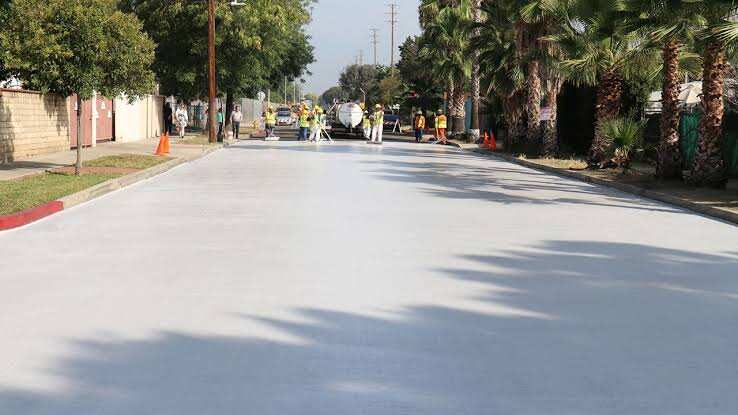
Urban centres around the world are looking for ways to cope with rising temperatures as heat waves become more frequent and prolonged. One possible solution may seem obvious, but it could still have significant effects. An experiment in California suggests that roads could help reduce rising temperatures, although the effects are more complex than they first appear.
Get breaking news anytime, anywhere. Download the TOI app now!

According to a peer-reviewed study by researchers at the University of Southern California and Columbia University, published in Environmental Research Letters , a solar-reflective coating reduced road-surface temperatures by up to 5°C. At the same time, the air temperature changed by just 0.2°C.
What are cool pavements?
Ordinary asphalt streets are usually dark, so they absorb more sunlight and retain heat throughout the day. An urban heat island occurs when a city becomes warmer than the surrounding countryside because buildings, streets and other surfaces absorb and retain heat.
According to the US Environmental Protection Agency , the daytime temperature of urban areas can be considerably higher than that of surrounding territories, whereas night-time temperature can also be increased as streets and buildings release retained heat.
Cool pavements work differently from ordinary asphalt. These streets are coated with special materials that increase the surface’s ability to reflect incoming solar radiation, a property known as albedo.
An experimental approach in California
While many other studies used simulation approaches in computer models, this study tested the effect of cool pavements through an experiment in a real residential area.
Temperature and reflectance measurements were taken by stationary and mobile devices before and after cool pavement installation. Increasing pavement reflectance from 0.08 to 0.26 reduced average afternoon surface temperatures by as much as 5°C. Morning average surface temperatures fell by 0.9°C. Air temperature near the ground fell by about 0.2°C during midday and evening.
The effects might not be perpetual
The research also examined how well the reflective coating would perform over the long term. According to the study, traffic, pollution and weathering caused the coating's reflectance to decline by 30 percent after one year. That reduced the coating’s cooling capacity.
The researchers found that due to aging, there was a decline of around 1.7°C in the cooling ability of the pavement. Heavy rain temporarily increased the coating’s cooling ability by washing away accumulated dirt.
It does not mean that cooler roads lead to cooler cities
Although road-surface temperatures fell, the researchers warned that cool pavements alone will not stop a city from overheating. Reflective road surfaces can also reflect more sunlight onto nearby surroundings. That means the pavement absorbs less heat, but in some conditions it may increase exposure to solar radiation.
According to the study, more research is needed to understand how cool pavements affect thermal comfort for people walking on streets. In their conclusion, the authors say cool pavements are only one tool for combating extreme heat and should be used alongside trees, green space and shade.






