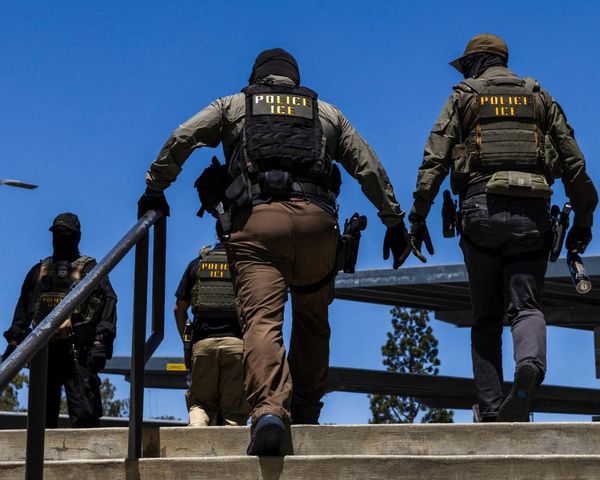
An excerpt from yesterday's decision in U.S. v. California, by Judge Mark Bennett, joined by Judges Jacqueline Nguyen and Daniel Collins:
[T]he United States seeks an injunction pending appeal that enjoins … enforc[ement of] § 10 of the [California] No Vigilantes Act … against federal agencies and officers. Section 10 requires any non-uniformed "federal law enforcement officer" operating in California, with narrow exceptions, to "visibly display identification" while performing federal law enforcement duties. Officers who violate the law may be criminally prosecuted by the State….
We conclude that § 10 of the No Vigilantes Act attempts to directly regulate the United States in its performance of governmental functions. The Supremacy Clause forbids the State from enforcing such legislation….
When "[t]he Framers split the atom of sovereignty," they put the federal government under the "control[ ] [of] the people without collateral interference by the States," which "have no power, reserved or otherwise, over the exercise of federal authority within its proper sphere." To that end, the Supremacy Clause [of the Constitution] renders "the activities of the Federal Government … free from regulation by any state." "It is of the very essence of supremacy," the Supreme Court has emphasized, "to remove all obstacles to its action within its own sphere, and so to modify every power vested in subordinate governments, as to exempt its own operations from their own influence." Therefore, "where 'Congress does not affirmatively declare its instrumentalities or property subject to regulation,' 'the federal function must be left free' of regulation" by the States.