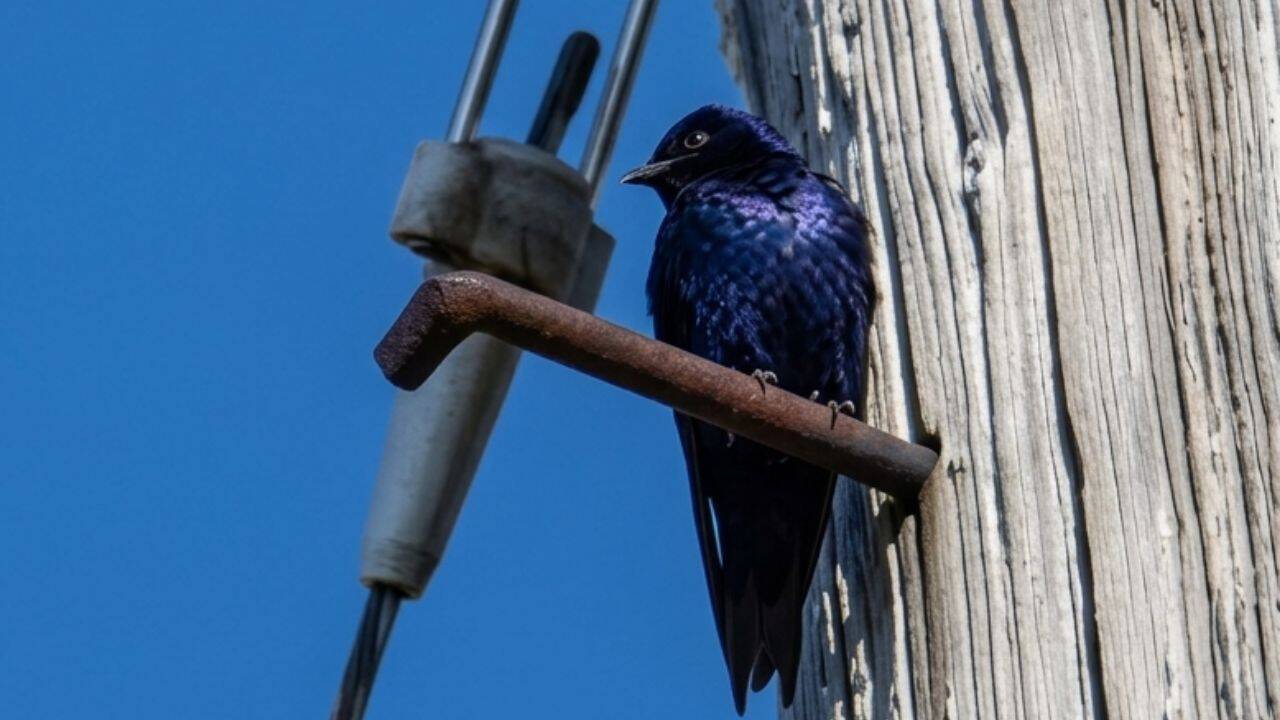
California crews left old telephone poles standing while restoring about 40 acres of land at Sierra Azul Open Space Preserve because purple martins use holes in the poles as nesting sites. The decision came as part of a wider restoration project in which more than 900,000 pounds of human debris was removed from the newly acquired properties.
Get breaking news anytime, anywhere. Download the TOI app now!

The Midpeninsula Regional Open Space District recently completed the restoration work on several properties that were added to the preserve. According to it, the land had abandoned vehicles, dilapidated structures and other debris accumulated over the years.
While most of these remains were removed, the old telephone poles were kept. Midpen staff had discovered purple martins nesting in holes inside similar poles near the mountain top while working on Mount Umunhum.
The discovery was significant because purple martins were thought to have disappeared from Santa Clara County. The western subspecies, Progne subis arboricola, prefers natural structures such as cavities in standing dead trees, known as snags. The birds found in Sierra Azul were using the old telephone poles in a similar way.
Purple martins' nests
Purple martins are migratory birds that typically spend winters in South America before returning to North America in summer to breed. During these months, they need suitable nesting places as well as areas with flying insects for food.
The western purple martin is different from the more common eastern variety in its choice of nesting sites. Eastern purple martins primarily rely on nest boxes supplied by humans, while the western subspecies prefers more natural cavities.
Competition from nonnative European starlings for suitable nesting sites had led biologists to believe that the western purple martin was close to local extinction. Finding the birds nesting in Sierra Azul therefore led Midpen to begin efforts to support the population.