
Get all your news in one place.
100’s of premium titles.
One app.
Start reading
LiveScience
LiveScience
Kristina Killgrove

Caergwrle Bowl: A 3,300-year-old stone-and-tin bowl with gold oars and 'protective eyes'

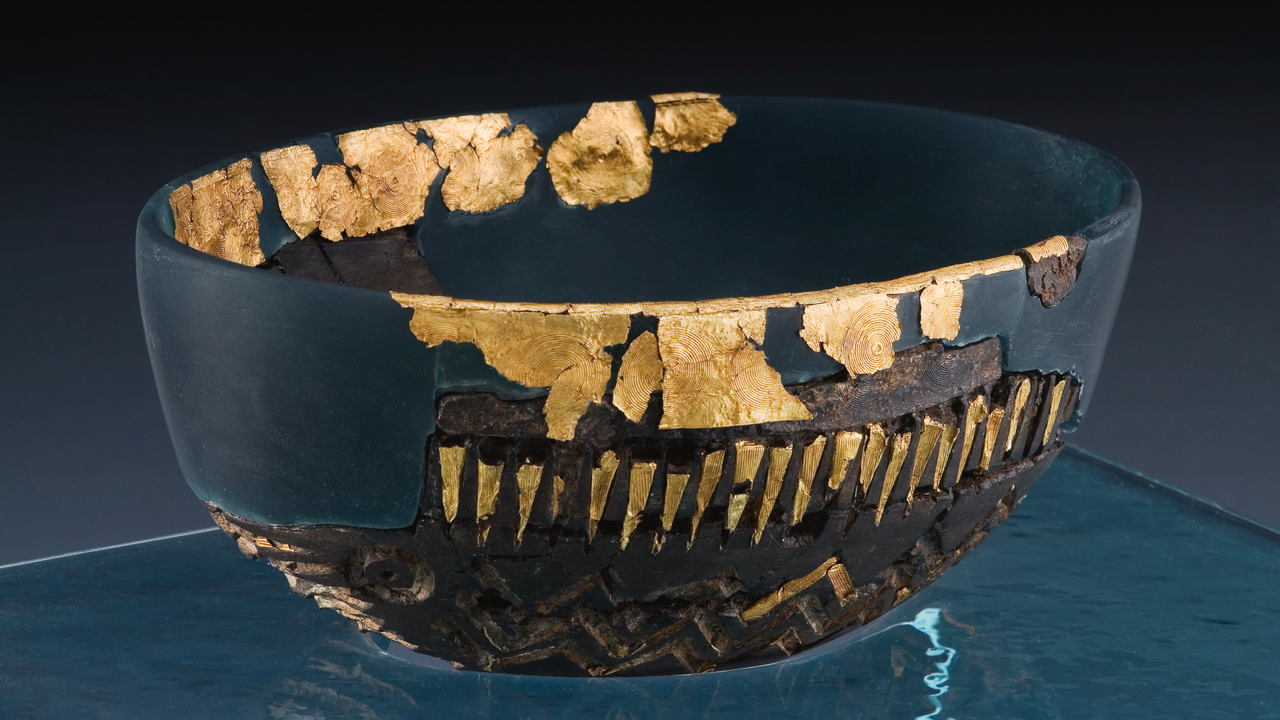
A fragmentary dark teal colored bowl has accents of gold lines, circles and zigzags.
QUICK FACTS

Name: Caergwrle Bowl

What it is: A shale bowl with gold and tin decorations

Where it is from: Caergwrle Castle, in Wales

When it was made: Circa 1300 to 1150 B.C.

About 200 years ago, while digging in a boggy field in Wales, a worker struck a rare, ancient bowl shaped like a ship. The Caergwrle Bowl, named after a nearby castle, showcases the importance of nautical travel in Great Britain's Middle Bronze Age (roughly 1500 to 1000 B.C.).

According to Museum Wales, which has the artifact in its collection, the Caergwrle Bowl was made from shale and tin from counties in southwest England; and gold from Ireland or Wales. About half the original artifact remains today, but when complete, the oval bowl was about 7.2 inches (18.2 centimeters) long and 3.1 inches (7.8 cm) deep.

The inside of the bowl is not decorated, but the exterior and the rim have been ornamented with gold-foil-covered tin in a variety of shapes.

"We think the zig-zags around the base are waves and the long triangles are oars," Museum Wales representatives wrote. "The eye symbol protected sailors. The circles are the shields of its heroic voyagers."

But a slightly different interpretation was put forward by nautical archaeologists in a 1980 study of the bowl.

Rather than seeing the concentric circles on the gold rim as shields, researchers argued that the closest parallel can be found in Bronze Age sun symbolism, such as the Nebra Sky Disc — which may also depict a boat — and the Nordic "Sun Chariot." And instead of the zigzag lines representing waves, the lines could depict the boat's wooden frame showing through the skins that were stretched over it.

Regardless of the exact meaning of the designs on the Caergwrle Bowl, its discovery in a boggy field near the River Alun, which flows toward the Irish Sea, strongly suggests it was created as a representation of a boat, according to Museum Wales. And considering many Bronze Age sun artifacts have been found in bogs as offerings to the gods, the Caergwrle Bowl was likely meant to be an ancient votive offering, perhaps by sailors seeking a safe sea journey.

For more stunning archaeological discoveries, check out our Astonishing Artifacts archives.

Sign up to read this article
Read news from 100’s of titles, curated specifically for you.
Already a member? Sign in here
Related Stories
Top stories on inkl right now
One subscription that gives you access to news from hundreds of sites
Already a member? Sign in here
Our Picks
Fourteen days free
Download the app
One app. One membership.
100+ trusted global sources.