
Get all your news in one place.
100’s of premium titles.
One app.
Start reading
TechRadar
TechRadar
Ruth Hamilton

Buying a dehumidifier for drying clothes? There are two types – and the one to choose depends on if your priority is speed or running cost

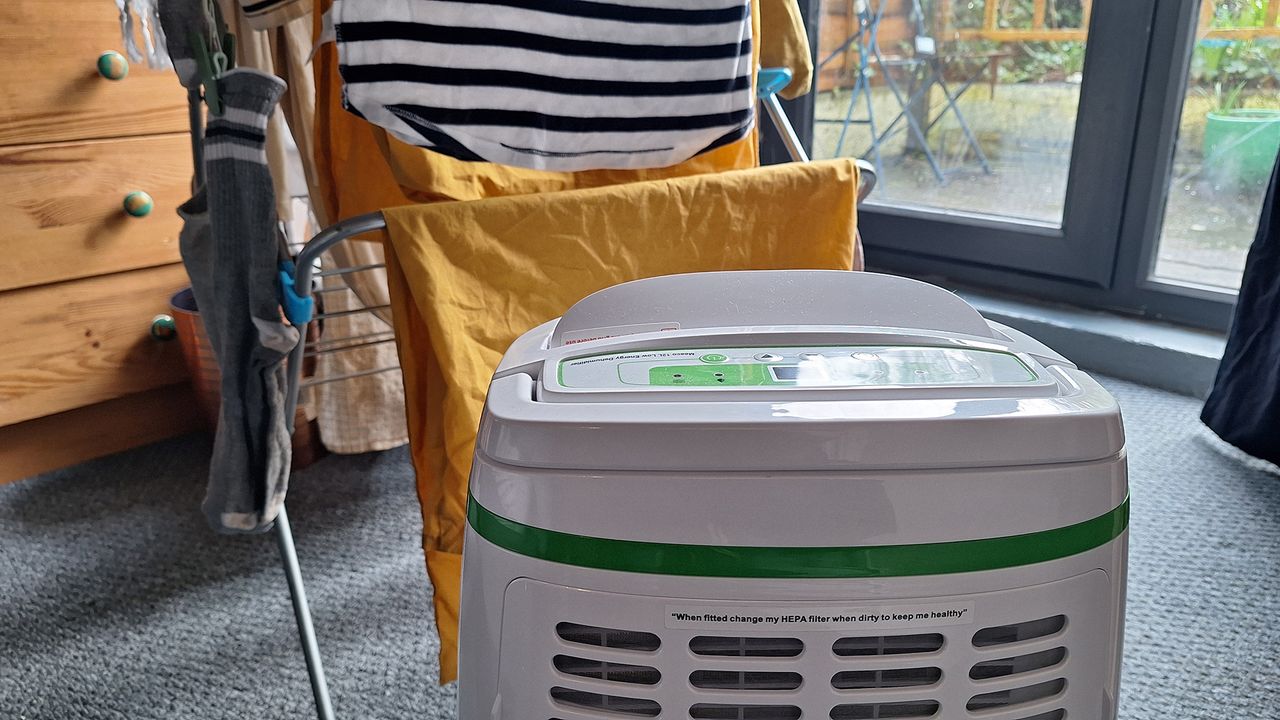
Meaco 12L Low Energy Dehumidifier in front of a rack of drying clothes.

A dehumidifier is a game-changer when it comes to speeding up the process of drying clothes indoors. They're especially useful your home is prone to damp, and you ideally want to avoid adding even more wetness into the situation. They're also great if you don't have space for a tumble dryer – or the funds to run one regularly throughout the winter months.

As someone for which all of the above applies, I speak from experience. Before I introduced my beloved dehumidifier into my home, drying clothes during the chilly, wet UK winter (and let's face it, autumn and spring) months was a long, damp process. Now I wouldn't be without one.

Towards the end of last year, aircare brand Meaco ran a test to find the best way to dry clothes indoors, and concluded that combining a dehumidifier with a pedestal fan was the elite setup. Now they've gone a step further to figure out the best kind of dehumidifier to use.

Here's the low-down on which kind of dehumidifier to buy for drying clothes, with expert insights from Chris Michael, Meaco's co-founder and Chief Product Officer.

Desiccant vs compressor dehumidifiers

There are two main types to be aware of: a desiccant dehumidifier and compressor dehumidifier.

A compressor dehumidifier is the more common option, and works by using a fan to draw damp air over a cold set of coils, where the water vapor condenses, and drips down into the collection tank. The air is then passed over warm coils to get it back to around room temperature before it's released back into the room.

In contrast, desiccant dehumidifiers work by using moisture-absorbing materials to collect water from the air. In this setup, heat is used to dry out the desiccant material, so the dehumidifier will release the generated heat out into the room. Chris describes it as "a nice addition of heat to the space, but not enough for it to be called a room heater".

(Image credit: Meaco)

In its test, Meaco found that as a general rule of thumb, if your priority is speed of drying, you should opt for a desiccant dehumidifier. If your priority is keeping running costs low, you should buy a compressor dehumidifier.

However, that's only true for larger dehumidifiers (20L/25L) – for smaller machines, you might just always be best off going for a desiccant option for clothes drying.

The test

In its tests, Meaco washed 13 T-shirts, then timed how long they took to dry in different scenarios. All other aspects of the trial (T-shirts used, machine cycle used, drying location etc.) were kept the same. Here were the results:

Setup

Drying time

Estimated cost

Natural drying (no appliances used)

20 hrs (round 1) / 28rs (round 2)

Free

20L compressor dehumidifier only

4 hrs 45 mins

28p

Desiccant dehumidifier only

3 hrs 30 mins

54p

Compressor dehumidifier with a fan

2 hrs

14p

Desiccant dehumidifier with a fan

1 hr 40 mins

32p

For reference, the appliances used were the Arete 20L compressor dehumidifier, the DD8L Pro desiccant dehumidifier, and the Sefte 10in pedestal fan. Understandably, they're all Meaco machines. These have performed well in our reviews, but there are of course plenty of alternatives to choose form.

Which kind of dehumidifier should you use?

If your priority is keeping costs down, choose a compressor dehumidifier. "Compressor dehumidifiers are most efficient and have a lower cost-per-liter of water collected above 15°C (Meaco 20 and 25L machines can push this rule of thumb down to 10°C)," says Chris.

You'll have noticed the caveat in that quote. Chris explains further: "The colder the air gets, the less water a compressor dehumidifier will collect, and that is where desiccant comes in – these don’t care what the room temperature is, their performance remains the same and they are more than happy below 10°C."

(Image credit: Meaco)

In general, a desiccant compressor dehumidifier will be the quicker option, too. "They will dry clothes faster because of their high airflow and warmth coming out," adds Chris.

However, he emphasizes this is only true for larger dehumidifiers (20L/25L): "On smaller compressor machines the drying time will be much longer, and a desiccant might just beat them on cost too then."


Follow TechRadar on Google News and add us as a preferred source to get our expert news, reviews, and opinion in your feeds. Make sure to click the Follow button!

And of course, you can also follow TechRadar on YouTube and TikTok for news, reviews, unboxings in video form, and get regular updates from us on WhatsApp too.

Sign up to read this article
Read news from 100’s of titles, curated specifically for you.
Already a member? Sign in here
Related Stories
Top stories on inkl right now
One subscription that gives you access to news from hundreds of sites
Already a member? Sign in here
Our Picks
Fourteen days free
Download the app
One app. One membership.
100+ trusted global sources.