
Get all your news in one place.
100's of premium titles.
One app.
Start reading
Euronews
Euronews
Euronews

Bulgaria's battery storage boom pays off as summer drought hits power plants

As Eastern Europe's power sector has taken a hit from a record drought, Bulgaria has benefitted from building out battery storage capacity alongside its rapid solar expansion.

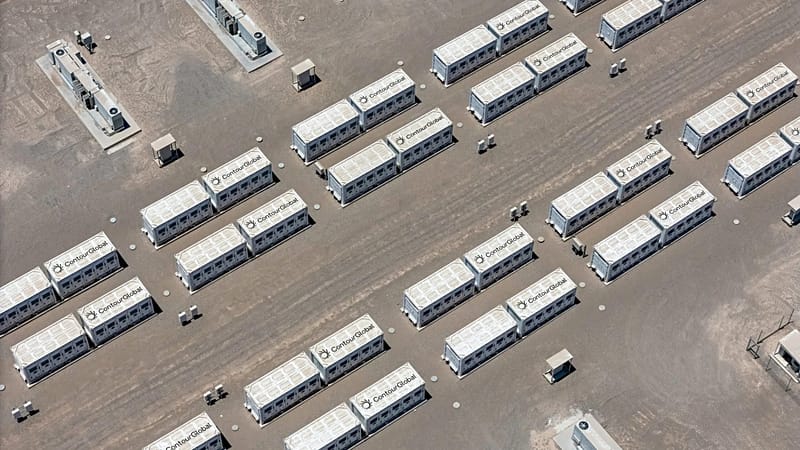
Around a hundred battery energy storage system (BESS) sites are now operating, most of them built in the past two years.

The large-scale projects take advantage of former industrial sites and airfields or are integrated into existing power stations, including coal-fired plants.

"The scale and speed of storage deployment in Bulgaria is unprecedented in a European context," Stavros Papathanassiou, a professor at the National Technical University of Athens, told the AFP news agency.

Low administrative hurdles, a receptive market for clean energy and EU funding are among the reasons expert cite for the country's leading role in the region.

The battery installations absorb surplus power from solar installations and feed it back into the grid when demand rises.

That proved a boon when exceptionally low levels on the River Danube disrupted power generation at nuclear and hydroelectric plants in Eastern Europe, boosting demand for electricity imports.

ContourGlobal’s BESS project in the Stara Zagora region, January 2026 (@ContourGlobal)

In July and August, Bulgaria, one of the EU's poorest countries, recorded net electricity exports of around 830 gigawatt-hours a month, more than twice the average in May and June.

In July alone, Romania accounted for nearly half of Bulgaria's outward electricity transfers, valued at an estimated €74 million.

Reducing coal reliance

At Maritsa East 3, once Bulgaria's second-largest coal-fired power plant, the shift away from dependence on the fuel is visible on the ground.

Built under communism with four generating units, the plant sharply reduced coal operations in 2024, repurposing existing grid infrastructure for a battery facility.

"We could leverage the large connection to the grid. We decided to disconnect one coal unit and connect batteries," said Vassil Shtonov, head of Bulgaria operations for the British-based power company ContourGlobal.

"Coal is out, battery is in. It was the right place at the right time," Shtonov told AFP, though he said Bulgaria should maintain a minimum coal-fired reserve for severe winters or disruptions to gas supplies.

A train passes by Republika Power Plant in town of Pernik, 21 April, 2022 (AP Photo)

While Bulgaria accounted for about 9% of European battery-storage additions and about 2% of solar additions in 2025, it can "serve as a positive example for other European nations," said Lennart Herrmann at the Munich-based research and consulting firm FfE.

"The right incentives...can enable a swift energy transition," he told AFP.

The Bulgarian energy ministry said the country had around 5.7 gigawatts of operational battery-storage power capacity this month.

That is equivalent, in power terms, to nearly a quarter of Bulgaria's installed power-generation capacity overall and more than five times neighbouring Romania's operational battery capacity.

Businesses in Bulgaria have also signed contracts for nearly 14 gigawatt-hours of large‑scale storage, part of which has already come online.

"The aim is for storage systems to find a sustainable role in the market," the ministry said, adding that it "must go hand in hand with other investments, such as in transmission and distribution grids."

'By chance'

Nikola Gazdov, president of Bulgaria's Association for Production, Storage and Trading of Electricity, attributed the battery boom to a combination of factors rather than a crafted strategy.

"Everything happened almost by chance," he told AFP.

Solar and wind capacity has expanded rapidly across the region, but Bulgaria's renewables boom has been particularly solar-heavy, creating growing daytime surpluses.

And in Bulgaria, large battery projects can be up and running in just nine to 18 months, much less than many solar or wind projects, Gazdov added.

But battery storage technology has its limits.

Wind power generators are seen through an electric station near the village of Bozhurec east of Sofia, 6 April, 2010 (AP Photo)

One is that grid connections with neighbouring countries are limited in the amount of current they can transport.

Another is that current batteries can store power only for relatively short periods, "typically between one and six, sometimes up to eight hours," said Herrmann at FfE.

So while they can support the grid in case of a temporary drop in power supply, they cannot replace a nuclear reactor that goes offline due to drought.

And their success could ultimately reduce their own profitability, because when more BESS operators buy electricity when prices are low and sell it back at peak times, the gap between the two price periods will narrow.

Sign up to read this article
Read news from 100's of titles, curated specifically for you.
Already a member? Sign in here
Related Stories
Top stories on inkl right now
One subscription that gives you access to news from hundreds of sites
Already a member? Sign in here
Our Picks
Fourteen days free
Download the app
One app. One membership.
100+ trusted global sources.


