Get all your news in one place.
100's of premium titles.
One app.
Start reading
The Economic Times
The Economic Times
Neelanjit Das

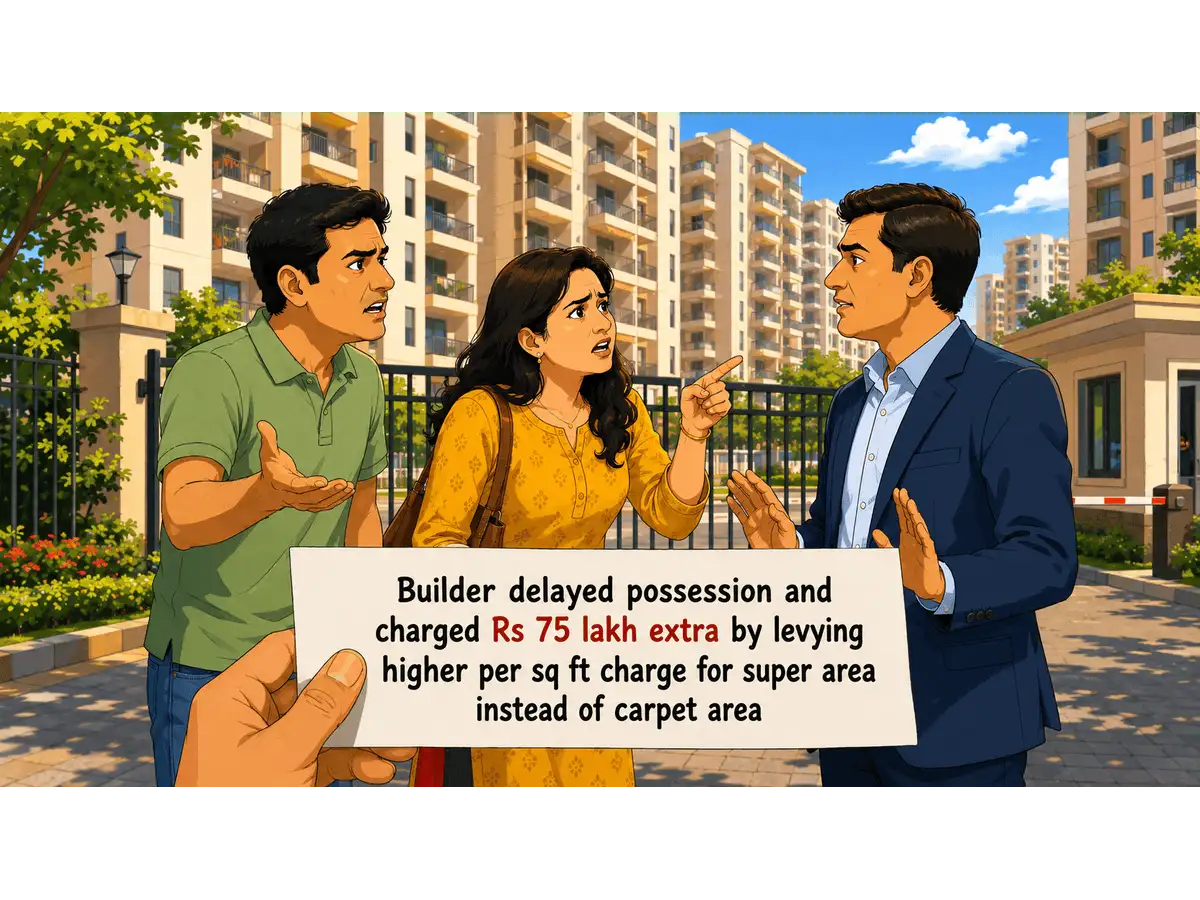
Builder delayed possession and charged Rs 75 lakh extra on the basis of super area instead of carpet area; homebuyers partly win case in Punjab RERA for delayed possession

In a recent ruling, the Punjab RERA stated that builders can’t just charge homebuyers extra for any increase in carpet area or super area unless both parties have clearly agreed to it in the contract.

This decision came about after the homebuyers from Rani Ka Bagh, Amritsar, took legal action against a builder based in Kalkaji, Delhi. The builder and homebuyers had signed an agreement where the carpet area was stated as 139.17 sq. meters (1498 sq. ft.) which was also registered with the RERA Authority.

However, when the flat was handed over to the homebuyers, the builder charged for the super area (2570 sq. ft.) instead of carpet area. The homebuyers alleged that the builder had manipulated the RERA Model Agreement and had charged Rs 7,056 per sq. ft. instead of Rs 6,190 per sq. ft., thus overcharging an extra Rs 75 lakh (75,64,032) through misrepresentation and without legal authority.

This is how the dispute between the homeowners and the builder began as up until the date they took legal action, the builder had neither adjusted the excess amount paid nor refunded the money to the homebuyers for the extra 1072 sq. ft.

However, the homebuyers ultimately lost the case in Punjab RERA even though the RERA authority ruled that the builder could not have unilaterally charged homebuyers for any increase in carpet area or super area unless those charges were agreed upon in the buyer's agreement.

The reason the homebuyers lost the case is because, in the builder-buyer agreement executed by them, the total area to be sold has been clearly and categorically mentioned with its rate and price in per square feet and per square meters. Punjab RERA said that the homebuyers should have carefully read the terms and conditions before signing the agreement.

Why did the homebuyer partly lose the case but got awarded interest for delayed possession?

Nishant Arora, Partner at Khaitan & Co, said to ET Wealth Online that the Real Estate Regulatory Authority, Punjab partly allowed a homebuyers' complaint, awarding interest for delayed possession but rejecting their claim for refund of “super area” charges. The two reliefs sought by the complainants raised distinct legal questions and were adjudicated by the Authority on independent footings.

The first issue is about the payment of interest for delayed possession, the analysis turned on Section 18(1) of the Real Estate (Regulation and Development) Act, 2016 .

According to Arora, the RERA Authority held that the right to claim interest on delayed possession is an “indefeasible and unqualified” right conferred on an allottee by the RERA Act, which cannot be taken away or declined. After considering the submissions of both parties, the Authority found that there had been a delay by the builder in handing over possession, and accordingly held the complainants entitled to interest for the period of delay and directed the respondent to make payment of such interest to the complainants.

The second issue concerned the homebuyers' contention that, after passing of the RERA Act and as per the model agreement prescribed in Form Q of the Punjab State Real Estate (Regulation and Development) Rules, 2017, only carpet area could be sold and charged for, and that the builder had unlawfully recovered an excess amount from them by billing on a super area basis.

According to Arora, the RERA Authority rejected this contention, holding that Form Q does not prohibit pricing on a super area basis and does not prescribe carpet area as the only permissible pricing basis; it merely requires that the total price be clearly disclosed with a transparent break-up referable to carpet area.

Arora says that the RERA Authority observed that the model agreement does not take away the freedom of contract but only seeks to guide the parties for the sake of clarity in things agreed upon, so that the rights of the parties may be properly adjudicated in the event of a dispute.

Since the Buyer's Agreement (BBA) executed between the homebuyers and the builder expressly recorded the price as based on super area, with both the super area (2570 sq. ft.) and the carpet area (1498 sq. ft.) clearly disclosed and the total consideration duly accepted, the complainants were bound by the terms of the BBA they had executed.

Thus Arora says that applying the principles of pacta sunt servanda (pacts must be kept) and caveat emptor (buyer beware), the RERA Authority held that the complainants were contractually bound by the pricing terms agreed to in the BBA and accordingly declined the refund.

Arora says: "The Authority, however, clarified that nothing could be charged for any unilateral increase in carpet area or super area unless such charge was expressly agreed between the parties in the buyer's agreement."

Arora says that this ruling clarifies that while the RERA Act strongly protects allottees against delays and developer defaults, contractual terms transparently disclosed and voluntarily accepted by the parties remain binding so long as they are not in conflict with the model agreement prescribed under the Rules.

Punjab RERA order discussion

Punjab RERA gave this judgement on May 14, 2026 while the complaint had been filed by the homebuyers on December 11, 2023.

Buyer has to be be aware of the terms and conditions

The Punjab RERA authority has said that the homebuyers failed to show if the referred demand or charges were in derogation of the terms and conditions mentioned in the Form prescribed.

Punjab RERA thus said that another rule of mercantile jurisprudence 'Caveat Emptor' applies in the matter which means 'let the buyer beware'.

Punjab RERA said: “So, complainants (homebuyers) should have been vigilant enough about the terms and conditions duly mentioned in the agreement."

Punjab RERA also said that the homebuyers have failed to show that the charges imposed on them by the builder were contrary to the prescribed rules and framework. Applying the principles of Pacta sunt Servanda and Caveat Emptor, the Authority held that buyers who knowingly agreed to the pricing terms could not seek a refund of those amounts later, reported LiveLaw Biz.

In RERA model agreement, there is no concept of a super area

The Punjab RERA authority found that the total sale consideration of the unit has also been duly mentioned in the agreement that has been executed and signed by both the parties. As such, whatever has been agreed upon and all the terms and conditions thereof have to be followed by the parties to the agreement.

The RERA authority also said that under RERA model agreement, there is no concept of 'super area', nor could anything be charged on the basis of super area or super structure.

Punjab RERA authority said that the model agreement provided in the Rules does not seek to take away the freedom of contract by putting restraints on it. It only highlights the important and necessary contents of an agreement between buyer and builder, which must form part of it for bringing clarity and transparency in a sale transaction.

The Punjab RERA authority also said that the 'Form Q which is the model agreement for sale provided under the rules, its highlighted term i.e. term no. 1.2 only requires that the total price for the apartment/ plot based on the carpet area be clearly and distinctly mentioned by giving its break-up and clear description so that breakup of the consideration charged separately for the separate nature of area to be sold is clarified.

The model agreement thus does not put any restraint or impose any bar on the nature of the area to be sold.

If there are any conflicting terms in the builder-buyer agreement compared to the Form Q of the model agreement, it does not violate RERA law

The Punjab RERA said that in their opinion nothing can be charged for an unilateral increase either in the carpet area or in super area if it has not been agreed upon by the parties in the buyer's agreement that has to be of course in the form prescribed in accordance with Section 13(2) of the RERA Act.

RERA rules, 2017, providing the model agreement, seek to supplement Section 13(2) of the RERA Act that requires an agreement to be in the form as may be prescribed.

The RERA authority said that the builder-buyer agreement needs to specify the particulars of development of the project including the construction of building and apartments, along with specifications and internal development and external development works, the dates and the manner by which allottees will make payments towards the cost of the apartment, plot or building, as the case may be. It also has to mention the date on which the possession of the apartment, plot or building is to be handed over, the rates of interest payable by the promoter to the allottee and the allottee to the promoter in case of default, and such other particulars, as may be prescribed.

The RERA Authority pointed out that the Model agreement seeks to guide the parties for the sake of clarity of the things agreed upon so that in case of dispute between them, the rights of the parties could be properly adjudicated upon and determined.

Punjab RERA said: “It is thus held that all the terms and conditions of the agreement are binding and nothing can be charged over and above those unless those are against the terms provided in the said Form Q or in conflict with those.”

Order:

Punjab RERA partly allowed the homebuyer’s complaint on the ground of delayed possession and ordered the builder to give interest from July 31, 2023 till January 18, 2024 by taking the interest rate as SBI’s highest MCLR rate plus 2% after adjustment of any pending dues payable by the buyers.

Sign up to read this article
Read news from 100's of titles, curated specifically for you.
Already a member? Sign in here
Related Stories
Top stories on inkl right now
One subscription that gives you access to news from hundreds of sites
Already a member? Sign in here
Our Picks
Fourteen days free
Download the app
One app. One membership.
100+ trusted global sources.