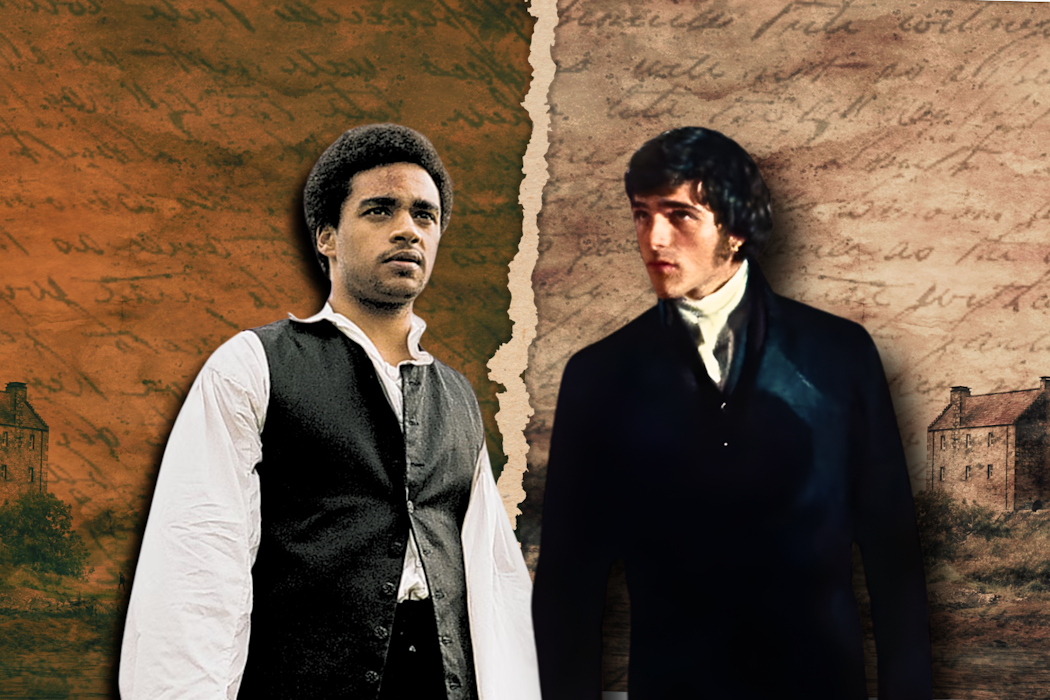
The race of Heathcliff, the brooding antihero of Emily Brontë’s 1847 novel Wuthering Heights, is a much-discussed element of the classic tale.
Brontë variously describes him as “a little lascar, or an American or Spanish castaway”; “that gipsy brat,” not “a regular black,” the offspring of the “Emperor of China,” and the son to an “Indian queen”.

But in her recent film adaptation, director Emerald Fennell has cast white Australian actor Jacob Elordi in the role. What does this mean for our understanding of the story?
Is Heathcliff white?
Scholars, especially since the late 20th century, have debated Heathcliff’s racial identity without forming a consensus. They continue to examine the text for evidence.
He has been variously identified as Irish, a migrant fleeing famine; African, found at the Liverpool docks (then England’s largest slave trading port); or Romani, often shorthand for a racially ambiguous and “threatening” outsider.
I do not feel the novel invites us to identify Heathcliff with a fixed racial identity. The book’s strange, otherworldly and almost hallucinogenic nature resists clear interpretation.
In 19th century Britain, post-Enlightenment Europe and the United States, the concept of race was categorised and studied, and exerted a strong influence on government policies and popular culture.
People were placed into hierarchies of humanity to justify slavery, colonialism and genocide. This system of “scientific racism”, as it has come to be known, placed “whiteness” at the top.
But this notion of whiteness was different to the one we hold today, which explains Heathcliff’s racial “otherness” as being associated with Irishness.
Brontë’s novel, and Gothic fiction of the age more broadly, depicts race as something more malleable and fantastical.
In the case of Brontë’s Heathcliff, his racial identity seems to shift and morph, sometimes rendered supernatural and demonic in the eyes of other characters. His darkness and inhumanity is emphasised and seems to intensify in moments of brooding anger and villainy.
His complexion darkens and his eyes become, in the words of the maid Nelly, “black fiends” that glint and lurk “like the devil’s spies” with “a half-civilised ferocity”.
Heathcliff’s inhumanity, as tied to his non-whiteness, seemingly rises to the surface, as if the stain of his moral degradation seeps through his soul to appear on his face.
Critics of the casting
The casting of Elordi as Heathcliff has come under scrutiny.
Some readers and critics have interpreted Brontë’s book as a critique of British institutional racism in the late 18th century, when the novel is set, and the Victorian era (1837–1901), when it was written.
One such reading is that the novel links the oppression of white women to that of non-white subjects of the British Empire to critique social structures of violence, cruelty and inequality.
This reading sees the novel’s representation of female subjugation as a mirror image to the oppression that people of colour faced at the time.
Many critics of the film have said it isn’t an accurate adaptation, and misunderstands what Brontë’s text is really about. But an argument around “intent” is hard to make, since we can never really know what a novel “is about”. We can only guess.
And there are limitless interpretations of a text, especially one as strange and enigmatic as this one. As such, though race is a part of the original Wuthering Heights, assigning a singular, definitive meaning to the novel’s representation of race is complicated.
In Brontë’s novel, nothing is as it seems. The ever-shifting image of Heathcliff – at once appearing to be a lascar, a Native American, Spanish and Black – would be difficult to depict effectively on film.
Film lacks the imaginative malleability as the reader’s mind’s eye, which can hold all these descriptions of Heathcliff’s image at once, allowing this Gothic strangeness to occur.
Race in Fennell’s film
While Heathcliff is cast as white, Fennell casts people of colour in other roles.
Fennell’s film is not interested in the racial commentary many critics have found in Brontë’s novel. The characters in Fennel’s created world do not appear to engage with race the same way people do in our world.
American-Vietnamese actor Hong Chau plays Nelly Dean (a housemaid in the novel, but an illegitimate daughter to a nobleman in the film), and English/Scottish–Pakistani actor Shazad Latif portrays Edgar Linton, Cathy’s wealthy and respected husband.
The casting of Edgar, a man of wealth and status, as a person of colour undermines the intersections of oppression and race that existed at the time.
I think Fennell’s decision to ignore race is a missed opportunity to foster a more nuanced discussion of race in the late 18th century and Victorian Britain.
Victorian Britain was shaped by the legacy of the transatlantic slave trade, the presence of Black peoples on its soil (who in some instances, had in the past been enslaved), and its colonies in Asia and the Middle East.
While it would not have been common to find people of colour in the Yorkshire moors in the late 18th and early 19th centuries, Britain (including Yorkshire) wasn’t as white as is widely believed. Fennell had an opportunity to highlight this fact.
Instead, in the film’s casting of Elordi as Heathcliff and Latif as Linton, we see a reticence to engage with the question of racial oppression at all. While this doesn’t make the adaptation “wrong”, it adds to the film’s almost complete lack of depth.
Ellie Crookes does not work for, consult, own shares in or receive funding from any company or organisation that would benefit from this article, and has disclosed no relevant affiliations beyond their academic appointment.
This article was originally published on The Conversation. Read the original article.