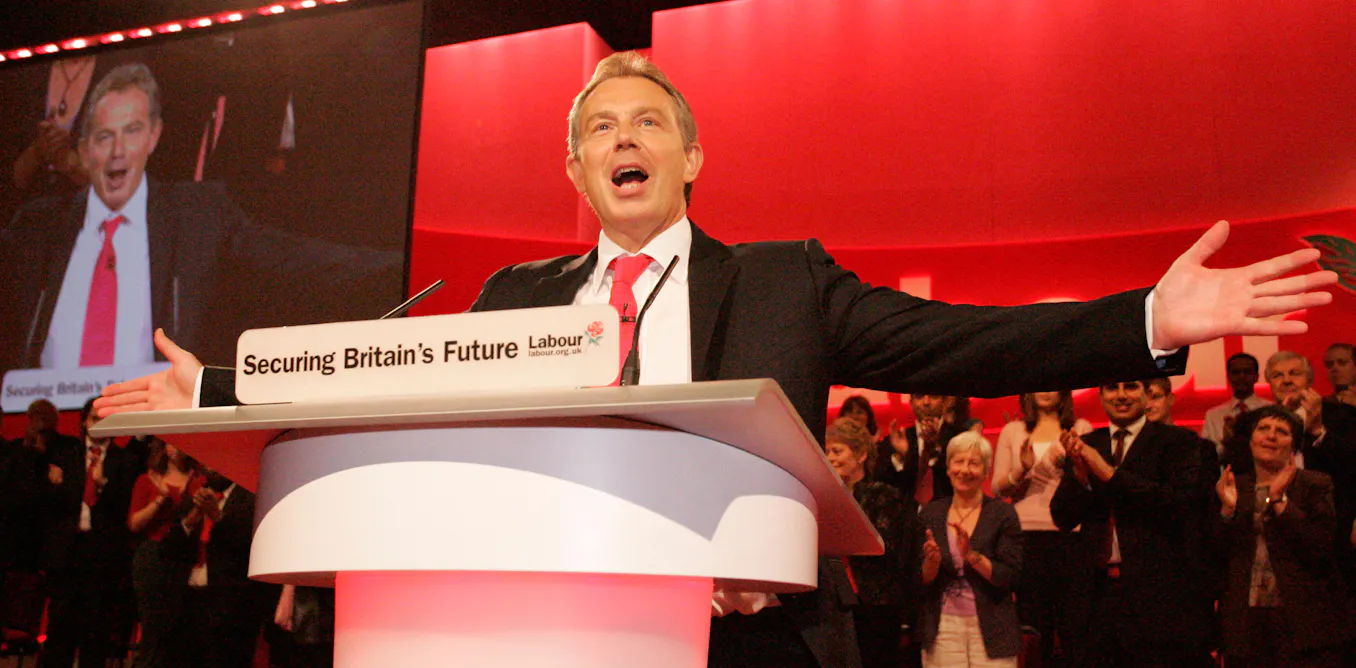
Summer 2001. Tony Blair had just won a second thumping election victory, promising opportunity for all. The new census showed a nation losing its religion, more inclined to live alone and more ethnically diverse. The maximum temperature was a tepid 32°C in west London in late June, while the twin towers rose tall and proud as always over the New York skyline.
Twenty five years on, we wanted to look at how the UK has changed. Welcome to the first of a six-part report from a group of 35 specialists, exploring all of the key developments in the intervening period.
Domestic politics
Martin Farr, Senior Lecturer in Contemporary British History, Newcastle University
2001: A Political Odyssey is one way of framing how Britain has changed in the first quarter of the 21st century. When that year arrived, it turned out to be rather less advanced than the world of moon bases and video calls that Arthur C. Clarke and Stanley Kubrick had imagined (even in 2026, the test launch for the latest moon rocket recently exploded on the launchpad).
Tony Blair’s Labour government had been re-elected in June 2001 in a second landslide, its last untarnished victory. By 2005 Labour would be mired in war, and coming to terms with a reduced – though still substantial – parliamentary majority on only 35% of the vote.
Populism was certainly a word in 2001, but its usage in Britain was rare – it derived from America, along with much else in our cultural life. In Britain, the same two parties had been in government since 1924, and power alternated between them. When in opposition, Labour or Conservative had only to wait for their next opportunity.
How has the UK changed since the start of the century? From Blair to Burnham, from the dotcom era to AI agents, time has certainly not stood still. In this six-part series, a team of some 35 experts look at everything from defence spending to species populations to the rise of populism to try and make sense of the intervening years.
The Britain of 2001 was much simpler – only one of the two legacy parties ever in office, their longevity lubricated by economic growth – though complications were in train. Devolution had become institutionalised three years earlier. Those who had advocated for self-government for Wales and Scotland did so for one of two reasons (Northern Ireland being a quite different matter).
Either they saw devolution as a staging post to independence, or they thought the opposite: that desire for independence could only be addressed by devolving – repatriating, as a nationalist might see it – powers from London to Cardiff and Edinburgh. Who was right? Too soon to say, but the First Ministers of both Scotland and Wales are nationalists who advocate independence for their nations.
Brexit
In one very limited sense things actually got simpler. In 2001 Britain had for 28 years been part of the European Economic Community, which had become the European Community, and then the European Union. For those who supported Brexit, the implication of those changes in title were of more than semantic interest: they helped explain the vote to leave. Brexit wasn’t even a word in 2001, of course. “Eurosceptic” was the nearest equivalent, in consequence of Margaret Thatcher’s landmark 1988 Bruges speech, warning of the dangers of a “European super-state”. From such acorns do mighty oaks rise.
The simplification of not having to be part of the 27-country assemblage, however, is dwarfed by the complications spawned by Britain’s departure, not least politically. To effect withdrawal from the EU, a culture of party political insurgency developed, usually promulgated by – one might say requiring – a charismatic individual.
James Goldsmith’s Referendum Party came fourth at the 1997 general election, with nearly a million new voters. A million also voted for Nick Griffin’s almost explicitly racist British National Party in the 2009 local elections. Yet by the 2015 general election, Nigel Farage’s Ukip, effectively the successor to Goldsmith’s party, received almost 4 million votes. Both the Ukip and BNP votes collapsed later that year with the Conservative offer of an EU referendum; Goldsmith died, but Farage would be back.
Brexit was a process as much as an event, but there were several others that were epochal: the 2003 Iraq war and the 2010 political “expenses scandal” shattered much of what public trust remained in Westminster. The SNP winning power in Scotland in 2007 led to the 2014 independence referendum. The nationalists lost, but in doing so created national faultines that could no longer be ignored.
Most of all, the 2008 financial crash defined the period. Stagnant living standards provide fertile grounds for grievances – catnip to populists. And so, in part, the appeal of Alex Salmond and Nicola Sturgeon in Scotland, of Jeremy Corbyn and Farage, and now the Green party’s Zack Polanski; charismatic individuals that characterise an increasingly individualistic society (curious how – conventionally – tainted so many of them became).
The new divisions
The greatest complication is voter fragmentation. In the 1950s more than 90% of voters voted Labour or Conservative (more often than not for the same party as their parents). It would have been inconceivable that there could be comparable standings for five parties in England, and six in Scotland and Wales. Multi-party politics is the new normal.
But the Westminster voting system wasn’t created to deal with such an array. Keir Starmer’s Labour government was elected on 33% of the vote, not only the most disproportionate outcome in British electoral history but the fourth most disproportionate in the world. Proportional voting could become a clarion under Andy Burnham (a longstanding supporter). As advocates see it, this would allow voters to vote for what they actually want, rather than for what they want to prevent.
Today, the new is helping revive the old in the sense that the 1970s question is being asked again: is Britain governable? Then, successive Conservative and Labour governments were both forced from office, effectively by trade union power. Nationalism and populism, in their different forms, have taken its place.
It is increasingly challenging for those who seek to explain and interpret, even predict, this uniquely fractured and fluid British political scene. In 2001 the Green Party managed 0.6% of votes in the general election. In 2026 they are on around 15%, run councils and have elected mayors.
In Reform UK polling suggests that Britain may have its first new party of government for over a century. Between 1979 and 2007 there were three prime ministers; since 2016 there have been seven.
In Clarke’s and Kubrick’s 2001 conception, a monolith had been left behind by an alien civilisation to help guide the evolution of intelligent life on Earth. If only, one may be forgiven for thinking, there was something similar in British politics.
Geopolitics and defence
Geraint Hughes, Reader in Diplomatic and Military History, King’s College London
In July 1998, the then-Labour defence secretary, George Robertson, presented the new government’s strategic defence review to parliament, with one of its conclusions being that Britain faced no real threat of attack by a major state adversary.
In April 2026 the now Baron Robertson of Port Ellen publicly berated the current Labour government for its “corrosive complacency” over defence. Robertson had co-authored the 2025 strategic defence review, which stated that the UK has to prepare for a possible war between Nato and a resurgent Russia.
He has clearly become frustrated that the review’s recommendations are being slowly (if at all) implemented, because of costs. And he’s not the only one: John Healey resigned as defence secretary for the same reason, telling the prime minister that the government’s spending plan “falls well short” of what is required to keep the country safe.
Keir Starmer finally responded on June 30, rushing out his long-delayed defence investment plan. It offers a £15 billion top-up focused heavily on drone warfare, yet still leaves the military well short of the funding Robertson and Healey believe is needed.
The new geopolitics
It is of course a constant challenge for the government to ensure that British armed forces have sufficient troops, firepower, ships and planes. Even at the time of the 1998 review there were fierce quarrels between Robertson and the Chancellor of the Exchequer, Gordon Brown, over defence costs. In 2010 the then-coalition government imposed swingeing cuts on the armed forces’ capabilities on the front line and the so-called rear echelon, which includes things like supply lines, logistics and medical care. The Royal Navy, British Army and Royal Air Force are still suffering as a result.
However, the strategic backdrop for British defence policy was very different in previous decades. Ten years after the cold war ended, Europe was largely at peace. Closer to home, the Good Friday agreement of April 1998 ended 30 years of British military operations in Northern Ireland.
At that time, the UK’s armed forces were involved in peace support operations in the former Yugoslavia. In retrospect, the 1999 stand-off between Russian and British paratroopers at Pristina airport, Kosovo, at the end of the war in that country should have warned us that great power rivalries hadn’t disappeared.
After 9/11, Tony Blair’s government committed British forces to fight alongside the US in Afghanistan and – far more controversially – Iraq. These conflicts led to the deaths of 636 British servicemen and women, and undermined public support for military interventionism.
Blair justified both wars by arguing that the UK needed to pay a “blood price” to bolster ties with its most important ally. President Donald Trump’s denigration of the sacrifice Britain and other Nato allies made in Afghanistan raises the question of whether this price was worth it.
Today, Britain and its European allies face the threat of a major war in Europe. Russia’s all-out invasion of Ukraine in February 2022 may have been a miscalculation, but Vladimir Putin has overseen a process of rapid military expansion, which means that the Russians could still potentially attack a Nato member state.
More alarmingly, the foundation of British defence policy – US membership and support for Nato – is being undermined by the Americans themselves. Trump and his officials blame the lack of European support for Operation Epic Fury against Iran for undermining the Atlantic alliance.
In reality, the current US president has long been a Nato sceptic, and his administration’s 2025 national security strategy had harsher language for America’s European allies than it had for Russia. Although US-European relations have rarely been trouble-free, previous presidents did not threaten to seize territory from their allies by force, as Trump has done with Denmark and Greenland.
It is true that it is very hard for any democracy to spend money on military power when there are other pressing requirements in the form of health, policing, education or welfare. The main political parties will accuse each other of running down Britain’s armed forces, but the uncomfortable truth is that in peacetime defence is never a priority for the British public.
Britons generally respect their servicemen and women. But at this moment of rising geopolitical tensions, they are split over whether to cut other public services to fund them, as well as generally unwilling to join up themselves.
Whether these attitudes will change in the event of another 1914 or 1939 moment is a matter for speculation and debate both inside and outside the UK’s defence establishment.
Constitutional challenges
Stephen Clear, Lecturer in Constitutional, Administrative and Public Procurement Law, Bangor University
Following the September 11 attacks, the UK government moved to expand its powers through measures such as the Anti-terrorism, Crime and Security Act 2001. While intended to strengthen national security, it created tension with civil liberties by permitting extended detention, surveillance and restrictions on the rights of suspected terrorists.
This was tested at the European Court of Human Rights (ECHR) in 2009 in a case about a group of 11 foreign nationals in the UK, who had been detained without charge on the grounds that they had links to al-Qaeda and posed a threat to UK national security. Their lawyers argued that the power to indefinitely detain individuals without a formal charge ran contrary to human rights obligations, and the court found in their favour, forcing the UK government to revise the 2001 legislation.
These events highlighted the struggle to balance security concerns with human rights. It demonstrated the power of the ECHR to intervene in matters concerning individuals’ liberties and the rule of law (in this case the principles that the law applies equally to everyone and no one can be indefinitely imprisoned without a fair trial).
The UK supreme court
The supreme court was established in 2009, replacing the former appellate committee of the House of Lords.
This resulted in the UK’s most senior judges no longer sitting in the House of Lords. The head of the judiciary is now the Lord Chief Justice (rather than the Lord Chancellor) and is therefore no longer a cabinet minister and politician.
This strengthened the separation of powers by formally separating the judiciary from parliament and enhancing judicial independence, as well as incorporating elements of separation of powers in modern legislation for the first time.
The court also moved to a new publicly accessible building and began live-streaming most open-court proceedings, which improved transparency.
Devolution
Scotland, Wales and Northern Ireland have gained expanded legislative and fiscal powers through successive devolution acts. There have been challenges to the status quo such as the 2014 Scottish independence referendum. There have also been difficulties surrounding the Northern Ireland power-sharing agreement, which notably collapsed from 2017-2020 over a green energy scandal.
These tensions exposed weaknesses in the UK’s unwritten constitutional model and raised questions about Westminster’s parliamentary sovereignty and the future of the union. Meanwhile, devolved governments increasingly shaped their own domestic policies, particularly during the pandemic, demonstrating both the flexibility and fragility of the current constitutional arrangements.
Brexit…again
The vote to leave the EU in 2016 triggered major constitutional change for the UK. Brexit was enacted by the EU (Withdrawal) Act 2018 repealing the European Communities Act 1972, while retaining some EU law within domestic legislation to ensure legal continuity.
Over the Brexit period, the supreme court ruled on the limits of government power in several cases brought by business leader Gina Miller. It reaffirmed parliamentary sovereignty by requiring the UK parliament’s approval for the government to trigger article 50 of the Treaty on European Union (to start the legal process of leaving the EU). It also confirmed the limits on the government’s power to suspend (prorogue) parliament at a strategic point during the negotiations to force through what it wanted.
The initial high-court ruling in the Miller cases in 2016 earned judges newspaper headlines branding them “enemies of the people”. This highlighted constitutional concerns about judicial independence and attempts to undermine their ability to make decisions in such circumstances.
Brexit’s effect on constitutional tensions could also notably be seen through the Northern Ireland Protocol, which created trade arrangements to avoid a hard Irish border, but also generated political and unionist opposition.
Tumultuous elections
Nine prime ministers since 2001 represents a high turnover by the UK’s historic standards. Frequent leadership changes, including prime ministers assuming office mid-parliament, raise concerns about their democratic legitimacy to govern.
The Insights section is committed to high-quality longform journalism. Our editors work with academics from many different backgrounds who are tackling a wide range of societal and scientific challenges.
There are also questions about broader executive accountability, since they can’t properly be held to account by parliament for the mistakes of their predecessor.
Frequent elections and party leadership challenges have led to concerns that the UK system has become constitutionally unstable, and shouldn’t be so flexible as to permit things like changes of prime minister without elections.
The Fixed-term Parliaments Act 2011 was a move in a different direction, mandating general elections every five years and removing the prime minister’s power to unilaterally call them earlier. However, the act’s repeal in 2022 restored the prime minister’s discretion to call elections.
Coronavirus lockdowns
COVID-19 emergency powers expanded government authority to impose lockdowns and restrictions. These developments raised constitutional concerns about the balance between civil liberties, ministerial power and parliamentary scrutiny through extensive secondary legislation which isn’t required to go through the full parliamentary legislative process.
At the same time, we saw rows over perceptions of inequality in how the lockdown rules were applied to elected officials, including through the “partygate” scandal over social gatherings at the heart of government.
The pandemic tested the ability of judicial review to act as an effective check amid a national crisis, in relation to government procurement of personal protective equipment. It also tested how the devolved governments could work with Westminster in such a period.
New head of state
After Queen Elizabeth II’s death, the accession of King Charles III in 2022 marked a once-in-a-generation constitutional transition.
The immediate transfer of the crown demonstrated the UK constitution’s principle that sovereignty is continuous, with no vacancy in the head of state.
Despite national mourning, the king was formally proclaimed without disruption. It represented a notable “first” for citizens witnessing a modern accession and coronation under contemporary constitutional and media conditions.
The future of human rights
More recently, criticism of judicial influence in immigration cases, migrant hotel use, and small boat asylum claims has fuelled calls for reform or repeal of the Human Rights Act 1998 and for the UK to leave the Council of Europe.
These pressures, alongside the rise of the Reform and Restore parties, have created a major constitutional battleground. They expose a deep clash between what the government can achieve politically, and the strict legal rules around human rights that currently limit what they can do.
The UK’s constitution has become more complex over the past 25 years. While Westminster parliamentary sovereignty remains fundamental to the UK model, it is increasingly balanced with judicial interpretation, devolved power, and stronger rights protections.
The events since the turn of the century confirm that the UK constitution is a living breathing instrument. Whereas it was largely about continuity in the past, where things were done in a certain way out of tradition, the constitution has increasingly been defined by its ability to adapt to major changes like devolution or react fast to developments like the pandemic.
For you: more from our Insights series:
-
‘It ain’t no unicorn’: meet the researchers who’ve interviewed 130 Bigfoot hunters
-
Is time a fundamental part of reality? A quiet revolution in physics suggests not
To hear about new Insights articles, join the hundreds of thousands of people who value The Conversation’s evidence-based news. Subscribe to our newsletter.
This article was originally published on The Conversation. Read the original article.